The P90 Thinline Build Thread

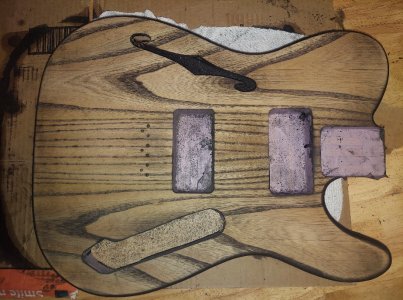
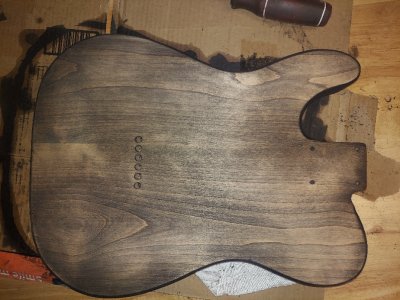
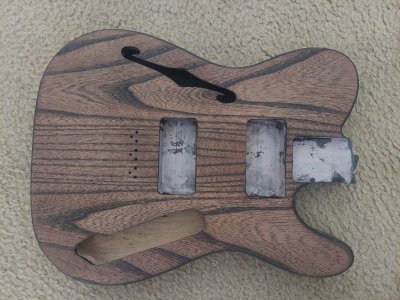
Tonight it got a coat of black oil based wood stain, which I've sanded back on the back and front to highlight the grain.

I've decided to leave the edges stained black, so I get a sort-of burst finish eventually.

Now I have to let it sit for at least 24 hours before another light sanding, followed by red mahogany stain. 20220331_003112.jpg 20220331_003230.jpg
 
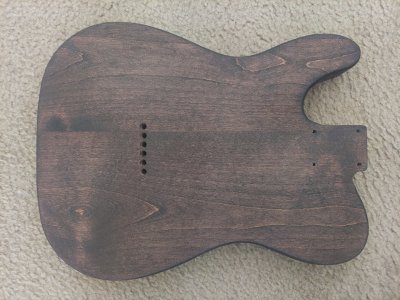
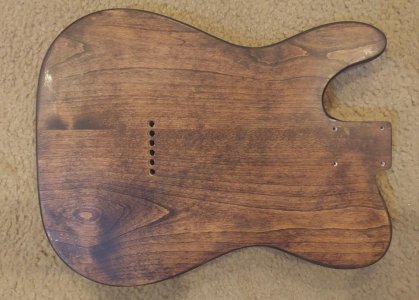
Put red mahogany stain on front, waited 5 minutes, wiped it off, then repeated on the back.

The back came out a bit blotchy, which I will attend to in due course.

Overall I'm quite pleased. The black I applied then sanded back has popped the grain just like I hoped. More so on the front than the back because they're different wood's to start with, but also because there's more figuring to begin with 20220331_150413.jpg 20220331_150405.jpg

Tomorrow or Saturday I can start with the clear polyurethane.
 
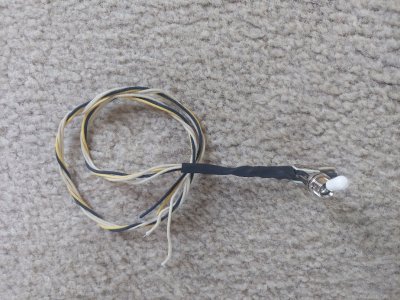
Switchcraft mini toggle wired up with 2 foot long tails. Those can be cut back in due course, of course. All of the connections have been heat shrinked, and another piece of heart shrink has been used to bundle the individual wires and provide some strain relief.

20220331_151325.jpg
 
That top came out very nice. It's gonna look great with some clear coat on it.

I've never heard of those mini toggles, have you used them before? Any problems or advantages with them (other than the size, of coarse which can really come in handy)?
 
I think the "mini" refers to the size behind the mounting, not the toggle itself. No real advantages or disadvantages, except of course that they're smaller / shorter, and therefore easier to fit inside a body cavity. Guitar body cavity, that is.

The poly is going on nicely. I'm using a wipe-on formula but applying it with foam "brushes", which builds up the thickness nicely. As they're as cheap as chips, I can afford to throw them away more or less after every coat. I'm putting 3 or 4 coats on, then rubbing back to 600, them one or two final coats before final sanding and polishing.

I'm now waiting for a job lot of 400 / 600 / 800 / 1000 / 1500 / 2000/ 3000 grit hook and loop sheets for my orbital sander to arrive, should be today. Once it's been sanded down to 3000, I'll finish up hand sanding t0 5000, 10,000 if I've still got some, then I'll get out the rubbing compound and Maguires (sp).

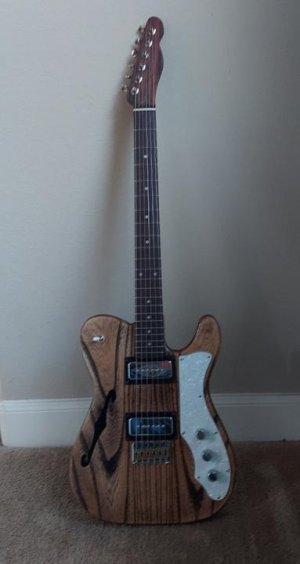
I've also got hold of a pearloid scratch plate, no holes for knobs or switches, which I'm going to cut back to suit and to expose the maximum amount of wood. It'll be drilled for three pots - two volumes and one tone, kind of like the controls on a Flying V. The tone only gets "shared" in P2, after all.

The neck should be here this week. I'm going to gloss the headstock but leave the back of the neck bare. If I don't like it it can get a thin layer of satin polyurethane buffed back.
 
Satin polyurethane is great on the back of maple necks. I've done that to a few myself. My oldest build was originally done with a thin coat of watco oil (in 1993) but after some years (10+) of playing and dirt buildup, I cleaned it up, gave it a light sand and put on about 3 coats of min-wax satin polyurethane. Feels smooooooth and plays great. The coloring has aged over the years too. Almost can't tell the difference between it and my roasted maple neck (no finish on that one).
 
The finished guitar looks awesome! Thanks for sharing your build on here. Hope it sounds as good as it looks.
 
Back
Top