They're Breeding I Tell Ya!

ThreeChordWonder

New member
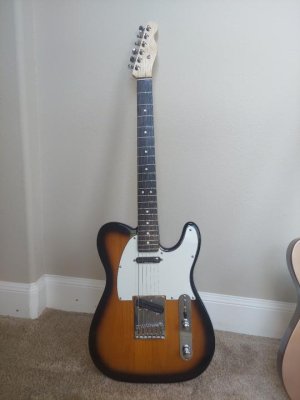
Newest arrival has an Allen Eden pre-painted alder body, about 5 lbs, a no name Chinese neck (22 frets 9-1/2 inch radius, rosewood fingerboard), Seymour Duncan Hotrails pickups, a Schaller 5-way switch, a Gotoh high mass brass bridge, and Kluson locking tuners. I used dual 500k push-pulls to coil split each humbucker as well.

And those hotrails are h-o-t HOT!!

On the 5'way switch,, the Hotrails in position 2 (neck plus bridge in series, half out of phase) sound a bit dull, very little treble, by the way. Not a complaint, just an observation.
Click image for larger version  Name:	20210527_124830.jpg Views:	0 Size:	31.4 KB ID:	6083886 Click image for larger version  Name:	20210527_124758.jpg Views:	0 Size:	62.6 KB ID:	6083887

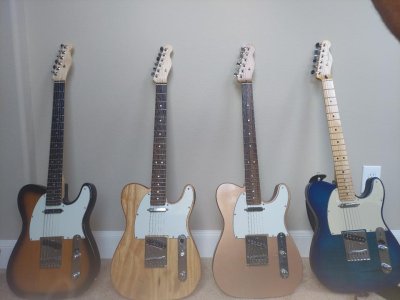
Left to right:
  • Allen Eden body with S-D hotrails.
  • The off-spec bodied ($50) wooden one with an S-D Little '59 bridge humbucker and a Vintage Stack in the neck.
  • "Oddjob" (rose gold metallic) now with S-D Quarterpounders.
  • The MIM Fender with Fender gen4 Noiseless pickups.
 
Last edited:
not surprised two hot rails in series is dark. a hot rails by itself doesnt have a ton of treble
 
Nice stable of T-types. I dig the natural - what kind of wood is that?
The gold one speaks to me too. Pretty fretboard. I bet it sounds huge with the QP set.

It's a great feeling to add another nice one without shelling out a ton of money.

How's the Chinese neck? I hear loose parts can be hit or miss, sometimes even from the same seller.
Still, it seems plenty of 'em are quite good, including the very inexpensive ones.

Have several Chinese-made guitars myself, including a couple of Epis and two Ekos that all played well right out of the box.
Also one Chibson and a Jazz Bass replacement neck which both needed fret-end filing but now are fine.
 
The natural is plain ash, finished with tung oil. It was an off-spec "second" I bought from a US maker on Fleabay. It was under- thickness and had a gouge in the back, which ended up mostly sanding out. I had to use a Schaller megaswitch because the control cavities aren't wide enough for genuine Fender Super-switches, and in this case the cavity wasn't deep enough either.

The gold one is painted in Rustoleum rose gold metallic from Hone Depot. And yes the QPs sound huge, easily driving my Marshall Origin into mild overdrive without any boost or pedals.

Seen and noted about the Hotrails, thank you..

A lot of people distrust Chinese necks,, bit I've bought three or four and apart from some mild fret sprout and one with an iffy nut, I really haven't had any problems.

Next build is going to he a thinline I expect...
 
The natural is plain ash, finished with tung oil. It was an off-spec "second" I bought from a US maker on Fleabay. It was under- thickness and had a gouge in the back, which ended up mostly sanding out. I had to use a Schaller megaswitch because the control cavities aren't wide enough for genuine Fender Super-switches, and in this case the cavity wasn't deep enough either.

The gold one is painted in Rustoleum rose gold metallic from Hone Depot. And yes the QPs sound huge, easily driving my Marshall Origin into mild overdrive without any boost or pedals.

Cool. Was thinking the grain lines in ash would show more contrast - but I was picturing ash under thick clear Fender poly.

Personally, I could wish a couple of my Teles were a tad thinner. They're so squared-off... Part of a Tele's primal appeal, I know.
Playing one after a Strat, though, it still feels like a piece of plank. Only one of my T-types has forearm contour & belly cut.

Glad the Rustoleum turned out so nicely. Did you clearcoat that one afterward?

Planning to do two Strat bodies with rattlecans myself, one of these days.
 
One tip I picked up over at the Reranch forum about rattle can paints is to warm them before use.
Paint is more fluid when it's warm, giving a finer spray and more consistently even coverage.
Warmth also increases the pressure slightly which ought to give a slightly longer useful spray time before sputtering.

They recommend a pot of hot water (tap-hot, not stove-hot) for five or ten minutes beforehand, and rewarming when it cools.

I had pretty good experiences doing this with age-tinted clear lacquer and transparent satin poly.
Seems to me it should be helpful for any spray can paint.
Might even work better for something designed to go on thick like Rustoleum, which may be fairly viscous.
 
Been doing that trick since I was spraying over 2-inch thick bondo to get old minis through their annual inspections.

I got lucky with the weather here in Houston when I was spraying back in March / April too. Mid 70s temperatures (or a bit chilly as we say around here) but only 40% humidity for days on end.
 
Back
Top