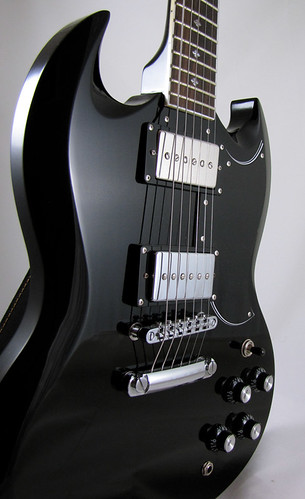
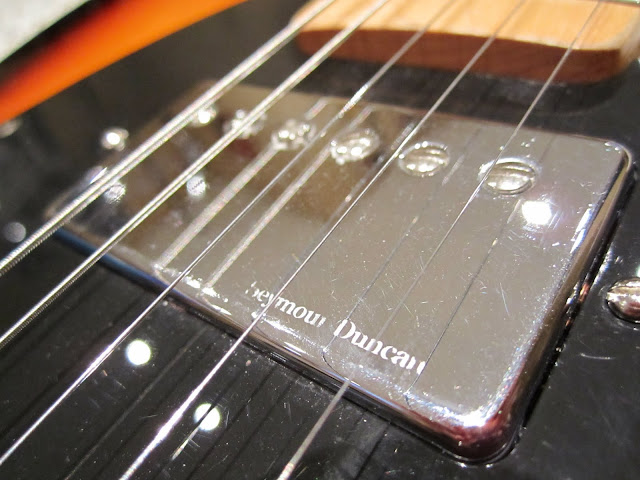
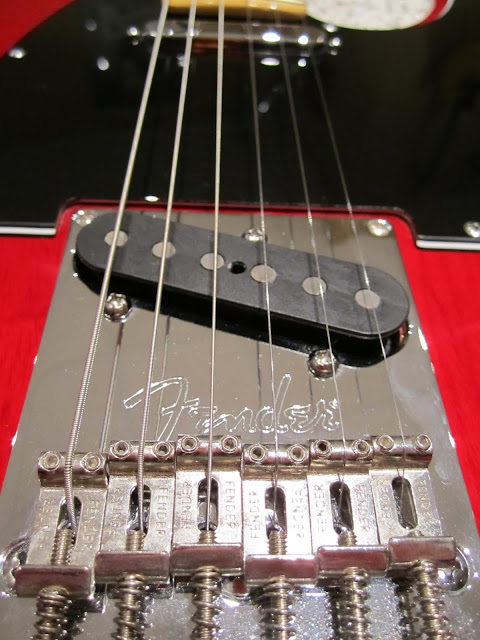
Before I post this I should point out that I don't do all this stuff on my forsale photos, mokay?

Well let's leave aside the dark stage for now.
One of the major things that makes guitar photography easier is that it is generally acceptable to have harsh shadows, and they don't squish their eyes. So you can just put them in bright sunshine. That makes everything easier because now you don't have to worry about noise anymore.
Another thing is depth of field. You want wide depth of field, so don't bother getting a camera with a large sensor or a lens with large aperture. Of course you want enough light for that. As for lenses, you want sharp. Macro lenses are generally where the music is.
Indoors is more problematic since flashing directly at the guitar has reflections that are meh. Even if you use a large flash and bounce off the ceiling, the highly reflective nature of the guitar's paint means you'll have to fiddle for a while. Ideally you want a product photography setup which means light from all directions evenly, but that's a pain to get for large objects like guitars.
Well, this is the mother of all questions, and guitars are not a very well-researched photography topic where people have specific expectations. You can always assume that rules of thirds apply, and that you want diagonal lines - of some kind. The rest if proportions. What do you put where so that the zoom factor in play enlarges it how relative to the other parts of the guitar? No rules, these aren't people that know very specifically which parts are supposed how to look how. Consider your audience's viewpoint. What do they
expect? Do they desire the guitar in a stand that was in that shop in 1983? Do they desire the far away zoomed view to a guitar somebody was playing on a stage? Do they want a real close feeling to trigger the same neurotransmitters that flow when
playing the guitar? Do you want them to admire you for your photography or do you want to make them hot for the guitar.
On glossy guitars you want to watch what is visible in the reflection. Keep it free or start modeling something that should appear in there to make it more striking (but not distracting).
If you want real control of proportions you can start messing with shift-tilt lenses (Canon's TS-E 45mm comes to mind). Also gives you tools to get pleasant non-straight lines and control depth-of field that allows you to have selective sharp panes that are not parallel to the viewpoint.
Full auto except aperture will do.
Well first of all put a white balance reference card into one of the pictures so that you will have a reference. Especially if you are indoors. WB isn't too important since there is no reference for the viewer either and you can make the color anything you desire, but be warned that some cameras have real problems with WB when photographing music gear that has no white anywhere.
Aperture I usually have around f/9 to f/11 on crop sensor bodies if there's enough light. I can post some statistics of the settings if you like, easy enough.
As I said, the camera is the least of the problems here. A rebel with a 50mm macro is probably close to perfect, but of course you will want some other focal lengths in the end.
Outdoors, wait for the sun or a nuclear attack. Indoors, a large flash bounced off the ceiling can do a good job. Messing around with the usual softboxes or umbrellas in product photography can be frustrating.
White balance, obviously.
Use the techniques that you normally use to "pop" eyes and apply them to hardware detail. I usually use it on things like pickup polepieces/screws, logos, bridge saddles, the writing on knobs and the like. It makes you picture appear more "valuable".
See below for exposure mixing - underexpose the picture, keep bright details at that, lift the rest.
On glossy guitars you can "grab" on the shape of the contrast as it traverses a surface on the guitar. Open the color curves tool (don't use it on the colors, just the mix), pick the place where you are at for one point that is brighter and one point that is not so bright and then s-curve between those. Works especially well on black guitars.
A similar trick can be used to enhance structure that is below the surface. Namely flame maple under sunburst, but also the striping of rosewood.
Stage photography in bad light really has nothing to do with photographing your gear in a controlled environment. If the subject isn't moving you can obviously expose as long as you want but if there is outright shade on the good parts that's not gonna save you. I can ramble about it a bit if there's interest.
Random tricks:
- I often underexpose by 2/3rds of an f-stop (or more!) and bump it later in PP. The idea is that things like metal hardware, beige pickup rings and all the other bright things are not blown out in the original picture. You blend these from the dark version in the rest of the (bumped) picture. Don't worry about noise since you can expose as long as you want but keep in mind you want half the ISO as a minimum as you normally feel good with. The whole thing becomes much more saturated looking. Correctly exposed guitar photos generally suck.
- Restrict the noise reduction in the camera, if any. Note that Canon cameras do not allow you to turn off all NR even though the menu says so. But it only applies to the jpegs and with low enough ISO there shouldn't be any. You should be able to keep ISO low enough so that it doesn't do much but I often do without any. NR is the works of the devil. You want sharp, sharp, sharp, and as much detail as you can get, this isn't your girlfriend.
- Hammer away with the shutter. Get a fast picture viewer/selector. It's not really easy to see good angles in the viewfinder if you don't have a lot of experience, things are different on a computer screen. You should have hundreds of frames from a session. Shoot quickly, toss quickly.
- Get a step ladder, and comfortable kneepads, too. Don't let your height or your joint aches dictate your picture composition.