I installed all 500 K potentiometers in my guitar along with a set of Seymour Duncan SH one and an SH5 . The problem is as I turn the tone knob down all of the change seems to be bunched at the end of the turn instead of being a smooth transition . Should I have installed 250 K potentiometers instead of the 500 K?

You are using an out of date browser. It may not display this or other websites correctly.
You should upgrade or use an alternative browser.
You should upgrade or use an alternative browser.
Tone Pot Bunching All Change To End
- Thread starter rgodshalk
- Start date

Brandenburg
New member
Re: Tone Pot Bunching All Change To End
sounds like the taper is Logarithmic(i.e. audio) and you wired the cap to the wrong terminal/side.. perhaps you need a linear taper pot..
not sure about the switch from 500 to 250k but i dont think it will help you.. someone else will chime in that are more knoledable than me on the subject in a bit no doubt
I installed all 500 K potentiometers in my guitar along with a set of Seymour Duncan SH one and an SH5 . The problem is as I turn the tone knob down all of the change seems to be bunched at the end of the turn instead of being a smooth transition . Should I have installed 250 K potentiometers instead of the 500 K?
sounds like the taper is Logarithmic(i.e. audio) and you wired the cap to the wrong terminal/side.. perhaps you need a linear taper pot..
not sure about the switch from 500 to 250k but i dont think it will help you.. someone else will chime in that are more knoledable than me on the subject in a bit no doubt

dystrust
Well-known member
Re: Tone Pot Bunching All Change To End
TL;DR: It sounds like you have a linear taper pot when it should be audio taper.
Sounds the opposite to me. For example my Marshall Lead 12 has a linear taper gain pot; it stays completely clean until 6/10, gets slightly dirty between 6 and 8, and the majority of the gain range is 8-10. I'm going to replace it with an audio taper pot as soon as I can get the parts and expect a much larger usable range of adjustment.
sounds like the taper is Logarithmic(i.e. audio) and you wired the cap to the wrong terminal/side.. perhaps you need a linear taper pot..
not sure about the switch from 500 to 250k but i dont think it will help you.. someone else will chime in that are more knoledable than me on the subject in a bit no doubt
TL;DR: It sounds like you have a linear taper pot when it should be audio taper.
Sounds the opposite to me. For example my Marshall Lead 12 has a linear taper gain pot; it stays completely clean until 6/10, gets slightly dirty between 6 and 8, and the majority of the gain range is 8-10. I'm going to replace it with an audio taper pot as soon as I can get the parts and expect a much larger usable range of adjustment.
Brandenburg
New member
Re: Tone Pot Bunching All Change To End
audio taper is suposed to do what you say.. almost nothing until 50%.. the linear taper is supposed to gradual throughout the whole traverse of the pot
TL;DR: It sounds like you have a linear taper pot when it should be audio taper.
Sounds the opposite to me. For example my Marshall Lead 12 has a linear taper gain pot; it stays completely clean until 6/10, gets slightly dirty between 6 and 8, and the majority of the gain range is 8-10. I'm going to replace it with an audio taper pot as soon as I can get the parts and expect a much larger usable range of adjustment.
audio taper is suposed to do what you say.. almost nothing until 50%.. the linear taper is supposed to gradual throughout the whole traverse of the pot
Re: Tone Pot Bunching All Change To End
I put in audio taper pots.... Should I have used linear then?
audio taper is suposed to do what you say.. almost nothing until 50%.. the linear taper is supposed to gradual throughout the whole traverse of the pot
I put in audio taper pots.... Should I have used linear then?
Brandenburg
New member
Re: Tone Pot Bunching All Change To End
id try linear..
I put in audio taper pots.... Should I have used linear then?
id try linear..
Re: Tone Pot Bunching All Change To End
Due to the nature of how a tone control works (starts out imposing added load, ends up forming a lower resonant peak when turned all the way down), it's never going to perfectly linear. The transition from load to a new lower frequency resonance occurs where the resistance of the pot becomes less than the resistance of the pickup, which is near 0 on the any pot, but any audio tapper pot will dedicate a wider portion of the sweep to that lower portion of resistance.
Did you change the wiring of the tone pot at all when you installed the Duncan SH and SH5? Did this guitar have the same problem before? What pickups were in it before?
I installed all 500 K potentiometers in my guitar along with a set of Seymour Duncan SH one and an SH5 . The problem is as I turn the tone knob down all of the change seems to be bunched at the end of the turn instead of being a smooth transition . Should I have installed 250 K potentiometers instead of the 500 K?
Due to the nature of how a tone control works (starts out imposing added load, ends up forming a lower resonant peak when turned all the way down), it's never going to perfectly linear. The transition from load to a new lower frequency resonance occurs where the resistance of the pot becomes less than the resistance of the pickup, which is near 0 on the any pot, but any audio tapper pot will dedicate a wider portion of the sweep to that lower portion of resistance.
Did you change the wiring of the tone pot at all when you installed the Duncan SH and SH5? Did this guitar have the same problem before? What pickups were in it before?
Brandenburg
New member
Re: Tone Pot Bunching All Change To End
what taper you use is a personal choice.. some like linear.. some like audio..
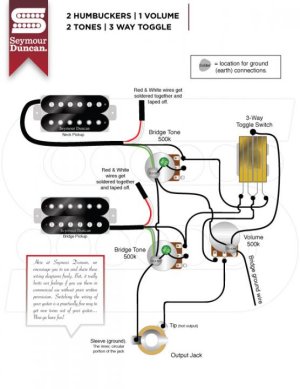
If I should have used linear pots for tone, why doesn't Seymour Duncan specify this in their wire diagrams?
what taper you use is a personal choice.. some like linear.. some like audio..
Re: Tone Pot Bunching All Change To End
For your personal needs you 'should' use linear.
For other people's need they 'should' use audio.
Explain to me how 1 diagram is going to predict which preference each user consulting the diagram has.
If I should have used linear pots for tone, why doesn't Seymour Duncan specify this in their wire diagrams?
For your personal needs you 'should' use linear.
For other people's need they 'should' use audio.
Explain to me how 1 diagram is going to predict which preference each user consulting the diagram has.

Re: Tone Pot Bunching All Change To End
I've never heard linear tone pots be 100% linear, and I use my tone pots all the time. There is always a section of the pot (linear and audio) where most of the 'action' happens. I just learn to live with it. It matters more to me in a volume pot. However, always have a few different types laying around, as they may work differently in different wiring. I never noticed a difference in 500k vs 250k, though.
I've never heard linear tone pots be 100% linear, and I use my tone pots all the time. There is always a section of the pot (linear and audio) where most of the 'action' happens. I just learn to live with it. It matters more to me in a volume pot. However, always have a few different types laying around, as they may work differently in different wiring. I never noticed a difference in 500k vs 250k, though.
Re: Tone Pot Bunching All Change To End
The pot is linear, it's what the pot accomplishes that is not linear. A tone pot isn't really a "more of / less of" control, rather it transitions the resonant LC circuit from one set of values to another, with a big, asymmetrical dip in between.
At 10 on the dial, you have, say a pickup with 3H inductance and 100pF parasitic capacitance forming a high resonant peak. As you turn down the tone control, the added load kills the resonance, the tone cap is still there, but not able to do much because there is a lot of resistance in it's way. As you approach zero on the dial, the resistance from the tone pot is small enough that the tone cap is able to for a resonance with the pickup, and now you have 3H inductance and .022uF capacitance forming a new, lower resonance. Once the tone control is at zero, it's almost as though you have a new pickup in your guitar, since you've wholly changed what is probably it's most defining characteristic.
I've never heard linear tone pots be 100% linear, and I use my tone pots all the time. There is always a section of the pot (linear and audio) where most of the 'action' happens.
The pot is linear, it's what the pot accomplishes that is not linear. A tone pot isn't really a "more of / less of" control, rather it transitions the resonant LC circuit from one set of values to another, with a big, asymmetrical dip in between.
At 10 on the dial, you have, say a pickup with 3H inductance and 100pF parasitic capacitance forming a high resonant peak. As you turn down the tone control, the added load kills the resonance, the tone cap is still there, but not able to do much because there is a lot of resistance in it's way. As you approach zero on the dial, the resistance from the tone pot is small enough that the tone cap is able to for a resonance with the pickup, and now you have 3H inductance and .022uF capacitance forming a new, lower resonance. Once the tone control is at zero, it's almost as though you have a new pickup in your guitar, since you've wholly changed what is probably it's most defining characteristic.
Similar threads


- Replies
- 35
- Views
- 2K

- Replies
- 0
- Views
- 290