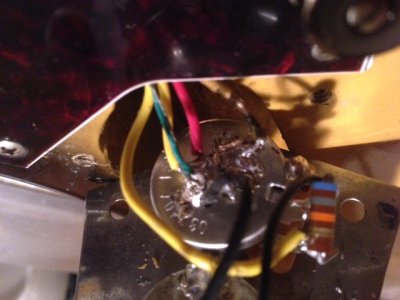
Treble bleed mod without the cap just the resistor

smallclone

New member
I saw a picture of the treble bleed mod but didnt have any spare parts to make one properly but i did have a 68k 1/2 watt 5% resistor (yes 68k)

So i wired it to the middle post and the opposite post of the ground. I do not have a tone knob, just the one volume and its a 500k going into a JB.

Anyway so i wired this "mod" and it sounds awesome!!!!!! The bass responce is incredible!!! The guitar sounds thick, full and warm!

Anyone have any idea what i did?
 
Last edited:
Re: Treble bleed mod without the cap just the resistor

That's not so much a treble bleed
More of a modified pot value
In parallel with the ground, your signal takes an alternate path
The cap acts as a frequency filter
The resistor forces it through the pot until the pot is rolled back far enough
 
Re: Treble bleed mod without the cap just the resistor

Yep, you've dropped the K reading of the pot effectively......and modified the taper.

Effectively a 'treble mute'
 
Re: Treble bleed mod without the cap just the resistor

Yep, you've dropped the K reading of the pot effectively......and modified the taper.

Effectively a 'treble mute'

Theoretically but it may be muting an insignificant amount of treble in reality
 
Re: Treble bleed mod without the cap just the resistor

^ er, resistors in parallel drop the overall resistance by quite a lot actually.
 
Re: Treble bleed mod without the cap just the resistor

By putting it between the pickup and the output side of the pot, when the volume is on full, it is essentially out of the circuit because the electrons will take the path of least resistance. It will only have an effect when you start rolling the volume back and it is just doing weird things to the taper of the volume pot, you could probably get the same sounds without, just at different settings of the volume knob.

I can't image it really changed the sound, a resistor impedes all frequencies equally, a capacitor is a frequency dependent impedance, the lower the frequency, the higher the impedance, which is why it lets higher frequencies pass/bleed through. As the resistance of the pot increases, varying amounts of higher frequencies start to go through the cap taking the path of least resistance.

If anyone is interested the formula to calculate the impedance of a capacitor at different frequencies is:
Xc = 1/(2*pi*f*C)
where Xc is the impedance, f is the frequency, C is the capacitance, and pi is pi, 3.14 (don't know how to make the symbol on here)

You may have snake oiled yourself if it seems to be making a difference at full volume, I'm not sure how it would.
 
Re: Treble bleed mod without the cap just the resistor

By putting it between the pickup and the output side of the pot, when the volume is on full, it is essentially out of the circuit because the electrons will take the path of least resistance. It will only have an effect when you start rolling the volume back and it is just doing weird things to the taper of the volume pot, you could probably get the same sounds without, just at different settings of the volume knob.

I can't image it really changed the sound, a resistor impedes all frequencies equally, a capacitor is a frequency dependent impedance, the lower the frequency, the higher the impedance, which is why it lets higher frequencies pass/bleed through. As the resistance of the pot increases, varying amounts of higher frequencies start to go through the cap taking the path of least resistance.

^^ That is basically what I meant as well
 
Re: Treble bleed mod without the cap just the resistor

By putting it between the pickup and the output side of the pot, when the volume is on full, it is essentially out of the circuit because the electrons will take the path of least resistance. It will only have an effect when you start rolling the volume back and it is just doing weird things to the taper of the volume pot, you could probably get the same sounds without, just at different settings of the volume knob.

I can't image it really changed the sound, a resistor impedes all frequencies equally, a capacitor is a frequency dependent impedance, the lower the frequency, the higher the impedance, which is why it lets higher frequencies pass/bleed through. As the resistance of the pot increases, varying amounts of higher frequencies start to go through the cap taking the path of least resistance.

If anyone is interested the formula to calculate the impedance of a capacitor at different frequencies is:
Xc = 1/(2*pi*f*C)
where Xc is the impedance, f is the frequency, C is the capacitance, and pi is pi, 3.14 (don't know how to make the symbol on here)

You may have snake oiled yourself if it seems to be making a difference at full volume, I'm not sure how it would.

It effectively drops the resistance of pot and so, it darkens the sound. Its like you've switched your volume pot from 500k to 50k. It's not the same thing than lowering the volume, because adjusting the pot also changes inline resistance of signal.

I use 100k resistor between in and out lugs of volume pot in strat to smoothen out the taper, (log pots usually drop out gain too quickly for my taste.) That also easens the treble loss, when rolling down the volume.
 
Re: Treble bleed mod without the cap just the resistor

It only drops the resistance on the side that goes to the output jack, it doesn't change the path to ground.

When the volume pot is on 10, there is 0 ohms resistance on the output side and 500K (or whatever the value of the pot is) to ground, so pretty much all of the signal goes through the output side. When the volume is at 0, there is 500K (or X) ohms on the output side and 0 ohms on the ground side, so the signal goes to ground, hence no output. By putting the resistor in parallel on the output side (not to ground), is only affects the resistance on the output side, or as said, the taper of the output side. That said, when the path through the outputs is 0 ohms through the pot (vol on 10), the signal will basically ignore the parallel resistor. Depending on whether the pot is log or linear will dictate how it changes the taper, or more accurately, feel, of how the volume rolls on.
 
Re: Treble bleed mod without the cap just the resistor

It only drops the resistance on the side that goes to the output jack, it doesn't change the path to ground.

When the volume pot is on 10, there is 0 ohms resistance on the output side and 500K (or whatever the value of the pot is) to ground, so pretty much all of the signal goes through the output side. When the volume is at 0, there is 500K (or X) ohms on the output side and 0 ohms on the ground side, so the signal goes to ground, hence no output. By putting the resistor in parallel on the output side (not to ground), is only affects the resistance on the output side, or as said, the taper of the output side. That said, when the path through the outputs is 0 ohms through the pot (vol on 10), the signal will basically ignore the parallel resistor. Depending on whether the pot is log or linear will dictate how it changes the taper, or more accurately, feel, of how the volume rolls on.

Correct. But OP said he connected the resistor between middle lug and ground.
 
Re: Treble bleed mod without the cap just the resistor

Nope, he said "So i wired it to the middle post and the opposite post of the ground."
 
Re: Treble bleed mod without the cap just the resistor

You may have snake oiled yourself if it seems to be making a difference at full volume, I'm not sure how it would.

thanks for taking the time to answer my question. trust me, no snake oil here. ive been playing guitar for over 20 years and the sound its producing reminds me of throwing a compressor on the sound. it becomes warm, a lot rounder with less high end bite.
 

Attachments

  • IMG_6393.JPG
    IMG_6393.JPG
    99.8 KB · Views: 0
Back
Top