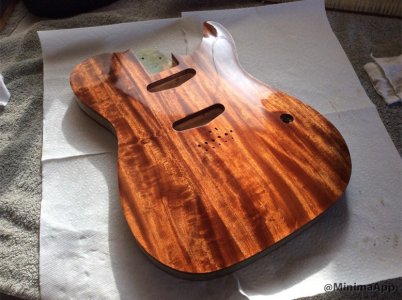
I've done a couple of guitar necks with tru-oil and yeah you can absolutely buff it to a high gloss if you want.
Here's some things I have learned and what works for me when using tru-oil:
- Buy a small bottle, once opened it will start to go off and slowly cure no matter if you close the bottle tight. When you open the bottle some time later for another neck, you can still use it but it will not be as good as it was fresh.
- The prep work is one of the if not the most important stage in finishing a neck with tru-oil. Every imperfection underneath the finish will be exaggerated and pop out at you. So make sure you do your sanding work and make it the best sanding job you ever did or it will look sketchy in the end. I learned this the hard way on my first neck.
- Wipe on very thin and even layers and wipe off excess. You must take your time with this and respect the drying time in between layers. This I have found out the hard way too is key to a pro looking end result. There is no set in stone time when you can apply the next coat just make sure its properly dry and not sticky or tacky when applying the next coat.
Sometimes in the summer I was able to apply the next coat within a couple of hours, sometimes I had to let it dry overnight or even longer.
- The first coat(s) will soak in pretty quickly into the bare wood, so you can follow up coats faster but the more coats you add the longer the drying time will be. After a couple of coats when you can start seeing the depth of the finish build up you can start sanding with very fine sandpaper (I prefer to use micromesh pads as opposed to the very messy steelwool) in between coats to knock down any high spots or dried up swipe marks from applying. I use a (lint free) rag to apply tru-iol by the way.
- Once you see that there is a nice layer of finish is being build up (not sure how many coats but I did a neck that has like 10-20 layers) you will be able to polish the finish with a polishing compound. I do not have recommendations for a specific brand but I like to stick with automotive brand stuff ( I use a compound called commandant 4 that is silicone free). Now as for using stuff that has silicone or not... Micromesh pads are made of silicone I believe, so if you insist on silicone free then maybe use steelwool instead. I dont know much about this to be honest mayeb someone else here does.
- when sanding a bigger flat surface like a headstock, use a sanding block. Or if you can find a very small random orbital sander that will work too.
- I always wetsand, never dry. I found it to be easier to work wet and leave a better result and less deep scratches to buff out. learned this the hard way too. There is a theory to this too: dry sanding will leave deeper scretches that will show more because of the way the scratch groove is shaped and how it will reflect light as opposed to wet sanding.
- I am not a luthier by any means, just a hobbyist who put in the work, time and effort to make my own great guitars the way I want them to be. Hope this helps.
Oh yeah, I am not 100% convinced that tru-oil on a neck is the best out there. While it feels absolutely amazing, I really love satin finished necks too, they feel fine and will have a better protection on the road. Oil finishes are not as hard withstanding a beating as poly or nitro. For DIY stuff I might even lean towards 2K spraycans (matte or satin for necks) because its faster and more forgiving to work with.