Tube Overdrive

Davii

New member
Hey all,

I've been toying with the idea of building myself a tube amp, and one thing (no doubt amongst many) that I'm lost on, is how OD channels are done.

From what I understand so far, gain is a combination of tube rating, and the voltage applied to the plate(?), but have never nailed down whether that's simply having a [gain] pot adjusting that voltage, or whether that is doing something else. I've Googled a fair bit whenever I'm come back to the idea of building something, but results tend to get lost amongst a ton of unrelated things.

Initially, I'd just thought about building a power amp, to go with my rack mounted JMP-1 preamp (in the hope of improving the lead sound in particular), then thought I might as well do the whole thing, and I'd be able to choose how the tone stack is done etc.

If anyone has any useful links, that would be handy. In the process of typing this, I'd suddenly realized that I could've looked up circuits for tube pedals, but hey, I might as well post anyway :)
 
Re: Tube Overdrive

hey not sure on any of what you want to do Ive been playing for awhile but never learned a lot of the electronics of amps and pedals and stuff. Just a guitar player but I want to learn more and slowly am. I wanted to ask you a question about mods on my vintage monster tube OD by Behringer VT999 is it hard to apply the BITMO mod to that pedal its only 20 bucks to buy the kit and you do it yourself but I dont want to fry anything there is instructions but not sure if I want to attempt it on my own yet. Do you think its hard? And have you heard of this?
 
Re: Tube Overdrive

hey not sure on any of what you want to do Ive been playing for awhile but never learned a lot of the electronics of amps and pedals and stuff. Just a guitar player but I want to learn more and slowly am. I wanted to ask you a question about mods on my vintage monster tube OD by Behringer VT999 is it hard to apply the BITMO mod to that pedal its only 20 bucks to buy the kit and you do it yourself but I dont want to fry anything there is instructions but not sure if I want to attempt it on my own yet. Do you think its hard? And have you heard of this?

I've built some pedals on bread boards, but nothing involving tubes, hence having some general info from the web, YouTube videos etc, but with plenty of gaps, so I'm not the best person to ask.

I don't know how hard these things are myself, hence asking about the gain aspect as part of finding out, and can't say I've heard of the mod you mentioned.
 
Re: Tube Overdrive

Are you familiar with the AX84 project? http://ax84.com

Ironically, the guy who started AX84 now plays an AxeFx. :p
That is a great place to start.!

To the OP....you seem "hung up" on gain for some reason.
It is the ratio between the change of voltage of the input and output.....how many times the signal is amplified.
But that Is/Can Be different than OD/Clipping...where the output signal no longer matches the shape of the input.
Are you wanting to build a high gain preamp...is that what you are saying.?
 
Last edited:
Re: Tube Overdrive

That is a great place to start.!

To the OP....you seem "hung up" on gain for some reason.
It is the ratio between the change of voltage of the input and output.....how many times the signal is amplified.
But that Is/Can Be different than OD/Clipping...where the output signal no longer matches the shape of the input.
Are you wanting to build a high gain preamp...is that what you are saying.?

I was having difficulty seeing where the [front panel] gain control was on some of the schematics I'd downloaded, so although I felt ok on the basic idea of what was going on, I was scratching my head as to where the overdrive gain was being adjusted, at which point, etc.

I currently have a rack mounted JMP-1 midi preamp, a Behringer EPQ900 power amp, and an old Boss GX700 fx unit. The setup is ok, but lacks warmth, a lead sound I like, and the sweet way feedback swells up on tube amps I've had, so have been looking into changing part, or all of the rig (ignoring the fx unit) for some time.

Initially, I'd thought to just take the SS part out, and build a tube power amp, but then considered that the JMP-1 wasn't necessarily the tube preamp I'd thought it to be when I'd bought it a few years back, and although I do like the dirty power chord sound (very balanced/even to my ears), everything else left me feeling meh. So then I thought I might as well do the whole thing, but have become a bit muddled in the detail in the process.

I can't afford to just go buy an amp, so making one bit by bit seemed worth of investigation. High gain wouldn't be something that I'd flag as a particular stipulation, but looking for leads to sing :)

Ps, sorry for the waffle!
 
Re: Tube Overdrive

I'm not, as I've spotted most of them, mainly through spotting configuration (like tone stacks), though what power/voltage ratings are involved with components is another area that's a bit foggy. I've got a demo version of the Proteus circuit simulation software, so have been indulging myself with this in that :)

I'd been looking at a schematic for the Marshall 600 (love the cleans from that), which doesn't indicate the purpose of the pots, so as I was going through through it, trying to figure out which one was adjusting the signal gain on the overdriven channel. I'd been looking for something either adjusting the plate voltage, or attenuating the signal going to a grid etc, but not finding it. Given the voltages involved, I'd assumed the latter was in play....somewhere, but thought I may as well start asking :)
 
Re: Tube Overdrive

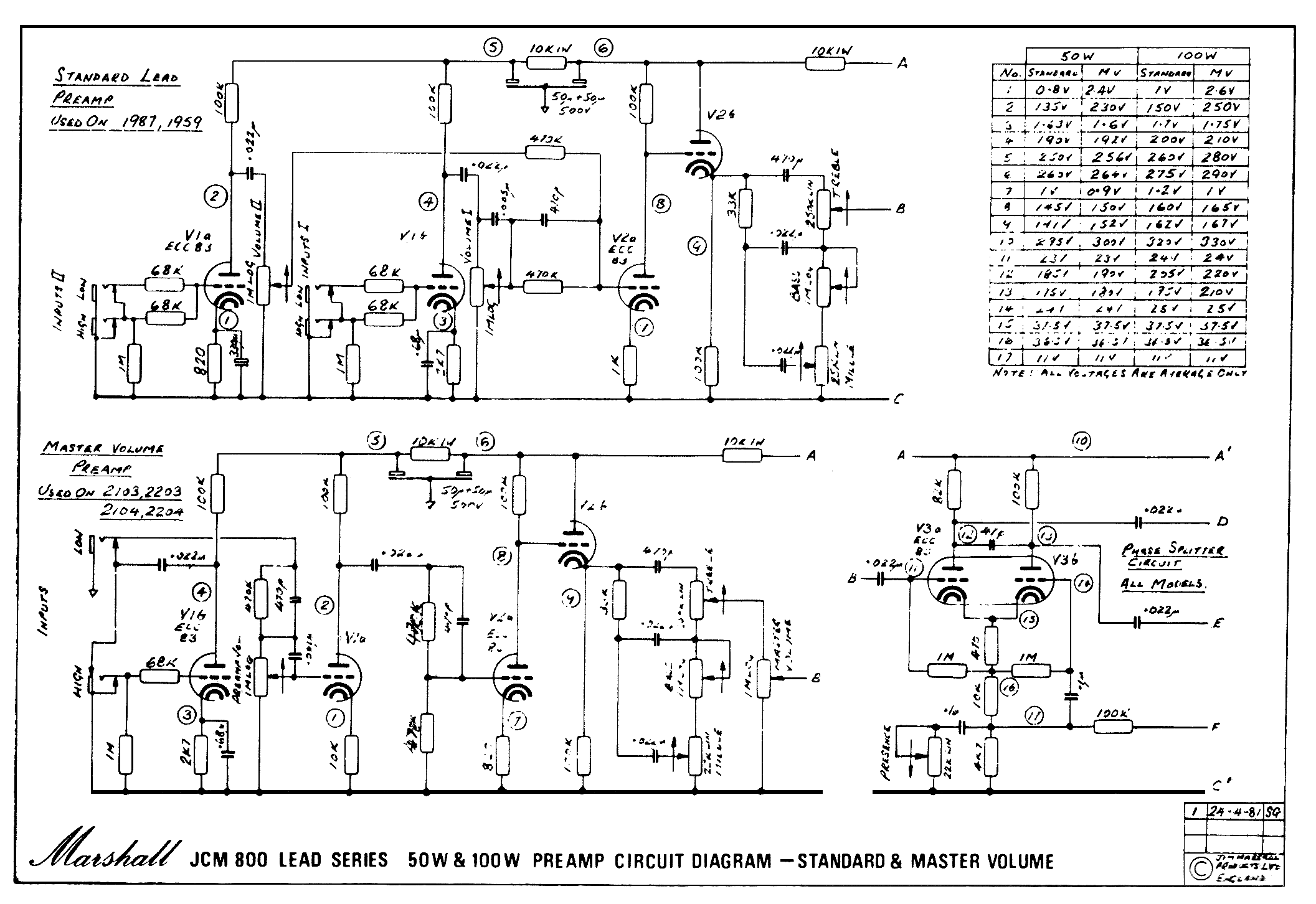
What you think of as "volume" on a non-master volume amp is essentially the "gain" on a master volume amp.

Look at this schematic from the JCM800 line. YOu can see that on the non-master, the Phase Inverter is fed from point "B", which is the output of the treble pot. On the Master Volume schematic, there is an additional pot fed from the Treble Pot, Master Volume. Other than aditional impedance loading, when this pot is fully clockwise, it's basically the same as a non-master volume circuit. This allows you to turn up the input volume hotter and hit the next tubes with a hotter signal causing clipping. The Master Volume then pulls the level back before hitting the Phase Inverter and Power Amp section.

jcm800pr.gif


Once you get into cascading gain stages, you can put a volume control on each to attenuate how hot a signal each successive gain stage gets. Some amps have three volumes, a pre-gain, post-gain and master. This doesn't even touch on the post-Phase Inverter Master Volume either.

Dave Hunter's Book (Tube Amp Handbook) is a great read to actually learn the basic ideas of tube amplification, I highly recommend it.

Also, don't think of building an amp as a way to save money. Think of it as a hobby that rewards your curiosity and in the end you get an amp. ;)
 
Last edited:
Re: Tube Overdrive

I'm ok with the pot following the output from the tone stack, and had been working on that basis, but the noticeable difference between those circuits, and the one I'd been look at, are the pots in the signal path to the grids. What you've posted is so much easier to look at, and I'd probably have not needed to ask the question :)

That detail probably is in the schematic I've been looking at, but just not obvious, and no doubt I would be prone to misinterpreting it :15:

I'm sure I'd find it rewarding, and will have to check out that book :)
 
Back
Top