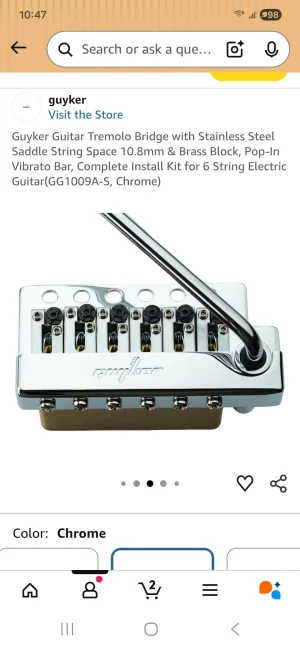
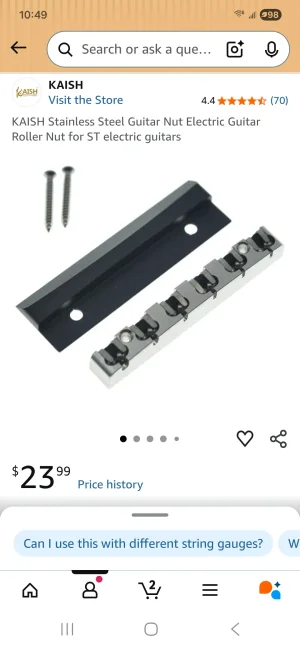
Tuning stability : nut, trees, saddles and nut files.

dsuigdsf

Active member
Hi!
I'm looking for the best tuning stability possible. I'd like to use the tremolo extensively.
I also tend to bend the neck with hardtail and I've noticed that it detunes it a bit.
As for the nut, everyone seems to agree and point to TUSQ or TUSQ XL as the best options.
Regarding string trees, is there a difference between classic, roller, and TUSQ? Does TUSQ require cutting? I've seen these trees flat on the bottom and have sharp edges.
Regarding bridge saddles, I see that Graph Tech String Savers aren't as popular as TUSQ nuts. Does this mean that regular bridge saddles are fine? Or is it worth investing in a string saver for a tremolo? Roller saddles are out of the question; I've tested them, and in my opinion, they ruin the sound.
I'm also wondering about good nut files. I've heard that not all of them have rounded bottoms and require careful handling. Apparently, Music Nomad has files that are perfectly shaped for the string, so you don't need to polish the grooves.
Is it also worth drilling the tremolo block to minimize the amount of string inside? EVH did this, and the Gotoh 510 also has something along those lines (FST function).
 
The Tusq string trees may need to be sanded down a bit to get the angle just right

I use the LSR , or a copy of from Kaish

With my LSR I removed the string trees all together

Locking tuners for short string wraps

I thought about getting Locking saddles for the tremolo bridge

With one of these


1000013521.webp


Ultimately decided the string doesn't move that much with trem use at the saddle
But it does at the nut. You can hear it

Rollers remove that


1000013523.webp
 
The best tuning stability is with a double locking trem system. I have guitars with fully floating floyds that only need tuning if there's a swing in humidity/temperature and the neck goes out a little. If you're planning to use the trem a lot, that's the way I'd go. Even a perfectly set up standard trem will never achieve this level of stability.
 
Before you do all that stuff try a few different lubricants in the nut slots. I use a mixture of graphite and vaseline.
 
Even a perfectly set up standard trem will never achieve this level of stability.
I disagree. My EVH 78 has a synchronized trem, a well cut nut, graphite reinforcement on the neck, and locking tuners, and it achieves the same level of stability. With a floating trem, however, I do agree.
 
I disagree. My EVH 78 has a synchronized trem, a well cut nut, graphite reinforcement on the neck, and locking tuners, and it achieves the same level of stability. With a floating trem, however, I do agree.

You can probably get it very close . . . .but even a fixed bridge guitar isn't as stable as using a double locking trem system. There will always be friction at the nut that just isn't present with double locking.


Now, once the knife edges start to wear on the double locking trem, all bets are off . . . but that's a whole other problem.
 
You can probably get it very close . . . .but even a fixed bridge guitar isn't as stable as using a double locking trem system. There will always be friction at the nut that just isn't present with double locking.


Now, once the knife edges start to wear on the double locking trem, all bets are off . . . but that's a whole other problem.
Actually there is more friction at the nut on a double locking system 😉
 
As for the nut, everyone seems to agree and point to TUSQ or TUSQ XL as the best options.
Wrongo! I won't even install a Tusq nut anymore. It's bone nuts only in my shop. A good setup by a competent and experienced luthier is your best bet for achieving your goal. He will eliminate all the friction points for you, and maximize the setup for best intonation and ease of play.
 
Wrongo! I won't even install a Tusq nut anymore. It's bone nuts only in my shop. A good setup by a competent and experienced luthier is your best bet for achieving your goal. He will eliminate all the friction points for you, and maximize the setup for best intonation and ease of play.
On my Fender TUSQ XL, it works well. If I bend and then press the string behind the nut (like Jake E Lee), the guitar stays in tune.
I can't say the same about my Ibanez. The string angle is greater there. It turned out that bone, pencil lead, lithium grease, and winding the strings upwards almost produced the perfect result, though not as good as the Fender (of course, I compared it with a lubricated TUSQ in the same configuration). Now I understand why most guitars with tremolos have straight headstocks, a shallower angle, and better tuning.
 
Before you do all that stuff try a few different lubricants in the nut slots. I use a mixture of graphite and vaseline.
Similarly, I spotted a local luthier who used pencil lead first and then applied grease. It works great with bone.
 
I disagree. My EVH 78 has a synchronized trem, a well cut nut, graphite reinforcement on the neck, and locking tuners, and it achieves the same level of stability. With a floating trem, however, I do agree.
Jeff Beck used his tremolo like crazy. Yngwie Malmsteen, John Norum, Gary Moore, even John Petrucci has a regular, non-locking tremolo. Somehow, these guys stayed in tune.
 
Back
Top