
You are using an out of date browser. It may not display this or other websites correctly.
You should upgrade or use an alternative browser.
You should upgrade or use an alternative browser.
Watch me ruin a guitar I kinda hate!
- Thread starter GuitarStv
- Start date


Chris Pile
Well-known member
Re: Watch me ruin a guitar I kinda hate!
NO. In all my decades making stainless aircraft parts it didn't get gummy. Aluminum did.
Get a file card to clear the chips. If it's clogging a lot - the file is dull from rattling around in a sea of tools. Or, buy a new Nicholson bastard single cut file that is FLAT. Check it on a piece of glass.
Stainless just gums up the file
NO. In all my decades making stainless aircraft parts it didn't get gummy. Aluminum did.
Get a file card to clear the chips. If it's clogging a lot - the file is dull from rattling around in a sea of tools. Or, buy a new Nicholson bastard single cut file that is FLAT. Check it on a piece of glass.

kramersteen
PowerMetalRaph
Re: Watch me ruin a guitar I kinda hate!
haha Goob!
haha Goob!
Chris Pile
Well-known member
Re: Watch me ruin a guitar I kinda hate!
No food grade experience here. All my industrial training was as a tool & die guy here in Wichita's aircraft industry. Let's talk Inconel, Titanium, Waspaloy, and Monel. All fun turning blocks of metal into shiny little chips. I still dream about it sometimes.
There are many grades of stainless Goob
Some are magnetic and structural
Some are non magnetic
Some are food grade
Some are aircraft grade
My experience differs
No food grade experience here. All my industrial training was as a tool & die guy here in Wichita's aircraft industry. Let's talk Inconel, Titanium, Waspaloy, and Monel. All fun turning blocks of metal into shiny little chips. I still dream about it sometimes.

ItsaBass
New member
Re: Watch me ruin a guitar I kinda hate!
Have you thought about how cramped .110" frets will feel on a 24" scale instrument? They feel cramped to me even on 25.5" scale, and even 6230s (.078" wide) feel cramped to me on my Jaguar (24" scale).
What about 6105s (.090" x .055"), or 6150s (.102" x .042"), which would be getting toward the feel of the 6100s you like, but would not feel as cramped on the short scale neck?
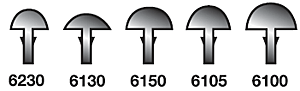
I like big frets. Going with Jescar 57110 Stainless Steel Fret Wire:

Have you thought about how cramped .110" frets will feel on a 24" scale instrument? They feel cramped to me even on 25.5" scale, and even 6230s (.078" wide) feel cramped to me on my Jaguar (24" scale).
What about 6105s (.090" x .055"), or 6150s (.102" x .042"), which would be getting toward the feel of the 6100s you like, but would not feel as cramped on the short scale neck?
Last edited:
Re: Watch me ruin a guitar I kinda hate!
Congratulations, you're learning from your own experience and mistakes how to do a fairly involved job just using "stone-age" tools and Mac Guyver techniques. It's a complex job even using all the proper fretting tools. Well done!
Now you have some fret leveling, crowning, and polishing to do. Also, fret end filing so you don't cut up your hand as you play.
Keep us posted.
Congratulations, you're learning from your own experience and mistakes how to do a fairly involved job just using "stone-age" tools and Mac Guyver techniques. It's a complex job even using all the proper fretting tools. Well done!
Now you have some fret leveling, crowning, and polishing to do. Also, fret end filing so you don't cut up your hand as you play.
Keep us posted.

GuitarStv
Sock Market Trader
Re: Watch me ruin a guitar I kinda hate!
Well, last night was boring.
I've got four files:
A small pointy triangular one:

A big flat one:

An actual luthier type tool that I was told I'd need for this (it has like weird rounded concave cutting edge):
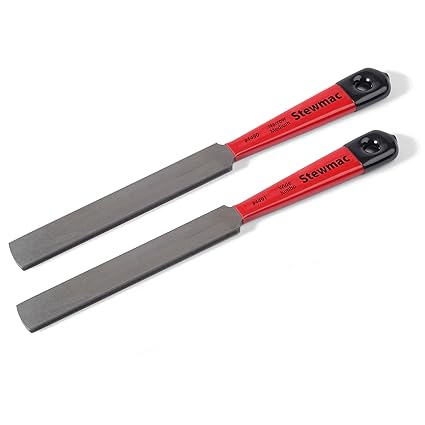
And the tiniest, itsy bitsiest small toothed flat file that I could find at the hardware store.
I've only needed the big ass one and the tiny flat one so far.
So, The first thing I wanted to do was get rid of all the pokey and painful fret ends.
- Turn the neck so that the frets are pointing to the right, put the big flat file on top of the frets, move the file back and forth across all the frets evenly. Then panic that you're doing something wrong and are going to ruin stuff and stop.
- Turn the neck so that the frets are face up, hold the fret flat against them on the right hand side. Now you can see a tiny gap between the file and the neck . . . that's caused by the fret ends sticking out. File away (just slide the file back and forth . . . you need to apply a little pressure, but not too much) until that gap disappears. This is much better because you can see what the hell you're doing and are much less likely to accidentally wreck anything.
- So, initially I started out so that I was filing at about 90 degrees to the frets. But then when I ran my hand over it it didn't feel right. I checked some of my other guitars, and it looks like the edge is usually beveled. You don't want to bevel too much, because then you've got less playing area on the top of the fret, but too little will make the frets feel uncomfy in your hand. I settled on about 30 degrees. Adjusted the file, and went at it again.
- The file didn't really seem to dull. I just tapped it against the corner of a garbage can and occasionally wiped it off with a rag to get the bits of metal out. You want to keep going until you're just starting to make contact with the wood at the edge of the neck. Go slow at the end.
This process didn't take too long (maybe 40 minutes or so) and was pretty easy.
So, at this point I ran my hands up and down the neck again. Nothing was sticking out, but it still felt scratchy. The problem was the edges . . . I appeared to have filed them razor sharp. So then I took my itsy bitsy flat file and rounded off every fret. After slightly scratching the fret board with the first pass I made over the fret end, I decided to put some painters tape over the board. After that, it was pretty straight forward to round off all the fret edges working one by one. But it ****ing took forever. Just file, run your hand up and down over the fret and when it's smooth go to the next one. This was easily two, two and a half hours. It's done now (finally), and feels great when I run my hands up and down the board. This was the most boring part of fretwork so far.
So, next up would be leveling the frets. To prep for it, I took a small metal string action guage that I've got that's about 3 1/2 inches by 2 inches:
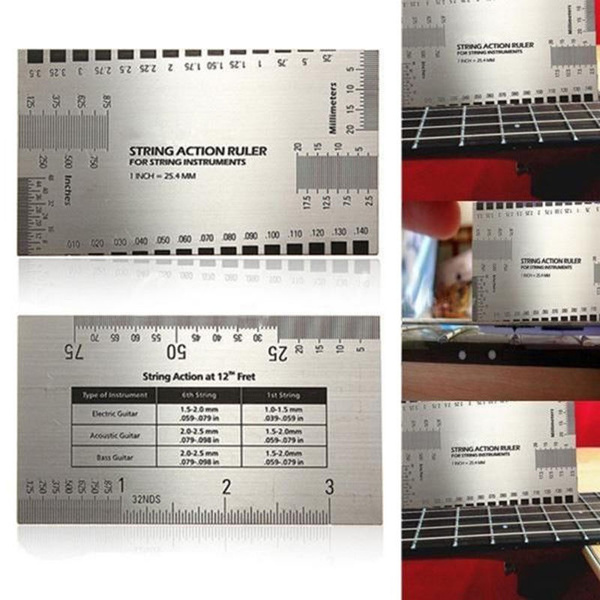
It has straight edges, so I just laid it across three frets at a time and rocked it to see if the middle fret was high or not. When I got to the higher frets I had to use the smaller side. Then any parts that were too high, I marked with a sharpie on the fret. (On the highest frets it was too wide to do this.) My plan is that tomorrow I'll take the big flat file and lightly run it over the tops of the frets, paying the most attention to the areas with sharpie. I'll keep checking with my ghetto fret rocker until they're all at about the same height, and then (since the tops of some of the frets will be pretty flat) figure out fret crowning.
Pro Tip - When you notice a large pile of metal shavings/dust all over the living room floor . . . quickly but quietly get the vacuum cleaner and remove all evidence before your wife finds out. Also, pick up a half doze stainless steel fret ends that have flown all over the place. She'll be happy that you're cleaning things, you'll be happy that she's not angry at you for doing something that probably isn't even damaging the living room too much.
What I learned today:
- Be really careful with the pointy end of your big flat file (the red part in the pic). It will jab you over and over as you're working with it. If you have the capability, maybe cut it off. I might try that tomorrow with a hack saw.
- Filing stuff is easy, but very slow and boring as ****.
Nope, I did not think of that at all. Just bought an lb of the biggest frewire that I could get. Bigger is better, right? (Actually, my main reasoning was that stanless steel lasts a long time, and big frets last a long time . . . so together they should just about last forever so I never have to do this **** again.)
I guess we'll find out when the strings go back on. Just handling the neck it doesn't feel too bad though. There's a reasonable size gap that you can get your fingers in even at the 21st fret. There's a reason I'm trying this first on a guitar that I kinda hate.

(I was actually hoping to use this fretwire for doing an old virtually fretless mandolin that I've got too. In retrospect, that is likely asking a touch too much of it.)
Well, last night was boring.
I've got four files:
A small pointy triangular one:
A big flat one:
An actual luthier type tool that I was told I'd need for this (it has like weird rounded concave cutting edge):
And the tiniest, itsy bitsiest small toothed flat file that I could find at the hardware store.
I've only needed the big ass one and the tiny flat one so far.
So, The first thing I wanted to do was get rid of all the pokey and painful fret ends.
- Turn the neck so that the frets are pointing to the right, put the big flat file on top of the frets, move the file back and forth across all the frets evenly. Then panic that you're doing something wrong and are going to ruin stuff and stop.
- Turn the neck so that the frets are face up, hold the fret flat against them on the right hand side. Now you can see a tiny gap between the file and the neck . . . that's caused by the fret ends sticking out. File away (just slide the file back and forth . . . you need to apply a little pressure, but not too much) until that gap disappears. This is much better because you can see what the hell you're doing and are much less likely to accidentally wreck anything.
- So, initially I started out so that I was filing at about 90 degrees to the frets. But then when I ran my hand over it it didn't feel right. I checked some of my other guitars, and it looks like the edge is usually beveled. You don't want to bevel too much, because then you've got less playing area on the top of the fret, but too little will make the frets feel uncomfy in your hand. I settled on about 30 degrees. Adjusted the file, and went at it again.
- The file didn't really seem to dull. I just tapped it against the corner of a garbage can and occasionally wiped it off with a rag to get the bits of metal out. You want to keep going until you're just starting to make contact with the wood at the edge of the neck. Go slow at the end.
This process didn't take too long (maybe 40 minutes or so) and was pretty easy.
So, at this point I ran my hands up and down the neck again. Nothing was sticking out, but it still felt scratchy. The problem was the edges . . . I appeared to have filed them razor sharp. So then I took my itsy bitsy flat file and rounded off every fret. After slightly scratching the fret board with the first pass I made over the fret end, I decided to put some painters tape over the board. After that, it was pretty straight forward to round off all the fret edges working one by one. But it ****ing took forever. Just file, run your hand up and down over the fret and when it's smooth go to the next one. This was easily two, two and a half hours. It's done now (finally), and feels great when I run my hands up and down the board. This was the most boring part of fretwork so far.
So, next up would be leveling the frets. To prep for it, I took a small metal string action guage that I've got that's about 3 1/2 inches by 2 inches:
It has straight edges, so I just laid it across three frets at a time and rocked it to see if the middle fret was high or not. When I got to the higher frets I had to use the smaller side. Then any parts that were too high, I marked with a sharpie on the fret. (On the highest frets it was too wide to do this.) My plan is that tomorrow I'll take the big flat file and lightly run it over the tops of the frets, paying the most attention to the areas with sharpie. I'll keep checking with my ghetto fret rocker until they're all at about the same height, and then (since the tops of some of the frets will be pretty flat) figure out fret crowning.
Pro Tip - When you notice a large pile of metal shavings/dust all over the living room floor . . . quickly but quietly get the vacuum cleaner and remove all evidence before your wife finds out. Also, pick up a half doze stainless steel fret ends that have flown all over the place. She'll be happy that you're cleaning things, you'll be happy that she's not angry at you for doing something that probably isn't even damaging the living room too much.
What I learned today:
- Be really careful with the pointy end of your big flat file (the red part in the pic). It will jab you over and over as you're working with it. If you have the capability, maybe cut it off. I might try that tomorrow with a hack saw.
- Filing stuff is easy, but very slow and boring as ****.
Have you thought about how cramped .110" frets will feel on a 24" scale instrument? They feel cramped to me even on 25.5" scale, and even 6230s (.078" wide) feel cramped to me on my Jaguar (24" scale).
What about 6105s (.090" x .055"), or 6150s (.102" x .042"), which would be getting toward the feel of the 6100s you like, but would not feel as cramped on the short scale neck?
View attachment 100643
Nope, I did not think of that at all. Just bought an lb of the biggest frewire that I could get. Bigger is better, right? (Actually, my main reasoning was that stanless steel lasts a long time, and big frets last a long time . . . so together they should just about last forever so I never have to do this **** again.)
I guess we'll find out when the strings go back on. Just handling the neck it doesn't feel too bad though. There's a reasonable size gap that you can get your fingers in even at the 21st fret. There's a reason I'm trying this first on a guitar that I kinda hate.
(I was actually hoping to use this fretwire for doing an old virtually fretless mandolin that I've got too. In retrospect, that is likely asking a touch too much of it.)
Last edited:
Chris Pile
Well-known member
Re: Watch me ruin a guitar I kinda hate!
NEVER steel wool (see my rants elsewhere about that). Yes - sandpaper, I use 3 grits - 220, 440, and 620 wet or dry paper. But first, use the triangular file to round over the flat edge of the fret and the corners at the edge of the fretboard. Also - the tang of the file that is poking you? They make handles for those so you don't stab yourself....
Oh, new question for everyone. How do you get all the tool marks out of the frets after leveling and make them perfectly smooth? Sandpaper? (What grit?) Steel wool?
NEVER steel wool (see my rants elsewhere about that). Yes - sandpaper, I use 3 grits - 220, 440, and 620 wet or dry paper. But first, use the triangular file to round over the flat edge of the fret and the corners at the edge of the fretboard. Also - the tang of the file that is poking you? They make handles for those so you don't stab yourself....
GuitarStv
Sock Market Trader
Re: Watch me ruin a guitar I kinda hate!
OK, I'll give that a shot. I've got some 400 and I think 600 grit somewhere in the back of the garage. I assume that you sand the long way, lengthwise across the fret?
I tried it with the handle on, but the handle was kinda wide and then wouldn't lay flat to let me slide it up and down the fretboard nicely.
NEVER steel wool (see my rants elsewhere about that). Yes - sandpaper, I use 3 grits - 220, 440, and 620 wet or dry paper.
OK, I'll give that a shot. I've got some 400 and I think 600 grit somewhere in the back of the garage. I assume that you sand the long way, lengthwise across the fret?
But first, use the triangular file to round over the flat edge of the fret and the corners at the edge of the fretboard. Also - the tang of the file that is poking you? They make handles for those so you don't stab yourself....
I tried it with the handle on, but the handle was kinda wide and then wouldn't lay flat to let me slide it up and down the fretboard nicely.
GuitarStv
Sock Market Trader
Re: Watch me ruin a guitar I kinda hate!
I've been doing my best to avoid excitement this time. I want boring with a good result.
@GuitarStv: I'm starting to hope that you'll find many more guitars that you can "ruin". Excellent writings! Anxiously waiting for the next updates like it's some super exciting TV series - only it's better!
I've been doing my best to avoid excitement this time. I want boring with a good result.

idsnowdog
Imperator of Indignation
Re: Watch me ruin a guitar I kinda hate!
I would probably just remove the frets, pot the pickups, shield it, and use a taller nut so it could be used for slide. Because I doubt you can intonate that thing very well to begin with so I'm not sure it would be worth refretting?
I would probably just remove the frets, pot the pickups, shield it, and use a taller nut so it could be used for slide. Because I doubt you can intonate that thing very well to begin with so I'm not sure it would be worth refretting?
GuitarStv
Sock Market Trader
Re: Watch me ruin a guitar I kinda hate!
My whole goal was simply to learn how to refret stuff! If I get a playable instrument at the end, so much the better . . . if I don't like it in the end maybe I'll be able to sell it to recoup the costs of the fretwire.
I've got several cheap guitars that aren't worth refretting but mean a lot to me that I'd like to fix up if this works out. So far so good.
I would probably just remove the frets, pot the pickups, shield it, and use a taller nut so it could be used for slide. Because I doubt you can intonate that thing very well to begin with so I'm not sure it would be worth refretting?
My whole goal was simply to learn how to refret stuff! If I get a playable instrument at the end, so much the better . . . if I don't like it in the end maybe I'll be able to sell it to recoup the costs of the fretwire.
I've got several cheap guitars that aren't worth refretting but mean a lot to me that I'd like to fix up if this works out. So far so good.
Chris Pile
Well-known member
Re: Watch me ruin a guitar I kinda hate!
Lengthwise with the coarse, then across the fret as you use the finer stuff.
Right. Just be careful.
This is probably a good time to remind you that Dan Erlewine and Stewart-Macdonald have some great vids on YouTube. You might want to check them out.
OK, I'll give that a shot. I've got some 400 and I think 600 grit somewhere in the back of the garage. I assume that you sand the long way, lengthwise across the fret?
Lengthwise with the coarse, then across the fret as you use the finer stuff.
I tried it with the handle on, but the handle was kinda wide and then wouldn't lay flat to let me slide it up and down the fretboard nicely.
Right. Just be careful.
This is probably a good time to remind you that Dan Erlewine and Stewart-Macdonald have some great vids on YouTube. You might want to check them out.
GuitarStv
Sock Market Trader
Re: Watch me ruin a guitar I kinda hate!
So, I was looking at the wiring for this guitar last night. It seems pretty straight forward. There's a volume and tone pot, and three on/off switches (one for each pickup). That all makes sense to me.
But there's also a regular/solo switch. It was disconnected from the circuit and I tried to take a pic of it here:
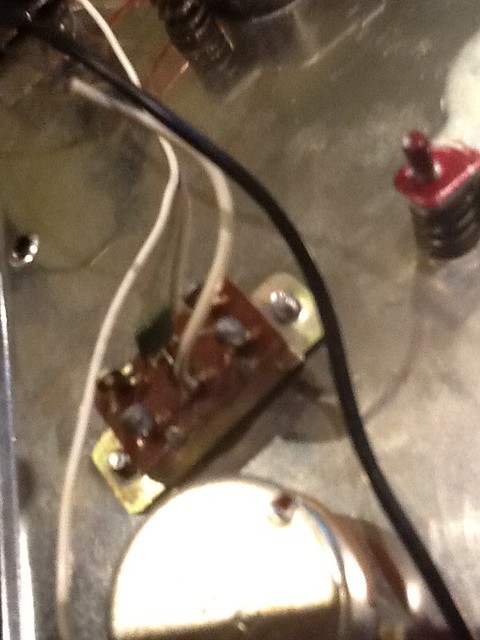
Kinda blurry, but if the switch is like this:
P1 P2
P3 P4
P5 P6
- There's a cap wired from P2 to P6. Couldn't read the value, I think it said 100 something. I know that's not helpful.
- There's a white wire that goes from P3 to nowhere
- There's a white wire that goes from P4 to nowhere
That wiring makes no sense to me at all. Anyone know what the hell this thing did, or how to hook it back up? Or even if I should?
If not it's no biggie, I'll just use the switch to disconnect the tone pot in 'Solo' mode for more volume/brightness and add it back in for 'Regular' mode. These old pickups didn't sound very strong, so the ability to kick a little more volume out of them might be handy.
Yeah, I like Erlewine's videos . . . you can get some great information out of them. Sometimes it kinda feels like they're just flogging Stew-Mac tools though.
So, I was looking at the wiring for this guitar last night. It seems pretty straight forward. There's a volume and tone pot, and three on/off switches (one for each pickup). That all makes sense to me.
But there's also a regular/solo switch. It was disconnected from the circuit and I tried to take a pic of it here:
Kinda blurry, but if the switch is like this:
P1 P2
P3 P4
P5 P6
- There's a cap wired from P2 to P6. Couldn't read the value, I think it said 100 something. I know that's not helpful.
- There's a white wire that goes from P3 to nowhere
- There's a white wire that goes from P4 to nowhere
That wiring makes no sense to me at all. Anyone know what the hell this thing did, or how to hook it back up? Or even if I should?
If not it's no biggie, I'll just use the switch to disconnect the tone pot in 'Solo' mode for more volume/brightness and add it back in for 'Regular' mode. These old pickups didn't sound very strong, so the ability to kick a little more volume out of them might be handy.
This is probably a good time to remind you that Dan Erlewine and Stewart-Macdonald have some great vids on YouTube. You might want to check them out.
Yeah, I like Erlewine's videos . . . you can get some great information out of them. Sometimes it kinda feels like they're just flogging Stew-Mac tools though.

nexion218
New member
Re: Watch me ruin a guitar I kinda hate!
I might have misssed it, but have you checked the neck for being straight before levelling? Or you are going to do the whole thing with the ghetto rocker-3 frets at a time approach and that way you expect the effect of relief to be negligible over such short sections of the neck?
When I corrected a few dead spots on frets, I even went up to 1000 grit to remove the toolmarks and then used either jewelry polishing coth or car polish compound.
I might have misssed it, but have you checked the neck for being straight before levelling? Or you are going to do the whole thing with the ghetto rocker-3 frets at a time approach and that way you expect the effect of relief to be negligible over such short sections of the neck?
When I corrected a few dead spots on frets, I even went up to 1000 grit to remove the toolmarks and then used either jewelry polishing coth or car polish compound.
GuitarStv
Sock Market Trader
Re: Watch me ruin a guitar I kinda hate!
So, I leveled the frets last night. Didn't seem like a biggie. First I filed down the high spots a bit that had been marked previously with the triangular file, checking with the ghetto fret rocker if things were far enough/too far. Then I did a few quick passes with the big ass file over all the frets. Checking with the rocker again it seemed to look good. I did a sanity check with my level against them and they seemed to be good.
Then there were some noticeable flat sections so I tried to crown the frets. First I drew a black line across the top of each with a sharpie, and then I tried using the triangle file to make a nice crown. I didn't like it. The pointy edges make me nervous around the fretboard (even though it's taped), and it's really hard to hold it in the right position. I also found that it was hard to get a rounded profile to the fret crown. So, I tried the fret crowning file with the concave sides. This was better, although it took me a while to get a feel for it it seems to leave a more rounded upper fret surface. It's weird to use though, you don't just press it down and file the top of the fret, you kinda angle it to take off the shoulders of the fret. It's annoying because it builds up with metal shavings very quickly so I had to stop and clean it off with a paper towel regularly.
Maybe some pictures will show what I mean . . .

I wanted the round shaped fret . . . but was getting the triangle shaped one with the triangle file (which, admittedly, was probably user error). The fret crowning file gave me the shape on the left. Anyhoo, this part wasn't too bad. Maybe a half hour or so and I had sanded down the thick black sharpie lines on the tops of the frets to pretty thin black sharpie lines. But now there were lots of marks on my previously beautiful and polished frets.
Then I dug through my sandpaper in the garage and found some 200, 300, 400, and 600 grit paper. Man alive, this part was boring. I went over each fret lengthwise with the each grit of sandpaper and it gradually got smoother and smoother. Tried going over the short section of the fret rather than lengthwise with the 600 grit, but I found it difficult to do. Probably about two hours to do this. It is pretty smooth now, but could be smoother. I'll pick up some 800 grit (and 1000 if they have it) from the hardware store tonight and give 'er a few more passes.
Yeah, don't know if I mentioned it but I measured the fretboard itself after pulling all the frets and it was very straight (almost dead on). I didn't really have a way to measure the straightness of the neck after banging the frets in, so am hoping that this hasn't changed the neck significantly, and the three fret approach will be close enough.
This is what I'm thinking. Which seems silly . . . on a low output guitar with three single coils I don't think bass is going to need to be cut too much. I had a think about wiring last night, and have decided to go with a blower switch in it's place that cuts both the volume and tone control out of the circuit. This way you can be playing along in rhythm with your tone/volume dialed in, flick on the blower circuit to get max tone/volume for a solo, then flick it off to go back to your previous settings. I think that this wiring should do it:
Solo Switch:
P1 P2
P3 P4
P5 P6
- link P5 to P6
- link P1 to P2
- pickup hot wire to P3
- connect P4 to the hot lug of the jack
- P2 to the middle lug of the volume pot
If my reasoning is correct, in solo position this will give me a straight path from the pickup to jack (pickups - P3 - P5 - P6 - P4 - input jack) and in regular mode it operates as normal with vol/tone (pickups - P3 - P1 - P2/volume pot/P4/ground). This way, the blower should work on whatever pickup combination in selected.
So, I leveled the frets last night. Didn't seem like a biggie. First I filed down the high spots a bit that had been marked previously with the triangular file, checking with the ghetto fret rocker if things were far enough/too far. Then I did a few quick passes with the big ass file over all the frets. Checking with the rocker again it seemed to look good. I did a sanity check with my level against them and they seemed to be good.
Then there were some noticeable flat sections so I tried to crown the frets. First I drew a black line across the top of each with a sharpie, and then I tried using the triangle file to make a nice crown. I didn't like it. The pointy edges make me nervous around the fretboard (even though it's taped), and it's really hard to hold it in the right position. I also found that it was hard to get a rounded profile to the fret crown. So, I tried the fret crowning file with the concave sides. This was better, although it took me a while to get a feel for it it seems to leave a more rounded upper fret surface. It's weird to use though, you don't just press it down and file the top of the fret, you kinda angle it to take off the shoulders of the fret. It's annoying because it builds up with metal shavings very quickly so I had to stop and clean it off with a paper towel regularly.
Maybe some pictures will show what I mean . . .
I wanted the round shaped fret . . . but was getting the triangle shaped one with the triangle file (which, admittedly, was probably user error). The fret crowning file gave me the shape on the left. Anyhoo, this part wasn't too bad. Maybe a half hour or so and I had sanded down the thick black sharpie lines on the tops of the frets to pretty thin black sharpie lines. But now there were lots of marks on my previously beautiful and polished frets.
Then I dug through my sandpaper in the garage and found some 200, 300, 400, and 600 grit paper. Man alive, this part was boring. I went over each fret lengthwise with the each grit of sandpaper and it gradually got smoother and smoother. Tried going over the short section of the fret rather than lengthwise with the 600 grit, but I found it difficult to do. Probably about two hours to do this. It is pretty smooth now, but could be smoother. I'll pick up some 800 grit (and 1000 if they have it) from the hardware store tonight and give 'er a few more passes.
I might have misssed it, but have you checked the neck for being straight before levelling? Or you are going to do the whole thing with the ghetto rocker-3 frets at a time approach and that way you expect the effect of relief to be negligible over such short sections of the neck?
Yeah, don't know if I mentioned it but I measured the fretboard itself after pulling all the frets and it was very straight (almost dead on). I didn't really have a way to measure the straightness of the neck after banging the frets in, so am hoping that this hasn't changed the neck significantly, and the three fret approach will be close enough.
Sounds like the "solo" switch might have been something similar to the "strangle" switch on a Jaguar: a bass cut.
This is what I'm thinking. Which seems silly . . . on a low output guitar with three single coils I don't think bass is going to need to be cut too much. I had a think about wiring last night, and have decided to go with a blower switch in it's place that cuts both the volume and tone control out of the circuit. This way you can be playing along in rhythm with your tone/volume dialed in, flick on the blower circuit to get max tone/volume for a solo, then flick it off to go back to your previous settings. I think that this wiring should do it:
Solo Switch:
P1 P2
P3 P4
P5 P6
- link P5 to P6
- link P1 to P2
- pickup hot wire to P3
- connect P4 to the hot lug of the jack
- P2 to the middle lug of the volume pot
If my reasoning is correct, in solo position this will give me a straight path from the pickup to jack (pickups - P3 - P5 - P6 - P4 - input jack) and in regular mode it operates as normal with vol/tone (pickups - P3 - P1 - P2/volume pot/P4/ground). This way, the blower should work on whatever pickup combination in selected.
Last edited:


