I have a 2008 Slash Signature Les Paul, with the stock APH2 pickups , comes stock with small ceramic .22 caps, sounds great \m/Got a wicked bug for some Sweet tone checking out utoob clips and then Slash on Monday night football. Not really trying cop Slash's sound, but just want that sweet thick tone outta my LP. So, gonna try some slash AIIps.
Im assuming I should run 500k pots. What caps would you recommend? I usually run .022 orange drops..

You are using an out of date browser. It may not display this or other websites correctly.
You should upgrade or use an alternative browser.
You should upgrade or use an alternative browser.
What caps to use with Slash AIIps?
- Thread starter BloodRose
- Start date
Ive got .022 orange drops in my two SGs and Charvel( prs'ish looking bolt neck import guitar) A ceramic .022 in my LP Jr, Ceramic .022 in my HSS strat, vintage poly cap I had in my Tele.
Honestly I dont think the type really makes a differance in a passive circuit like a guitar, value does make a differance for sure though.
I have a few old paper and oil caps around was gonna try um... but I dont forsee noticing anything.
Honestly I dont think the type really makes a differance in a passive circuit like a guitar, value does make a differance for sure though.
I have a few old paper and oil caps around was gonna try um... but I dont forsee noticing anything.

Señor Verde
Member
Some folks can't hear a difference between material types, others say they can. There are different types of orange drops, polyester and polypropylene. There was a pic of Slash's old guitar that had a polyester orange drop cap. I also remember seeing picks of a more recent Slash model that used 715P polypropylene. Maybe try both. They're inexpensive and easy to swap.
Chistopher
malapterurus electricus tonewood instigator
You absolutely can hear the difference between caps of the same nominal value of you get unlucky with the tolerance. An 22 nF orange drop at the bottom of its range and a bumble bee at the top of its tolerance are 19.8 nF and 26.4 nF respectively.Some folks can't hear a difference between material types, others say they can.
Now if you measure two 22 nF caps, both at 22.1 nF, material be damned they are going to sound identical. They may drift differently through the years though


GuitarStv
Sock Market Trader
Material of a capacitor doesn't matter at all. I suspect that most of the comparisons people make between materials where they're hearing a difference it's really just a difference between value of cap. When you measure and control for that all difference drops out in my experience.

Artie
Peaveyologist
Yup. Back when I was working in a Navy Cal lab, where I had access to multi-million dollars worth of test equipment, I bought an expensive ($22) Hovland .022uf cap. I measured it on a capacitance tester that was accurate to about 12 places. Then I grabbed some more caps from the parts bin and tested a bunch, until I could match a couple to better than 1%. I installed them into a guitar with an "aerospace" quality rotary switch. There was no perceivable difference in sound between the most cheap-ass disc, and the Hovland.Material of a capacitor doesn't matter at all. I suspect that most of the comparisons people make between materials where they're hearing a difference it's really just a difference between value of cap. When you measure and control for that all difference drops out in my experience.
Attachments
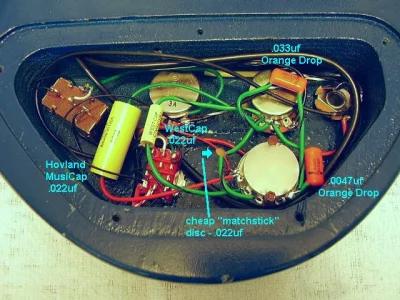

at least in a guitar circuit, i believe this to be true. i do tend to use orange drops or something of similar quality rather than the little ceramic disks. tolerances seem tighter and the leads are easier to work with. that said, if something has a little disk cap, im not swapping it out without reason.
in amps, i swear i can hear a subtle difference between caps, but it could be my ears and brain messing with me
in amps, i swear i can hear a subtle difference between caps, but it could be my ears and brain messing with me
Artie
Peaveyologist
No, it isn't. (In your ears, I mean.) In an amp, many/most of the caps control the signal that flows through. That is, the part you keep. In a guitar tone circuit, the cap controls the quality of the signal that you throw away. Kinda like washing your trash before you set it out to the curb.in amps, i swear i can hear a subtle difference between caps, but it could be my ears and brain messing with me
GuitarStv
Sock Market Trader
the internet spawns tons of its own snake oil bs. influencers are full of shit a lot of the time and post to get clicks
To be fair, it's not all posts and clicks. In this day and age I think that an awful lot of influencers are being paid by people who benefit from the shit being spewed too. : P

freefrog
Well-known member
Tone caps seem to be simultaneously a beaten dead horse and a red flag signal on the Web. I remember an engineer summing up the question by telling me: "Too much noise, not enough signal". How true! So many predefined and non documented opinions promoted as facts...
When I've tried to create a thread about tone caps on the previous music-electronics forum, members and mods even appeared to believe that I was trolling. So I've stopped to post in my own topic (!).
All that being said: lab tests have been done here to understand why some players were hearing a difference between tone caps.
A few leaky capacitors affected the resonant peaks in a different way, not announced by their carefully measured value (there's a life for leaky caps in guitars: they behave like the Fender Grease Bucket circuit, which was probably inspired by leaky caps anyway).
ALL "normal" (non leaky) capacitors were setting the resonant frequency as expected when the tone control was at 0/10: empirical measurements were strictly agreeing with resonance as calculated from components capacitance and pickup inductance. No surprise here.
BUT some differences did effectively appear when the tone pot was "in between" - IOW: set low enough to stop to be purely resistive.
These difference were about harmonics with a same pickup excited by a same electrical stimulus: harmonic spectra stacked exacly upon each others with some caps of the same value. With other caps, they had a different shape.
It happened with caps of different AND of the "same" materials (harmonic differences were noticed with mylar caps of various origins, for instance). It was NOT a random error due to the testing rig. There WERE repeatable differences - and in fact, I've already shared a few graphs borrowed to the related data, here on the Duncan forum, a few years ago.
I've never heard of similar tests done elsewhere than here.
Even if I was in situation to share the related data, publishing 'em wouldn't necessarily make much sense since people trust only what they do and notice by themselves.
So let's leave here the principle of such tests: one has to use an electrical stimulus producing a fundamental and its harmonics, injected in a guitar pickup. Consistency of the harmonic spectrum must be double or triple checked with a resistor instead of a tone control and without any capacitor to start with. Then capacitors can be inserted between "tone resistor" and ground. A few dozens of tests should suffice to illustrate what I've explained above.
When I've tried to create a thread about tone caps on the previous music-electronics forum, members and mods even appeared to believe that I was trolling. So I've stopped to post in my own topic (!).
All that being said: lab tests have been done here to understand why some players were hearing a difference between tone caps.
A few leaky capacitors affected the resonant peaks in a different way, not announced by their carefully measured value (there's a life for leaky caps in guitars: they behave like the Fender Grease Bucket circuit, which was probably inspired by leaky caps anyway).
ALL "normal" (non leaky) capacitors were setting the resonant frequency as expected when the tone control was at 0/10: empirical measurements were strictly agreeing with resonance as calculated from components capacitance and pickup inductance. No surprise here.
BUT some differences did effectively appear when the tone pot was "in between" - IOW: set low enough to stop to be purely resistive.
These difference were about harmonics with a same pickup excited by a same electrical stimulus: harmonic spectra stacked exacly upon each others with some caps of the same value. With other caps, they had a different shape.
It happened with caps of different AND of the "same" materials (harmonic differences were noticed with mylar caps of various origins, for instance). It was NOT a random error due to the testing rig. There WERE repeatable differences - and in fact, I've already shared a few graphs borrowed to the related data, here on the Duncan forum, a few years ago.
I've never heard of similar tests done elsewhere than here.
Even if I was in situation to share the related data, publishing 'em wouldn't necessarily make much sense since people trust only what they do and notice by themselves.
So let's leave here the principle of such tests: one has to use an electrical stimulus producing a fundamental and its harmonics, injected in a guitar pickup. Consistency of the harmonic spectrum must be double or triple checked with a resistor instead of a tone control and without any capacitor to start with. Then capacitors can be inserted between "tone resistor" and ground. A few dozens of tests should suffice to illustrate what I've explained above.
Last edited:
freefrog
Well-known member
Sure, differences don't matter if not detected by users, for whatever reason - different ears, gear, settings, wiring...
Now I wish a member had left at disposal some comparative samples shared on my Les Paul Forum many years ago: it involved PIO and ceramic caps of the same measured value with 50s wiring. Differences with "in between" settings were sonically obvious to me in this case.
Personally and despite all the experimental data in my archives, I don't vow a cult to tone caps (I like styroflex for low value capacitors but it stops there). Among the few dozens of instruments that we have at home, I don't even think two guitars host the same capacitors, in fact: as I like to experiment with the most possible things, I've all kinds of vintage or recent components following all kinds of wiring schematics.
But some old PIO caps + traditional 50s wiring won't leave my LP number one, bar none.
Now I wish a member had left at disposal some comparative samples shared on my Les Paul Forum many years ago: it involved PIO and ceramic caps of the same measured value with 50s wiring. Differences with "in between" settings were sonically obvious to me in this case.
Personally and despite all the experimental data in my archives, I don't vow a cult to tone caps (I like styroflex for low value capacitors but it stops there). Among the few dozens of instruments that we have at home, I don't even think two guitars host the same capacitors, in fact: as I like to experiment with the most possible things, I've all kinds of vintage or recent components following all kinds of wiring schematics.
But some old PIO caps + traditional 50s wiring won't leave my LP number one, bar none.

marcello252
Well-known member
Material of a capacitor doesn't matter at all. I suspect that most of the comparisons people make between materials where they're hearing a difference it's really just a difference between value of cap. When you measure and control for that all difference drops out in my experience.
material matters but not in audio range and not a the voltage range we use on guitar, given a selected value what we hear as differences are mostly component tolerances or, for pots for example, different tapers .
I'm a shameless hifi snob but I definitely hate gurus claiming snake oil solutions work, same for all the capacitors urban legends, physics is not witchcraft
freefrog
Well-known member
Do me a favor: read my post 35. And consider that it sums up 286 pages of screenshots, in 32 experimental files dedicated to tone caps in my crowded archives. It took years here to collect that...material matters but not in audio range and not a the voltage range we use on guitar
Artie
Peaveyologist
I think the myth that drives me the most crazy, is the guitar "ground loop" thang. Lindy Fralin, (his sales manager, actually), got it all wrong here:
Grounding
We talk about it more here:
Ground Loops
Grounding
We talk about it more here:
Ground Loops
Similar threads
- Replies
- 10
- Views
- 537

- Replies
- 27
- Views
- 2K


- Replies
- 9
- Views
- 2K
- Replies
- 12
- Views
- 7K
D
- Replies
- 38
- Views
- 14K