Lucius Paisley
Well-known member
When using dowel for filling in control cavities, how stable is the job (assuming the job is done correctly), has anybody ever had an issue with such a repair job "popping out"?


Properly executed glue joints are stronger than the wood parts they connect

When using dowel for filling in control cavities, how stable is the job (assuming the job is done correctly), has anybody ever had an issue with such a repair job "popping out"?
Could you clarify? Are you talking about filling in the whole Les Paul, or Strat cavity? Or are you talking about plugging one pot hole? (Potentiometer hole.)

Just the pot holes. In the case of a l-r conversion or just making one hole "go away" - in most cases, removing tone control.

Plugging a hole sounds simple but it's actually quite difficult. You need a tight fitting plug to begin with, but not so tight that the glue won't hold. Clamping down the plug is almost impossible.
I always use titebond first, then superglue to flood the top and plasticize the plug's front. If I have to drill a hole again for studs, I let the glue dry for 24 hours and drill with a super-sharp bit. I have trems that are super-stable with plugged holes and trems that are a nightmare without plugs. So in short, it doesn't matter if it's a plugged hole or not


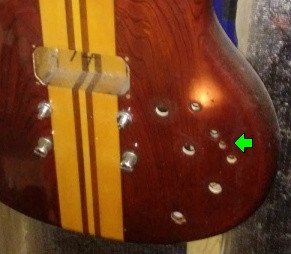
This guy used epoxy. It didn't come out too badly.
https://webcache.googleusercontent....ight-to-left-handed+&cd=1&hl=en&ct=clnk&gl=au
Unfortunately, this page is from Google cache because he's recently shut his site down due to a move, but you can see what he did well enough.

You'll run into an issue with the fact that dowels are end-grain, while the guitar body is face grain. They'll expand and contract at different rates, and eventually could leave a visible depression or raised surface.
Larry


If you put them in a guitar body almost no one will even ask about them
they just hanng out and look like a knob from a distance
What guitar is it that can't be bought lefty?