Your Favorite Tubes

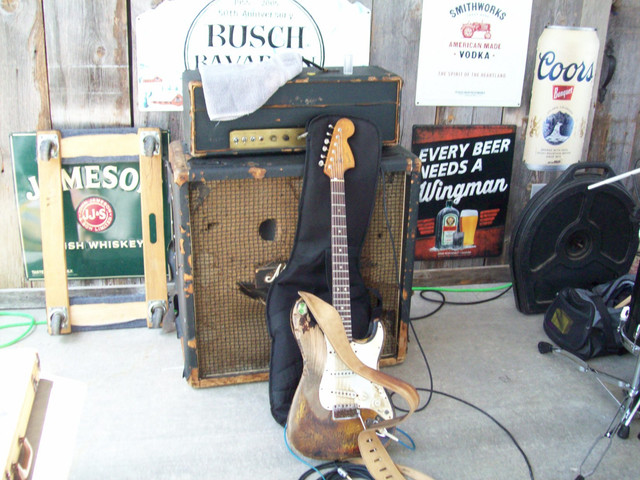
That pic makes miss my old cab.
I had a 1969 B cab. Had 2 of its original pre rola g12m 1 cream g12m and 1 cream g12h
Battered as hell cept mine the basketweave cloth had been sprayed flat black.
Was a sad day when I was forced to sell it.
 
I'm a simple man.

Preamps: I like a Mullard in V1 and the EHX everywhere else.

Powertubes: I like EHX, or JJs...or whatever matched quad is on sale works fine too.
 
The only dislike I ever had for a specific product of tubes is when I received my Dual Rectifier in the mail. Previous owner had put some power tubes that were physically a little bigger than Mesa's own tubes. They touched the ceiling of the amp and got shattered in shipping.
 
The only dislike I ever had for a specific product of tubes is when I received my Dual Rectifier in the mail. Previous owner had put some power tubes that were physically a little bigger than Mesa's own tubes. They touched the ceiling of the amp and got shattered in shipping.
Usually.most used amps Ive bought( and couple I sold and shipped) you pull the powertubes and wrap um in bubble wrap. Should number which socket they came from too.
Hopefully they made it good with you.
 
I've been pretty content with EHX or TungSol for preamp and JJ for power. Cost effective, reliable, and sound great. Those combos have worked well for me in the high gain contexts.
 
My Victory Sheriff 44 came with PM pre-amp valves, and TAD EL34’s.
It was a rotten, hi-mid heavy mess. Serious lack of gain. Lifeless. Everything a struggle.
The bass and lo-mids were indistinguishable from each other, and post-EQ could not successfully define those areas.
The top-end was horrible, and the amp was unusable.
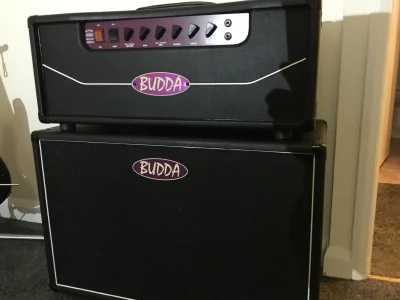
It then sat for 2 years whilst I explored modelling alternatives, and a Budda SD45, which immediately caught fire.
I was trying to replace a modified Pro Amplifiers V65, which had stopped working - my amp of some 15 years.
Cathode bias was out of the picture. The SD45 saw to that. But, on paper, and having studied the Sheriff’s circuit diagram - it seemed worth digging out.

I decided to source vintage Mullards.
Only interested in used valves that had better than book spec, with full test results.
Early on, it appeared that the short-plate type 161 ECC83 from Blackburn was my main contender.
Mullard XF2 EL34’s were expensive. But I bought a pair. Unfortunately they rattled, so were returned.
I went with used Original Svetlana winged-C EL34’s and biased them up correctly.
In my search for type 161’s, the following criteria had to be met, although all of them tested above book figures.

V1 - This was to be the quietest valve, with the highest anode current on both triodes. Still with good transconductance.
V2 - The cathode follower runs at unity gain, so current should be good, but transconductance should be the highest possible. Bear in mind it compresses only half the waveform.
V3 - Loop return and Impedance matcher. This just requires a good all-round valve.
V4 - Splitter. Good current needed. Transconductance should be high too. Both triodes must have identical test figures.

That was I think common sense, and at this time, there were still great examples on eBay UK, on average £50 each.

The whole premise, apart from anything else, was to achieve linearity across the complete frequency band.
The amp needed distinct, controllable bass. Lo-mids should be separate and also distinct. The overpowering, gnarly hi-mids had to go, and the top-end needed to be smoother, with a nice roll-off.

I serviced the amp fully, fitted the correct valves in their allotted positions, and biased the Svetlana’s to the recommended figure.
The transformation was off the charts.
I use a Palmer PDI-03, and a Joe Meek VC6Q, for recording.
The deep switch could now be switched from deep to flat.
With amp’s bass on 4, there was the perfect bottom-end.
I use middle on full, and the lo-mids were nicely distinct. Raising bass now did not affect lo-mids!
The hi-mid bias was gone. Instead, the entire mid-range was beautifully full and with seductive complexity.
The top-end was utterly sweet.
I could take your head off with harmonics and pick-slides, so treble and presence was reduced to virtually zero on this amp.
It became quickly apparent that the amp had a negative feedback sweet-spot. Master was happiest around 7 or so.
So, first try was really promising.

The Palmer was set flat.
To give more V1 level and gain, I begrudgingly added a Koko Boost to the high input. This gave +6dB of level, and an extra 6dB of mids in a modestly wide Q. Slightly wider, and set lower than an EMG SPC, or Clapton TBX.
This again transformed the amp up another level.
My highest gain was set with the guitar on 7 or 8 to weight the input, and the amp was then given an extensive testing.

First impressions were that the amp was now responding to the guitar’s input properly. All 3 single-coil EMG’s of different types, were now so distinct in their sound, and there was nothing else there. The amp was utterly silent, even with input gain on 10, where it stayed.
I use a big isolated UPS on my recording amps, and all cables are balanced. But it was the Mullards that were responsible for the noticeable lack of hum, hiss, and microphonics.

I gave the used Svetlana’s a week to develop, but to be honest, they didn’t need it, and were wonderful within minutes.
Not the massive bottom-end of NOS GE’s for sure. But still very, very good, and tight. Top-end was delightful, once the treble and presence controls were minimised. Mid-range was staggeringly clear and concise - becoming more complex as you added more content harmonically. Double-stops and triads rang clear, with huge density. The note-separation on full chords was unbelievable. An open E - you could still hear all 6 strings ringing - 30 seconds after hitting them!
The amp had simply lost all its earlier bad points, and was a lovely sounding, stable platform.

Playing with guitar-level, I could roll off to 3 or 4, and clean up nicely for any distorted rhythm work.
I did have the option to turn off the mids on the Koko Boost, if I wished to be cleaner, with the guitar on 2.
I also have channel one on the Sheriff, if I want to get really clean.

For my ultimate lead sound with this amp, I decided to add 6dB of mids at 1Khz on the VC6Q, and a smidge of bass boost/treble cut - probably 0.5dB.
Yep, that was it.

The amp is now impeccable, and a dependable recording platform.
Aside from zero noise issues and added frequency-distinction - the amp is now absolutely linear in its ‘processing’ of all frequencies. This means I’m really hearing the guitar, and what it is putting out. Overall gain is set by the Koko’s level, and guitar-volume.
Touch-sensitivity is incredibly good, and the amp is both efficient and responsive to anything I give it.

Summing up, I would say the amp has design faults. Certainly in it’s EQ section, and lack of V1 gain.
Victory relied on ‘shredders’ using cathode bias, and being wowed by the ugly, up-front hi-mid cacophony.
Ok for 15 minutes in a music shop, surrounded by gear.
But get it home, and it’s a dead duck - with only the Chinese bargain-bin valves to give it any kind of life.

My journey with Mullards began with my Pro-Amplifiers V65, converted to adjustable-bias with Svetlana’s.
But for the Sheriff, I’m glad I took the time to get the circuit-diagram, research valve-amp tech fully, and buy valves using a careful selection process. The used valves were £400 in total, but the amp would have been sold without them.

I then bought a Victory Baron 10W combo, and kitted that with 161’s, a 5751WC reverb valve, and XF2 and EL84 Blackburn Mullards. This amp is equally responsive and linear - through a Celestion Cream Alnico. Although I do use a Joe Meek VC6 and VC5 on the loop. It’s my upstairs practice amp.
The sound is more direct from the 1x12”, but this helps me focus. The Sheriff downstairs goes straight to the Mac from the VC6Q, and is more ‘processed’, as I add effects on the computer, and listen on my monitors.
So I can get parts right upstairs, then do a ‘performance’ in my whole mix.
This wouldn’t be at all possible without the linearity of the Mullards.

At this time, it is becoming increasingly difficult to find used 161’s way over book spec. EBay is full of some very poor, clapped-out valves, at scandalous prices.
I am happier to now source from the USA, and the private market is still quite buoyant, with good prices.

The good thing is that my Mullards will last a very long time indeed. In fact they will probably see me out.
And quite simply - no modern production valve comes close to that level of expertise and manufacturing.
The audiophile world has a couple of good valve-makers, but none will match the ruggedness and longevity of Blackburn 161’s - or the consistent quality, from a factory that produced millions every year.

Yes, there are Chinese, Russian, Slovakian valves in everything new you buy. Often re-badged to look fancier. But honestly, they are bargain bin junk, designed just to get the amp in the shop, and making a noise.

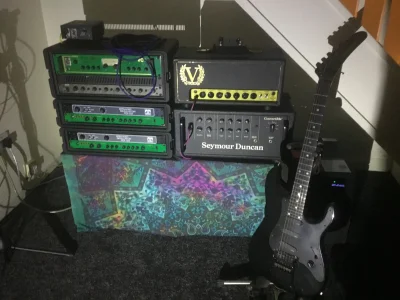
I recently branched out somewhat. I rebuilt a Seymour Duncan 100W Convertible Head.
Original valves are Groove Tube.
I kept the EL34’s, which work well.
With stock modules, I went with Mullard 161’s, using the same constraints for individual specs.
But this time, on the blue ‘presence’ channel, I used two GT12ax7M Mullard copies (Chinese!).
This gave a distinctly Joe Walsh/Carvin flavour to the blue channel, which is interesting. Hi-mids aren’t too much.
The red channel however with the 161’s - Now this is a real amp. EQ it anywhere and it sounds great.
Approximating my usual lead gain could be done easily without a Koko Boost, and the instant mid-range complexity is simply staggering. This is a well implemented amp. On paper it has faults, but in operation - it’s the missing link between the 60’s and what we have now. Even your average Pitbull fanboy would love it, for its density and downright guitaristic nature.

So now, the Convertible sits alongside my Sheriff for recording. The Sheriff is clinical and linear. The Convertible is simply exciting and makes me want to play.
In my view, I don’t think anyone has made an amp that sounds as good as the Convertible. It has no limits, no sweet-spot, everything is so good. Roadworthy it is not, unfortunately. 13 valves make a rebuild expensive. But mine is here to stay.
Mullards are not ‘dull’, they are simply linear - crying out for a well-designed amp to exploit their sonic excellence.

Lots there, and thanks for reading.
But the above is but just a few years of my long journey, and I hope keen readers will take some pointers and inspiration from that.

Lastly. Take time to go out in the woods, and just sit there and listen.
Nothing has EQ on it, yet the panorama is full of life and vibrant sounds.
After an hour, begin to imagine your ideal lead-tone. One that might belong in this soundscape.
I’ll bet that it won’t be flubby bass, no lo-mids, raspy hi-mids, with screeching treble.
So why the hell go home to Chinese valves with exactly those attributes ‘eh?
IMG_1055.webpIMG_0801.webp
 
Last edited:
what happened to the budda?
The first Budda was returned after it caught fire. Hadn’t been looked after.
I did have/try an SD18 which was a bit too dark for me.
I bought a newer, immaculate SD45 with FAT 2x12, and put the correct Sovteks in it. That is a great amp, but I’m not a cathode bias guy really. I have some NOS GE 5871? and a Harma Cryo rectifier for it, but haven’t got round to trying them. It has Golden Lion KT66’s in it, with a spare brand new pair. All cables and footswitch. Whole setup is mint.
It’s currently on sale on eBay at £650!
Fantastic setup for someone that wants to articulate pure valve tone, but it will do everything else too.

IMG_4919.webp

Edit - Disabled friendly.
 
Last edited:
those are great amps! i need another amp like i need to be shot in the leg though
£650 cash, and I’ll throw in a sturdy bracket to attach it to the back of your wheelchair.
Guess the clincher is whether they hit bone or not!
No point in buying it if you’re just gonna hobble about taking the piss on crutches for 6 weeks.
 
I have pretty much used JJ tubes for both preamp and main.

I have JJ KT77s in my YCV50 and JJ 12AX7 preamp tubes. It used to have JJ EL34s.

The EL84s in my H&K are still stock, but when the day comes, I'll likely be looking at JJ tubes.
 
The EL84s in my H&K are still stock, but when the day comes, I'll likely be looking at JJ tubes.
By then I should think the whole planet will be turned to glass and rubble - which is how I usually like to envisage the JJ factory when I think of their red-plating early efforts at output valves, and their pathetically noisy ECC83S valves.
God, they literally churned this shit out, and were virtually paying people to fit their products with them - and by then they were hyped way beyond their true worth, because they were everywhere. Unfortunately, a lot of that everywhere was in the dumpster behind some amp-tech’s shop, whilst they waited for replacement output transformers.
Classic case was Anderton’s Victory brand. All JJ’s, then suddenly PM and TAD - once Martin Kidd realised the JJ’s were running at their plate voltage limit, and were destined to fail disastrously sooner rather than later. Their service dept. couldn’t keep up with the returns.
Only a complete redesign of output valves could save JJ. Whether they have succeeded I don’t know, but quality control is better I think. Once bitten, twice shy though. Too many lovely vintage wonders around to mess about with - or even hang your hat on, like I do.
Easy to find a cheap matched-pair of Blackburn Mullard EL84’s above spec. With voltage capabilities beyond your amp’s requirements. That’s called headroom. Mullards are famous for it.
My Victory Baron sounds awesome with just one Mullard EL84.
The other valve is a very decent Svetlana winged-C EL34. This replaced an original Victory-fitted red-plating JJ6L6.
 
Last edited:
where, praytell, can one find a cheap matched pair of blackburn mullard el84s? nos examples are around $200 each from trusted dealers. i dont have any el84 amps at the moment. i ran jj in my modded blues jr for years without issue and use their 6v6 tubes with fine results. most of my amps are 6v6 and 6l6 these days, with a few el34 mixed in there. i do like the winged c el34 i have in my tw express clone. my favorite tubes are my old gec kt66 pair in a tweed bandmaster circuit, sound great in a pro reverb too.
 
By then I should think the whole planet will be turned to glass and rubble - which is how I usually like to envisage the JJ factory when I think of their red-plating early efforts at output valves, and their pathetically noisy ECC83S valves.
God, they literally churned this shit out, and were virtually paying people to fit their products with them - and by then they were hyped way beyond their true worth, because they were everywhere. Unfortunately, a lot of that everywhere was in the dumpster behind some amp-tech’s shop, whilst they waited for replacement output transformers.
Classic case was Anderton’s Victory brand. All JJ’s, then suddenly PM and TAD - once Martin Kidd realised the JJ’s were running at their plate voltage limit, and were destined to fail disastrously sooner rather than later. Their service dept. couldn’t keep up with the returns.
Only a complete redesign of output valves could save JJ. Whether they have succeeded I don’t know, but quality control is better I think. Once bitten, twice shy though. Too many lovely vintage wonders around to mess about with - or even hang your hat on, like I do.
Easy to find a cheap matched-pair of Blackburn Mullard EL84’s above spec. With voltage capabilities beyond your amp’s requirements. That’s called headroom. Mullards are famous for it.
My Victory Baron sounds awesome with just one Mullard EL84.
The other valve is a very decent Svetlana winged-C EL34. This replaced an original Victory-fitted red-plating JJ6L6.
Welcome to the shitification of global manufacturing for max profit. It's one of my motives behind the band name for one of the two bands I'm trying to form this year.

With that being said, the JJ tubes I have are from over a decade ago purchased through the tube amp doctor if I recall correctly. Perhaps I will go in another direction when I need new tubes in the future, but for now, the JJs are still working fine.
 
where, praytell, can one find a cheap matched pair of blackburn mullard el84s? nos examples are around $200 each from trusted dealers. i dont have any el84 amps at the moment. i ran jj in my modded blues jr for years without issue and use their 6v6 tubes with fine results. most of my amps are 6v6 and 6l6 these days, with a few el34 mixed in there. i do like the winged c el34 i have in my tw express clone. my favorite tubes are my old gec kt66 pair in a tweed bandmaster circuit, sound great in a pro reverb too.

IMG_1210.webp
This is the correct logo for authentic winged-C from St.Petersburg.
Anything else is Reflektor plant junk.
Currently £120 for a NOS matched pair of EL34 on eBay, but only one seller left now. He has tons though.
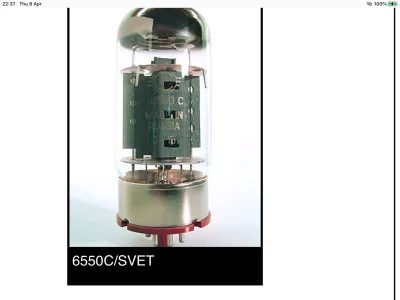
The authentic Svetlana winged-C EL34 and 6550 are the only valves I would buy NOS without test specs. But the used market is always worth a look.

The GE KT66 is a fantastic valve. As are brown base 50’s Tung Sol. I can still find bargain NOS GE 5871? which will replace a KT66, so long as your rectifier is a Sylvania black plate, or a Harma reissue - Cryo’d - and especially the wonderful Mullard GZ34.

For Mullard stuff, do not buy NOS. You want test results, and aim to buy used matched-pairs above book specs.
The valves must look good, and have no black burn areas. Always clean pins up with a small wire brush.
I’m a big fan of single halo getters and copper rods. Welded plates and triple mica construction. So my go-to’s are from 1960-1964. I tend to stick with Blackburn, and distrust anything more European.
There are many crap sellers of valves around now, so get the specs and knowledge under your belt. Become an expert in identifying internal construction, and you’ll quickly understand why GE and Mullard were so good. Early Tung Sol too.
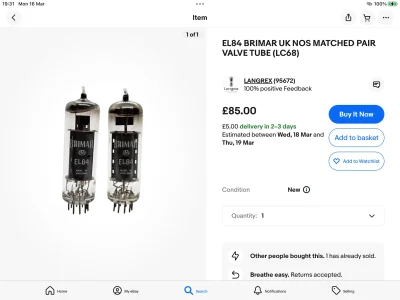
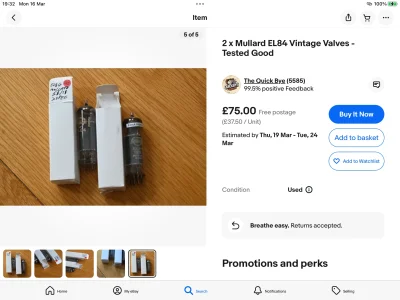
Expect to pay £60 or so for an above spec matched pair of Blackburn Mullard EL84’s. But putting them in a cathode bias amp would be a crime against humanity.
Brimar are also worth trying, but I have no personal experience with them. I believe their ECC83’s are slightly short of the Mullard’s qualities, but their EL84’s are worth looking at.

I can easily stick my neck out here and state that any Mullard EL34 XF2, or EL84 from Blackburn, with just 70% of life left in it - will still outperform anything manufactured today. Except for very expensive audiophile makers. But the Mullard will also last many times longer than anything. That is the absolute truth.
 
Last edited:
yes, my winged c have that logo, ive had them for years. well before i built the amp. 90% of the time, im using my '66 deluxe reverb which is currently running jj 6v6. i do have some nos 6v6 pairs, jan and ge labeled, but the jj sound good and havent given me any issues so i havent swapped.
 
Last edited:
yes, my winged c have that logo, ive had them for years. well before i built the amp. 90% of the time, im using my '66 deluxe reverb which is currently running jj 6v6. i do have some nos 6v6 pairs, jan and ge labeled, but the jan sound good and havent given me any issues so i havent swapped.
I’m into Jan Phillips 5751’s big-time. I used them to tame a Peavey Classic 50/50 power amp. Mullard CV4024’s as splitters. £100 for all 4, NOS.
I also have a Jan 12au7WC as a reverb driver/return in my Baron combo.
Here’s two examples from eBay. Both listings are good. Please tell me if I’m breaking any forum rules.

IMG_1204.webpIMG_1205.webp
 
Back
Top