
You are using an out of date browser. It may not display this or other websites correctly.
You should upgrade or use an alternative browser.
You should upgrade or use an alternative browser.
2007 Soldano SLO-100
- Thread starter JMP/HBE
- Start date
If it was pre Boutique Amps Distribution then it was serial. When he retired and sold/leased to B A D, he changed things around to suit PCB construction and went with a parallel design. While they really try and tout that the new amp is better, I beg to differ. I think it is not only a step back, but due to the more complex and added circuitry to implement the " improvements ", it subsequently makes the amp more prone to failure. I used to be a big fan of the Soldano offerings, but now that they are run through B A D, not so much...
There is a website I believe called slocloneforums.com which has a lot of info about building a clone. I used to be active on it years ago, but lost interest in the brand and the circuit once I learned more about it and the " sell off " to BAD. You can very certainly build the amp for roughly $800-1k, but the end product will very much be a reflection of your ability to build an amp.

Fixing the loop on a non B A D offering is pretty simple and worth doing if you need it improved. As far as the new amps sounding different than the original amps, I don't hear a difference really and if there is I am confident it isn't any different than one amp to another is. They are 99.+ the same sonically. I have an old one.

Toe-Knee
New member
Does anyone make a Slo Clone? A bag of parts that lets you build your own?
I would build one, but can't drop 5k on an amp.
C3 amps sell kits.
And Weber have the heather kit which is SLO-like.
The loop in the original isn't actually bad it's just designed for rack gear but it's easy to adjust with a single resistor and cap.
The newer ones are a little different sounding due to the clean channel not bleeding into the lead channel. It's only a tiny amount but it definitely affects the tone negatively imho. The newer ones are more aggressive and compressed.

Jeremy,
Not exactly, I think it was only really an issue if you used both amp channels at similar gain and volume levels. The vactrols used to switch channels could have some residual leak and if so would allow some interaction between the channels. It was especially noticeable if you used higher clean channel gain and less gain channel gain. If the vactrol didn't completely decouple them, there was bad interaction!
The amp had several design flaws if you will. Using vactrols was one of them. Vactrols are LDR switches, IE. they are light-dependent resistors. If they aren't tuned perfectly, there is a possibility that they could leak signal through. If the channel switching vactrol's leaked, there was an uneven number of stages that could mix together just before the FX loop. The more gain you used on the clean channel, the more it would mix in, out of phase with the gain channel signal, potentially causing issues. The FX loop was a big part of the amps sound, and because it could distort and how it was implemented in the chain, it was never actually out of circuit so to speak. I am not a fan of cathode followers, this amp utilizes two of them... Vactrols are nice because they are very fast, silent, and utilize little power vs that of relay's which could pop when switched, were slow to switch, and had more power needs.
The circuit as a whole is not a magic bullet by any means. Mike Soldano was lucky in that he was the first to find a way to hot rod a Marshall and still be fairly unique, and also to start the high gain amp movement. Realistically he burned up two tubes just to get an FX loop in the thing, but the way he did it more or less wasted the energy from the two tubes ( he dumps 99% of the signal going out of the FX send, and the return stage is there to simply make that loss back up ) and you could overdrive the FX loop from either the preamp or the return making for some ugly sounds if too egregious. The power amp stage was designed to stay clean and NOT break up. The power amp section contributed very little to the distortion of the amp. Almost 100% of the distortion in this amp is coming from the preamp. When I finally understood what he was trying to do and why he did it that way, I was less amused and turned off by the design. It does what only a Soldano can do, beyond that, it only does what a Soldano can do.
Not exactly, I think it was only really an issue if you used both amp channels at similar gain and volume levels. The vactrols used to switch channels could have some residual leak and if so would allow some interaction between the channels. It was especially noticeable if you used higher clean channel gain and less gain channel gain. If the vactrol didn't completely decouple them, there was bad interaction!
The amp had several design flaws if you will. Using vactrols was one of them. Vactrols are LDR switches, IE. they are light-dependent resistors. If they aren't tuned perfectly, there is a possibility that they could leak signal through. If the channel switching vactrol's leaked, there was an uneven number of stages that could mix together just before the FX loop. The more gain you used on the clean channel, the more it would mix in, out of phase with the gain channel signal, potentially causing issues. The FX loop was a big part of the amps sound, and because it could distort and how it was implemented in the chain, it was never actually out of circuit so to speak. I am not a fan of cathode followers, this amp utilizes two of them... Vactrols are nice because they are very fast, silent, and utilize little power vs that of relay's which could pop when switched, were slow to switch, and had more power needs.
The circuit as a whole is not a magic bullet by any means. Mike Soldano was lucky in that he was the first to find a way to hot rod a Marshall and still be fairly unique, and also to start the high gain amp movement. Realistically he burned up two tubes just to get an FX loop in the thing, but the way he did it more or less wasted the energy from the two tubes ( he dumps 99% of the signal going out of the FX send, and the return stage is there to simply make that loss back up ) and you could overdrive the FX loop from either the preamp or the return making for some ugly sounds if too egregious. The power amp stage was designed to stay clean and NOT break up. The power amp section contributed very little to the distortion of the amp. Almost 100% of the distortion in this amp is coming from the preamp. When I finally understood what he was trying to do and why he did it that way, I was less amused and turned off by the design. It does what only a Soldano can do, beyond that, it only does what a Soldano can do.

JMP/HBE
Well-known member
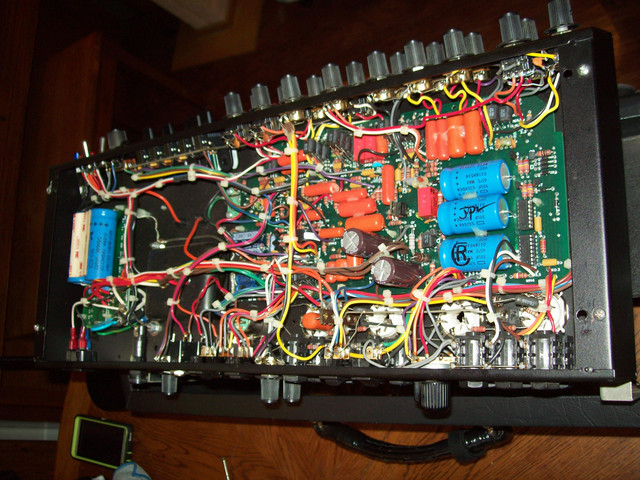
My Mesa MK IV had Vactrols triple piggybacked is most in 2 or 3 areas of the board and alot of suppliers stopped stocking Vactrols all together.
That coupled with the fact that my MK IV was going to need a cap job and none of my go to Tech's wanted to work on it is why i sold it.
No i didn't want to send it to Petaluma.
Jeremy,
Not exactly, I think it was only really an issue if you used both amp channels at similar gain and volume levels. The vactrols used to switch channels could have some residual leak and if so would allow some interaction between the channels. It was especially noticeable if you used higher clean channel gain and less gain channel gain. If the vactrol didn't completely decouple them, there was bad interaction!
The amp had several design flaws if you will. Using vactrols was one of them. Vactrols are LDR switches, IE. they are light-dependent resistors. If they aren't tuned perfectly, there is a possibility that they could leak signal through. If the channel switching vactrol's leaked, there was an uneven number of stages that could mix together just before the FX loop. The more gain you used on the clean channel, the more it would mix in, out of phase with the gain channel signal, potentially causing issues. The FX loop was a big part of the amps sound, and because it could distort and how it was implemented in the chain, it was never actually out of circuit so to speak. I am not a fan of cathode followers, this amp utilizes two of them... Vactrols are nice because they are very fast, silent, and utilize little power vs that of relay's which could pop when switched, were slow to switch, and had more power needs.
The circuit as a whole is not a magic bullet by any means. Mike Soldano was lucky in that he was the first to find a way to hot rod a Marshall and still be fairly unique, and also to start the high gain amp movement. Realistically he burned up two tubes just to get an FX loop in the thing, but the way he did it more or less wasted the energy from the two tubes ( he dumps 99% of the signal going out of the FX send, and the return stage is there to simply make that loss back up ) and you could overdrive the FX loop from either the preamp or the return making for some ugly sounds if too egregious. The power amp stage was designed to stay clean and NOT break up. The power amp section contributed very little to the distortion of the amp. Almost 100% of the distortion in this amp is coming from the preamp. When I finally understood what he was trying to do and why he did it that way, I was less amused and turned off by the design. It does what only a Soldano can do, beyond that, it only does what a Soldano can do.
What amps do you recommend that do the SLO thing better than the SLO? You make it sound like he was a dunderhead who was in the right place at the right time.
Certainly, here we are 30 years on, someone must have improved upon it? Or maybe it defined an era and people want *that* sound?
I totally get it if people want it "because Soldano" for same reason people buy Harleys, even though objectively they ain't the greatest performance machines.
He was certainly not a dunderhead, not saying that at all. Simply, that he was the first to popularize a Hot Rodded Marshall circuit that was at least partly unique, and with that amp started the high gain amp frenzy. He got two birds with one stone. A SLO does what a SLO does, it doesn't do some things very well at all, and other things it excels at.
I would say that Engl and Diezel probably picked up where Soldano left off. And that Friedman and Bogner kind of took his recipe and ran with it. Friedman and Bogner are more or less hot-rodded Marshalls, but without some of the design quirks. Engl makes several different amps and one or two of them could do the SLO thing, not necessarily better, but it can do it. The upside, if you will, is that they will have a real clean channel and a well-designed FX loop, and proper switching. Diezel's as you know, are very over-engineered tools that can do anything you can put your mind to. Still not an SLO, but close enough and without design issues.
I have come to a point in my career and life where simplicity is king and channel switching amps are not on my shortlist. Why? Mostly because of the issues they can have. I have a Jet City JCA50H, it has leaky vactrols in it and the interaction between the channels is HORRID. Conversely, I have had Pevey's where the relays hung and it could take a half-second for it to switch channels, long enough that it was annoying. I had a Crate many years ago where the relays were chattering, so the thing would switch between clean and gain spontaneously, randomly, and back and forth really quickly.
Don't get me started on Mesa amps..... They are probably the most overrated things on the planet. They do sound good... when they work... which is part of the problem. All amplifiers are at some point going to need some sort of service done to them, and Mesa's are the most egregious amps at making a tech's life difficult.
I would say that Engl and Diezel probably picked up where Soldano left off. And that Friedman and Bogner kind of took his recipe and ran with it. Friedman and Bogner are more or less hot-rodded Marshalls, but without some of the design quirks. Engl makes several different amps and one or two of them could do the SLO thing, not necessarily better, but it can do it. The upside, if you will, is that they will have a real clean channel and a well-designed FX loop, and proper switching. Diezel's as you know, are very over-engineered tools that can do anything you can put your mind to. Still not an SLO, but close enough and without design issues.
I have come to a point in my career and life where simplicity is king and channel switching amps are not on my shortlist. Why? Mostly because of the issues they can have. I have a Jet City JCA50H, it has leaky vactrols in it and the interaction between the channels is HORRID. Conversely, I have had Pevey's where the relays hung and it could take a half-second for it to switch channels, long enough that it was annoying. I had a Crate many years ago where the relays were chattering, so the thing would switch between clean and gain spontaneously, randomly, and back and forth really quickly.
Don't get me started on Mesa amps..... They are probably the most overrated things on the planet. They do sound good... when they work... which is part of the problem. All amplifiers are at some point going to need some sort of service done to them, and Mesa's are the most egregious amps at making a tech's life difficult.
JMP/HBE
Well-known member
What amps do you recommend that do the SLO thing better than the SLO? You make it sound like he was a dunderhead who was in the right place at the right time.
Certainly, here we are 30 years on, someone must have improved upon it? Or maybe it defined an era and people want *that* sound?
I totally get it if people want it "because Soldano" for same reason people buy Harleys, even though objectively they ain't the greatest performance machines.
Well technically an "SLO" is "suppose" to be a "modded Marshall" type thing [depends who you ask] but M. Soldano's first SLO "prototype" was actually "borrowed" from the Mesa Mark series amplifiers. Hence the 6L6 vs EL-34 thing to say the least.
Again depends who you ask YMMV.
So when i hear folks cry about Randall Smith stealing the SLO for the Rectifiers, again it depends who you ask.
Randall Smith came up with the first cascaded preamp and the first Master Volume amps at least 10 years before any other amp company. And it was prolly in his head years before that.
Again depends "who you ask" but these are all facts above. I have no dog in this fight.
I see alot of the BAD / SLO's returned and for sale IDK what the deal is but people just don't like them for whatever reasons.
Launching the 2.0 SLO new line during a pandemic and then a BAD warehouse fire didn't help either.
There is a guy here locally trying to sell a new SLO for $4500 good luck with that.
Last edited:
I think a lot of the reason for the B A D amps selling is a new crop of buyers are going off the original hype on the amp and simply checking them out. The popularity / buzz of any decent amp comes and goes and for a while people were really buzzing over the SLO-100. The modern player is probably seeking more amp feature wise for $4K. There are a lot of other amp companies offering a lot of amp for that much money or less and with more modern sounds. The people that really love the SLO are most likely lifers and will always enjoy the amp no matter the version. It does what it does well, but that is it IMO. I have a bit of a unique one in that it is a black chassis dual dirty channel with mods and some awesome lizard tolex. I will never part with it based on that alone! Also, I believe a lot of players today simply stay away from higher wattage amps (ridiculous to do so IMO) and the release of the 30 may be a bit confusing or conflicting to prospective buyers. The 30 is more than 30 watts and the 100 excels at being cranked so quite possibly the people flipping the new amps never even used them in their sweet spots sonically. Anyway, if I was going to drop the money for a new one Soldano wouldn't be my first choice but in fairness maybe it is because I already have what I have. Still, you can get a lot of amp elsewhere for that kind of money. YMMV
JMP/HBE
Well-known member
Ive turned down many SLO offers the last 10 years for the $1500 range and then as soon as Mike announces his retirement & sells to Friedman all of a sudden SLO's are $4500 ....... hard pass.
I'll wait another 10 years and pick one up for $1500 cash.
And if not thats fine too i never met a Soldano i had to have. Can't say that about Marshall.
I'll wait another 10 years and pick one up for $1500 cash.
And if not thats fine too i never met a Soldano i had to have. Can't say that about Marshall.
I guess if I had to come up with a list of amps based on reliability, ease of service, and quality of build; as much as it pains me to say it, Marshall kind of takes the win. BUTTTTTTTTT, it has to be the top-line models like the HW series, JCM-800, and other older models that were only two channels. Their modern multi-channel ( JVM, DSL, and similar ) amps are not as easy to repair when things go wrong.
Interestingly, most of Marshall's classic designs are now so comparatively simple, that they are hard to mess up. Any amp that can be replicated with a point to point turret board construction will be easy to repair, problem-free, and excel at a particular sound. This is what made the Soldano so good when it was first introduced. Aside from the vactrols, it really was as well made of an amp as it could possibly be. Many earlier Friedman's and Bogner's were much the same until they went commercial and sold out to BAD. Now, most of the amps sold through BAD have a hybrid PCB turret board. Morgan's are now PCB turrets, Bogner's have gone to all-out PCB, and Friedman's, depending on the model is either PCB or PCB Turret board. This leads us to Mesa..... The earliest company to embrace PCB construction with lots of ribbon connectors and stacked PCBs. They offered lots of features in a small or at least standard size package, which forced the need for PCB construction, unfortunately leading them to be the most hated name on a repair technician's workbench.
Interestingly, most of Marshall's classic designs are now so comparatively simple, that they are hard to mess up. Any amp that can be replicated with a point to point turret board construction will be easy to repair, problem-free, and excel at a particular sound. This is what made the Soldano so good when it was first introduced. Aside from the vactrols, it really was as well made of an amp as it could possibly be. Many earlier Friedman's and Bogner's were much the same until they went commercial and sold out to BAD. Now, most of the amps sold through BAD have a hybrid PCB turret board. Morgan's are now PCB turrets, Bogner's have gone to all-out PCB, and Friedman's, depending on the model is either PCB or PCB Turret board. This leads us to Mesa..... The earliest company to embrace PCB construction with lots of ribbon connectors and stacked PCBs. They offered lots of features in a small or at least standard size package, which forced the need for PCB construction, unfortunately leading them to be the most hated name on a repair technician's workbench.
I guess if I had to come up with a list of amps based on reliability, ease of service, and quality of build; as much as it pains me to say it, Marshall kind of takes the win. BUTTTTTTTTT, it has to be the top-line models like the HW series, JCM-800, and other older models that were only two channels. Their modern multi-channel ( JVM, DSL, and similar ) amps are not as easy to repair when things go wrong.
Interestingly, most of Marshall's classic designs are now so comparatively simple, that they are hard to mess up. Any amp that can be replicated with a point to point turret board construction will be easy to repair, problem-free, and excel at a particular sound. This is what made the Soldano so good when it was first introduced. Aside from the vactrols, it really was as well made of an amp as it could possibly be. Many earlier Friedman's and Bogner's were much the same until they went commercial and sold out to BAD. Now, most of the amps sold through BAD have a hybrid PCB turret board. Morgan's are now PCB turrets, Bogner's have gone to all-out PCB, and Friedman's, depending on the model is either PCB or PCB Turret board. This leads us to Mesa..... The earliest company to embrace PCB construction with lots of ribbon connectors and stacked PCBs. They offered lots of features in a small or at least standard size package, which forced the need for PCB construction, unfortunately leading them to be the most hated name on a repair technician's workbench.
What really pisses me off is that you can get a reissue JCM1800 for $1500usd in UK. Here in the USA its almost twice that. And Marshall won't let Thomann ship to the USA. Its a wicked kind of price fixing.

Cynical
Active member
Bogner amps have never been made by BAD (only their cabs and pedals), and their heads have always been PCB with the sole exception of the Helios. Furthermore, PCB is a better method of construction when it comes to performance and consistency; as anyone who knows anything about amps knows, interference between components is a big deal, and PCB minimizes this.I guess if I had to come up with a list of amps based on reliability, ease of service, and quality of build; as much as it pains me to say it, Marshall kind of takes the win. BUTTTTTTTTT, it has to be the top-line models like the HW series, JCM-800, and other older models that were only two channels. Their modern multi-channel ( JVM, DSL, and similar ) amps are not as easy to repair when things go wrong.
Interestingly, most of Marshall's classic designs are now so comparatively simple, that they are hard to mess up. Any amp that can be replicated with a point to point turret board construction will be easy to repair, problem-free, and excel at a particular sound. This is what made the Soldano so good when it was first introduced. Aside from the vactrols, it really was as well made of an amp as it could possibly be. Many earlier Friedman's and Bogner's were much the same until they went commercial and sold out to BAD. Now, most of the amps sold through BAD have a hybrid PCB turret board. Morgan's are now PCB turrets, Bogner's have gone to all-out PCB, and Friedman's, depending on the model is either PCB or PCB Turret board. This leads us to Mesa..... The earliest company to embrace PCB construction with lots of ribbon connectors and stacked PCBs. They offered lots of features in a small or at least standard size package, which forced the need for PCB construction, unfortunately leading them to be the most hated name on a repair technician's workbench.
Also, Marshall Super Leads were PCB by the mid '70s, so those amps that you say have the best quality of build ever? PCB.
Last edited:
Cynical,
While Bogner may only have a distribution deal with BAD for their pedals, you can safely bet that Bogner amps is following a similar business model, the mini-series SCREAMS BAD all over it... You can't even get to a legitimate Bogner website anymore and haven't been able to for a couple of years now. Something is certainly going on with Bogner and the fact that BAD even has his pedals leads me to believe that BAD has more of Bogner than we think they do? And Bogner made his amps initially with turret boards, he has been doing this for 33 years now and I would doubt highly that he was set up well enough at that time to bring the first production amplifiers to you in 100% PCB form. Earlier release Bogner amps were built with what is called hybrid construction today. He used PCB traces on turret board material that had eyelets in it for the contacts. Some of his amps were entirely turret board ( the Atmos comes to mind ), and others used turrets with some parts that had traces on them. It wasn't until the earlier part of the 2000's that he went to full-on PCB.
PCB is no better or no worse than point-to-point or Turret board construction. A well laid out design in either format is well laid out. PCB construction DOES NOT guarantee a better layout either. You can find videos all day of amps that have burned traces because the heater supply or something on the HT line did not have enough copper to support the current demands of the amp. You won't find that in PTP or Turret board amps because there are no traces to burn. I would say the only thing a PCB design may have over any of the other two is ground planes and grounding schemes. A very well-designed PCB can have a better ground plane and grounding scheme than other build types, but that is not to say it is common or typical, only that they can. PCB construction has a very limited amount of rework or repair time on them. You can only change a component so many times before the trace lifts, the board starts to burn ( when a PCB board burns it can become conductive BTW ) and become conductive, or you simply pull a trace altogether. With PCB, there is limited ability to modify the circuit at all. Keep in mind, any time you remove a component to change the circuit, that trace is still there acting like a little antenna. With Turret board and PTP, you can pretty much do whatever you like as many times as you like. It is very hard to make a turret board burn or ruin it.
I should also point out that Fender's use of eyelets on waxed cardboard was a problem. This is probably what leads many to believe eyelets are not ideal for construction? Eyelets are just as good as turrets provided the medium they are pressed in is nonconductive. Eyelets on a Garolite board are just as good as a turret is. I would only say that Turrets are more preferred simply because you can fit more components on them and it is easier to make a clean looking build.
You and I will probably not get a chance to own a vintage Marshall, Fender, or other rarer 50s-60s model amplifier. Most are all accounted for already and the ones up for sale currently are not cheap. Marshall's early PCB construction is almost more like turret board than it is PCB. All the components lay parallel to each other and utilize through-hole construction for standard components. The pots and the tube sockets were all chassis mounted, and the wires that connected everything on the board had stress relief holes. All in all, they were a very solidly built, easy to work on design and those amps are still to this day melting faces. Anything that says Marshall ST1 on the PCB board will be easy for techs to do repairs on. Was the early PCB Marshall stuff the best ever? Heck no.
To be clear, as an amp designer and builder myself, I prefer turret board construction over hybrid, eyelet, PCB, or PTP. For two reasons. I think it is the cleanest looking and is the most reliable way to build an amp. Is it the best way? Depends on who you ask I suppose.
While Bogner may only have a distribution deal with BAD for their pedals, you can safely bet that Bogner amps is following a similar business model, the mini-series SCREAMS BAD all over it... You can't even get to a legitimate Bogner website anymore and haven't been able to for a couple of years now. Something is certainly going on with Bogner and the fact that BAD even has his pedals leads me to believe that BAD has more of Bogner than we think they do? And Bogner made his amps initially with turret boards, he has been doing this for 33 years now and I would doubt highly that he was set up well enough at that time to bring the first production amplifiers to you in 100% PCB form. Earlier release Bogner amps were built with what is called hybrid construction today. He used PCB traces on turret board material that had eyelets in it for the contacts. Some of his amps were entirely turret board ( the Atmos comes to mind ), and others used turrets with some parts that had traces on them. It wasn't until the earlier part of the 2000's that he went to full-on PCB.
PCB is no better or no worse than point-to-point or Turret board construction. A well laid out design in either format is well laid out. PCB construction DOES NOT guarantee a better layout either. You can find videos all day of amps that have burned traces because the heater supply or something on the HT line did not have enough copper to support the current demands of the amp. You won't find that in PTP or Turret board amps because there are no traces to burn. I would say the only thing a PCB design may have over any of the other two is ground planes and grounding schemes. A very well-designed PCB can have a better ground plane and grounding scheme than other build types, but that is not to say it is common or typical, only that they can. PCB construction has a very limited amount of rework or repair time on them. You can only change a component so many times before the trace lifts, the board starts to burn ( when a PCB board burns it can become conductive BTW ) and become conductive, or you simply pull a trace altogether. With PCB, there is limited ability to modify the circuit at all. Keep in mind, any time you remove a component to change the circuit, that trace is still there acting like a little antenna. With Turret board and PTP, you can pretty much do whatever you like as many times as you like. It is very hard to make a turret board burn or ruin it.
I should also point out that Fender's use of eyelets on waxed cardboard was a problem. This is probably what leads many to believe eyelets are not ideal for construction? Eyelets are just as good as turrets provided the medium they are pressed in is nonconductive. Eyelets on a Garolite board are just as good as a turret is. I would only say that Turrets are more preferred simply because you can fit more components on them and it is easier to make a clean looking build.
You and I will probably not get a chance to own a vintage Marshall, Fender, or other rarer 50s-60s model amplifier. Most are all accounted for already and the ones up for sale currently are not cheap. Marshall's early PCB construction is almost more like turret board than it is PCB. All the components lay parallel to each other and utilize through-hole construction for standard components. The pots and the tube sockets were all chassis mounted, and the wires that connected everything on the board had stress relief holes. All in all, they were a very solidly built, easy to work on design and those amps are still to this day melting faces. Anything that says Marshall ST1 on the PCB board will be easy for techs to do repairs on. Was the early PCB Marshall stuff the best ever? Heck no.
To be clear, as an amp designer and builder myself, I prefer turret board construction over hybrid, eyelet, PCB, or PTP. For two reasons. I think it is the cleanest looking and is the most reliable way to build an amp. Is it the best way? Depends on who you ask I suppose.
Similar threads

- Replies
- 0
- Views
- 173

