...

Do a search for "hobby metals." There's all kinds of companies that make small dimensional metals for hobby projects. Micro-Mark is just one, for example.

https://www.micromark.com/hobby-supplies/metal?show=48

And hopefully, someone can correct me if I'm wrong, but I don't think that bar has any tonal characteristics. You could probably replace it with some maple. Or any easy to work material. (But I may be wrong.)
 
Last edited:
Do a search for "hobby metals." There's all kinds of companies that make small dimensional metals for hobby projects. Micro-Mark is just one, for example.

https://www.micromark.com/hobby-supplies/metal?show=48

And hopefully, someone can correct me if I'm wrong, but I don't think that bar has any tonal characteristics. You could probably replace it with some maple. Or any easy to work material. (But I may be wrong.)

Hi Artie,

I'd find very pretentious and ungrateful to "correct" you.

Now and if i can simply share something with you and the community: in my humble experience, the keeper bar contributes to the overall inductance and Foucault currents, so it allows to "fine tune" a tone to some extent. Not sure its effect wouldn't / won't be hidden by a double thick mag but it's a part that I find more meaningful tonally than maple. YMMV. :-)

I think that with a double thick mag, I'd try a double decker keeper bar (= two stacked ones, sanded or not) , just to hear what it sounds like... :-P
 
Last edited:
Don't know anything concerning various alloys and the keeper bar.
But AFAIK its function in a humbucker is to couple the magnetic field of the bar mag with the pole screws.
If so, it certainly isn't irrelevant - and replacing it with wood or plastic would more or less disable the screw coil.
It'd be almost like removing the screws.

This is also why bars with oversized holes could be an issue.
 
I think within this thread some people are just having misunderstanding of the meaning of words like spacer vs keeper bar. For this discussion the spacer is referring to the plastic or wooden piece that props the bobbins up so they don’t sag outward.

So when you use a double thick magnet you either make a special spacer, or flip the standard spacer onto its side so that it’s standing vertically. That would be tonally neutral.

The keeper bar, however; the metal bar that has holes in it that wraps the screws on the screw coil, does play a role in the sound of the pickup. But for the sake of this discussion the important thing to note is that most double thick magnet pickups only utilize 1 normal keeper bar, they don’t stack them, and it’s usually pushed to the top, just underneath the bobbin. Not sagged down toward the baseplate. Stacking another keeper bar could be a fun experiment though if you wanted to play with the inductance and flux return path.
 
Stack two keepers on top of each other. You can also get a low carbon steel bar and drill it, but that’s more work.

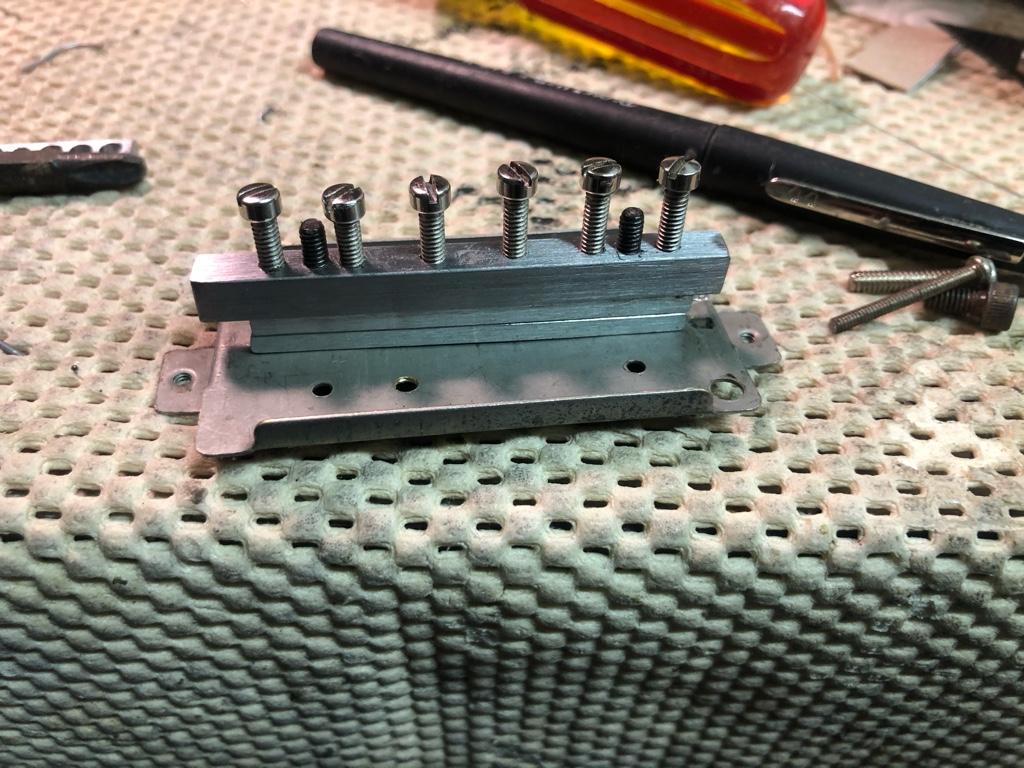
Here you see stacked keepers AND a drilled and tapped bar for the poles.
5dd550e6a0c36a550733d04d7b273673.jpg


Sent from my iPhone using Tapatalk
 
Stack two keepers on top of each other. You can also get a low carbon steel bar and drill it, but that’s more work.

Here you see stacked keepers AND a drilled and tapped bar for the poles.
Cool, thanks David.
I have a couple of humbuckers that I've considered as candidates for double mags.
How much difference does using a second keeper make - does it change the output significantly? Lower the resonant frequency?
What's the overall effect on tone & response?
 
Dumb. They solve one of the most common problems of filling out vintage or medium bridge hums. That's not a specialized use. Fun for high output, but you can simply stick a double thick alnico of your choice in a vintage output bridge and you get the openness of the wind without the clank.
 
Last edited:
Maybe you guys can clarify something for me. And know that I only have a rudimentary understanding of magnetics. Since like poles oppose each other, wouldn't stacked magnets try to degauss each other? In other words, is a magnet that's manufactured as a 1/4" thick going to be the same as two 1/8" thick mags clamped together?
 
Maybe you guys can clarify something for me. And know that I only have a rudimentary understanding of magnetics. Since like poles oppose each other, wouldn't stacked magnets try to degauss each other? In other words, is a magnet that's manufactured as a 1/4" thick going to be the same as two 1/8" thick mags clamped together?

Cermag said if you force like poles together, they will partially degaus each other. So no it is not the same. It will work to force 2 together, but it is not ideal. The way I make mine is I epox 2 mags together and then remagnetize them as 1 magnet.
 
Last edited:
Back
Top