A very technical question

WDeeGee

New member
Hi Folks, a very technical question here.

I’ve got a Michael kelley PAF plus in the neck, where I put an A4 magnet in.
There’s a real kind of magic going on and I love the sound it makes, sweet, smooth, yet clear and piano like, if that makes any sense. Quite unique, and that’s why I kept it (bridge is a ‘59 now).

Unfortunately, the pickup has a major flaw: it still a lot of bass with poor definition (even after the magnet swap), really noticeable when using chords.
I figured I’d change the baseplate from brass to nickel, but then I read nickel gives more attack. Maybe it would solve the bass problem, but I’m afraid it’ll also destroy the magic sweetness.

Screw pole pieces on this pup are short ones, and I have them fairly high up already.

Any suggestions?

I was think to put a cap in series before the pots (not after, as I the brigde pup has just the right amount of bass), but I’m not sure if turning the pots would affect the cap’s cut-off frequency. If it doesn’t, then that’s probably the best solution.
 
Last edited:
Re: A very technical question

I had this problem when I was fixing up a FirstAct GarageMaster (the VW guitar) a friend gave me. The stock pickups were pure mud.

I had a Duncan Jazz laying around so I put it in the neck (I had a DiMarzio Al Dimeola at the bridge).

In this guitar (basswood body) the Jazz was really woofy in the low end. It seemed to bring out the body resonance and made the neck pickup unplayable. After trying a few things I decided to just put a different pickup in the guitar. I ended up winding a new pickup with different wire gauges on each coil to prevent the low frequency reinforcement that was going on. Then I used an A2 magnet to smooth the top a little.

I know that doesn’t help you with that pickup, but my point in this is that I could not get that pickup to work in this guitar. But it sounded great in the guitar it came out of.


Sent from my iPhone using Tapatalk
 
Re: A very technical question

Hi Folks, a very technical question here.

I’ve got a Michael kelley PAF plus in the neck, where I put an A4 magnet in.
There’s a real kind of magic going on and I love the sound it makes, sweet, smooth, yet clear and piano like, if that makes any sense. Quite unique, and that’s why I kept it (bridge is a ‘59 now).

Unfortunately, the pickup has a major flaw: it still a lot of bass with poor definition (even after the magnet swap), really noticeable when using chords.
I figured I’d change the baseplate from brass to nickel, but then I read nickel gives more attack. Maybe it would solve the bass problem, but I’m afraid it’ll also destroy the magic sweetness.

Screw pole pieces on this pup are short ones, and I have them fairly high up already.

Any suggestions?

I was think to put a cap in series before the pots (not after, as I the brigde pup has just the right amount of bass), but I’m not sure if turning the pots would affect the cap’s cut-off frequency. If it doesn’t, then that’s probably the best solution.

A nickel BP wouldn't suffice to solve your problem IMHO / according to my experience... but I've never played the pickup that you mention so my statement is purely theoretical. :-)

Regarding the cap in series: it HAS to be placed AFTER the tone pot. If you put a serial cap between PU and tone control, this tone control will react like a 2d volume pot.
if your guitar features 4 pots (2 volume & 2 tones), you might go from the neck PU to its tone pot THEN through the cap in series towards the volume. It would avoid the phenomenon that I describe...

Good luck in your mods. :-)
 
Re: A very technical question

If you have long pole pieces in your parts bin (or can sacrifice from a donor pickup temporarily try them on just the bottom 3 strings. It will stretch the magnetic field out, possibly open up those low strings. It has an impact on the return path of the slug poles as well.
 
Re: A very technical question

If you have long pole pieces in your parts bin (or can sacrifice from a donor pickup temporarily try them on just the bottom 3 strings. It will stretch the magnetic field out, possibly open up those low strings. It has an impact on the return path of the slug poles as well.

"The bottom 3 strings", do you mean the first, second and third?
And by "long pole pieces", do you mean screws?
I was of the understanding long screws add more bass?
 
Re: A very technical question

Regarding the cap in series: it HAS to be placed AFTER the tone pot. If you put a serial cap between PU and tone control, this tone control will react like a 2d volume pot.
if your guitar features 4 pots (2 volume & 2 tones), you might go from the neck PU to its tone pot THEN through the cap in series towards the volume. It would avoid the phenomenon that I describe...

4 pots, 50's wiring (tone connected to taper of volume pot, PU goes to vol pot lug). So will it work if I place the cap between the taper (output) of the volume pot and the three way selector switch?
 
Re: A very technical question

4 pots, 50's wiring (tone connected to taper of volume pot, PU goes to vol pot lug). So will it work if I place the cap between the taper (output) of the volume pot and the three way selector switch?

Yes, it should work.I'll try to do a 5Spice sim about it and I'll post it if time permits. :-)
 
Re: A very technical question

If you have short screws and A4, I don't think there's much more you can do without some onboard bass cutting. You could crank up your pots to 1 meg with no load tones and then put a resistor on the bridge if it's a master setup.
 
Re: A very technical question

"The bottom 3 strings", do you mean the first, second and third?
And by "long pole pieces", do you mean screws?
I was of the understanding long screws add more bass?

I mean long screws, and I mean on The 3 bass strings. It elongates the magnetic field, and stretches out the return path. Don’t worry about what anyone has said about it adding or reducing bass. It’s also an attack/decay and string separation thing. If you do try it I would love to hear your experience.
 
Re: A very technical question

you either don't know physics or your experience is flawed. Caps before or after tone pots makes no dif...it's done both ways all the time.
 
Re: A very technical question

A cap IN SERIES with a pickup makes a tone pot react differently weither this cap is placed "before" or "after" the tone pot. That's a fact and should be easy to check for anyone seeing BS in this statement.

Incidentally that's how "capacitive" pickups can be recognized: their wire is broken somewhere but stays aligned and behaves like a capacitor in series with the pickup. When it's the case, tone controls (necessarily placed "after" the capacitive wire) don't react normally no more but lower the volume and thin out the tone.

I've repaired more than one pickup with this problem in my life and have always troubleshot them thanks to the tone pot behaving abnormally...

So, I stand on my statement: people, IF you put a cap in series with a PU, connect the tone pot to the pickup THEN the cap in series between this circuit and the output.

@frankfalbo: glad to see you back onboard! I've missed you. :-)
 
Last edited:
Re: A very technical question

So you're saying that if I put a cap from the output lug of the vol pot to the input lug of the tone pot (as opposed to wiring the vol pot directly to the tone pot and put the cap after the tone pot) the tone pot will act as a volume pot?
 
Re: A very technical question

OK, I get that. The cap is always in series with the tone pot (whether before or after the pot). But when (or why) would you ever have a tone pot in series? And IF it is in series, then it would work like a vol pot whether the cap is before or after the tone pot. Is this correct or am I off base here?
 
Re: A very technical question

Look, I'm just trying to understand what you're saying. To me, you're not being very clear.
 
Re: A very technical question

Hi Folks, a very technical question here.

I’ve got a Michael kelley PAF plus in the neck, where I put an A4 magnet in.
There’s a real kind of magic going on and I love the sound it makes, sweet, smooth, yet clear and piano like, if that makes any sense. Quite unique, and that’s why I kept it (bridge is a ‘59 now).

Unfortunately, the pickup has a major flaw: it still a lot of bass with poor definition (even after the magnet swap), really noticeable when using chords.
I figured I’d change the baseplate from brass to nickel, but then I read nickel gives more attack. Maybe it would solve the bass problem, but I’m afraid it’ll also destroy the magic sweetness.

Screw pole pieces on this pup are short ones, and I have them fairly high up already.

Any suggestions?

I was think to put a cap in series before the pots (not after, as I the brigde pup has just the right amount of bass), but I’m not sure if turning the pots would affect the cap’s cut-off frequency. If it doesn’t, then that’s probably the best solution.


Yes put the Cap after the pickup and before the Volume control. This is a HIGH PASS FILTER. It will not make you tone control act different. It could, I guess, if you are using 50's wiring. BUT with 50's wiring, the tone pot always acts strange.

Oh, and if that doesn't do it for you, swap the A4 for an A3.
 
Re: A very technical question

Look, I'm just trying to understand what you're saying. To me, you're not being very clear.

LOL... :-))

So, let's try again...

OK, I get that. The cap is always in series with the tone pot (whether before or after the pot). But when (or why) would you ever have a tone pot in series? And IF it is in series, then it would work like a vol pot whether the cap is before or after the tone pot. Is this correct or am I off base here?

Look again this schematic (I'm not its author but it's a consensual schemo often used in spice modeling by various winders, techs, engineers and so on):

https://www.talkbass.com/attachments/upload_2016-11-3_13-3-53-png.981681/

V1, L pickup, R pickup and C pickup sum up the four basic properties of any magnetic transducer: voltage, inductance, resistance, stray capacitance (IOW, these 4 components = 1 single pickup).

"R tone" is the standard tone pot. "C tone" is the standard tone cap. These R and C are in series with each other and their order doesn't matter. But the whole network is in PARALLEL with the pickup, like any tone control.

Then, there's another capacitor C2, named "Bass cap" on the schematic but it's probably a typo error: the author most likely wanted to highline C2 as a bass CUT capacitor, in SERIES with the pickup.

The guy who did the schematic did know his stuff: he has wired the standard tone control to ground THEN his "bass cut" cap in series towards the output. Because if he had put C2 between "C pickup" and "R tone", the tone pot would behave abnormally, by lowering the volume and thinning out the tone..

Anyone will easily check it with a pickup, two pots, two caps and a few alligator clips... :-)
 
Last edited:
Re: A very technical question

@WDeeGee:

Below are the 5spice sims promised in my post 7.

My archives contain similar pictures captured with our lab gear on real pickups but my sims should suffice since, anyway, experimenting with the location of the series cap in your guitar should show you directly/concretely/sonically what I meant. :-)

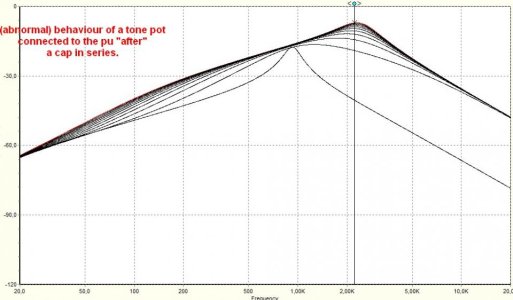
Here is the (normal) action of a tone pot on resonance from 10/10 to 0/10, when this tone control is wired first, before a series cap:

View attachment 102571

Here is the same action of a tone control on resonance from 10/10 to 0/10, when the PU signal passes through the series cap, then is filtered to ground by the standard tone network (which is now taming the signal although the volume pot stays full up all the time):

TonePotAfterCapInSeries.jpg

A series cap between the output of your volume pot and the selector will allow the tone control placed "before" to behave normally. Now and because of the interaction with other parms (like amp & effect circuits & settings) it might seem to change a bit the behavior of your volume pot itself, regardless of the tone control : that's the possible price to pay for clearer bass.

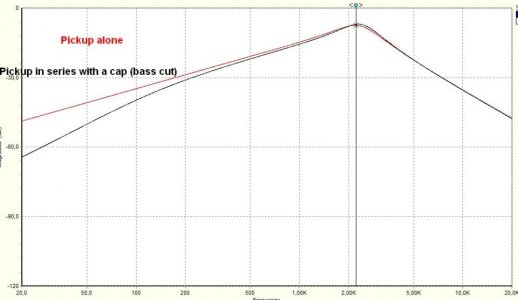
For the record, I add below a sim of the difference between a pickup alone and the same pickup filtered by a (commonly used 4.7nF / 0.0047µF) series cap for "bass cut" / high pass filter:

CapInSeriesWithPu.jpg


Good luck again in your mods, whatever they are (and sorry to have polluted your thread with OT posts).
 
Last edited:
Back
Top