gimmieinfo
Active member
In a paf style humbucker, with "all else being equal", would you say A3 is going to be more dynamic and have a wider range of clean to dirty using the volume knob? (using treble beed)


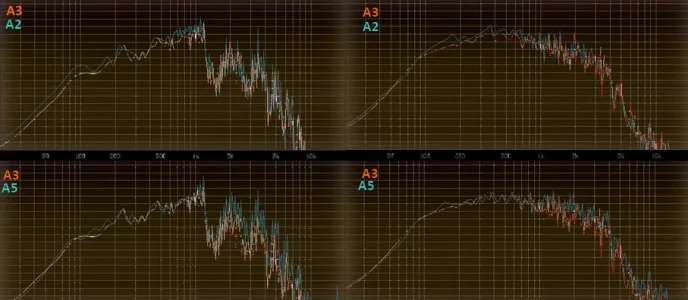
That's where height settings might be rewarding. Should make more difference compared to a A2 since A3 is weaker magnetically (reason why users hear A3 as explained in various posts above and in each case, I get what the contributor said: being weaker and albeit it boosts a bit the inductance, typical A3 doesn't bump fundamental notes up to 1000 or 1100hz as much as typical A2, as illustrated by the screenshot that I've shared in post 5)...I've had a A3 set and didn't notice much difference in the low end in the neck but that could have been any number of reasons and i'd appriciate more mids and less lows in the neck.


That's where height settings might be rewarding. Should make more difference compared to a A2 since A3 is weaker magnetically (reason why users hear A3 as explained in various posts above and in each case, I get what the contributor said: being weaker and albeit it boosts a bit the inductance, typical A3 doesn't bump fundamental notes up to 1000 or 1100hz as much as typical A2, as illustrated by the screenshot that I've shared in post 5)...
I think safe to say that theoretically, the difference should be really minor IF the flux measured from the strings by a magnetometer is identical with A2 PU down than with A3 PU up: in this case, the only remaining difference should be the slightly higher inductance due to more iron in A3.So I usually drop my neck pickups pretty low. Like with the A2 antiquity it seems to sound best to me slightly below my neck pickup ring. Would swapping in an A3 have much/any tonal difference if I need to raise it up a bit higher to keep the volume difference between bridge and neck from getting way too big?


I agree with this.A3 is clearly A5-like. It sounds like degaussed A5, not like A2.


