A3 vs A2

gimmieinfo

Active member
In a paf style humbucker, with "all else being equal", would you say A3 is going to be more dynamic and have a wider range of clean to dirty using the volume knob? (using treble beed)
 
A3 has a touch less bass and a touch more treble than an A2. They are extremely close.

If you held me at gun point and asked me to blindly pick which of two otherwise equal pickups was an A2 and which was an A3, there would be a 50/50 chance you would shoot me.
 
IME the EQ profile resulting from either magnet are very different. A3 is the lowest output of any alnico I've played. Clean to dirty with the volume knob is all relative. If I have hotter pickups, roll back the gain on the amp input, I can get the same range of clean to dirty with any pickup, even with an original Seymour-wound JB.
 
"Short" answer: to me, it would depend on heigth settings under the strings in this case. A pickup with A2 set low enough to give similar Gauss readings from the strings should behave not too far from the same pickup set higher and with an A3 (minus the small differences due to a wee bit more iron / more inductance / more eddy currents with A3).


Side notes - I won't repeat my stance about the variability of discrete magnets including those of a "same" alloy, since I'm not even sure that such posts are read.

I'd still wonder to which extent we can generalize on this topic. When Throbak defines A2 as "mid scooped" while Seymour finds in it a "warm, sweet full tone", the explanation is not necessarily that one winder is wrong and the other right. ;-)

Anyway.

Below is a comparison involving various alloys including A2 and A3 among others, FWIW (the contributor talks about "AlNiCo 3" while there's no cobalt in A3 but beside this indifferent error, I find his test instructive regarding what magnets really do: when we talk a long time about them, it emphasizes their properties in a way not necessarily indicative of how tone actually changes or not).


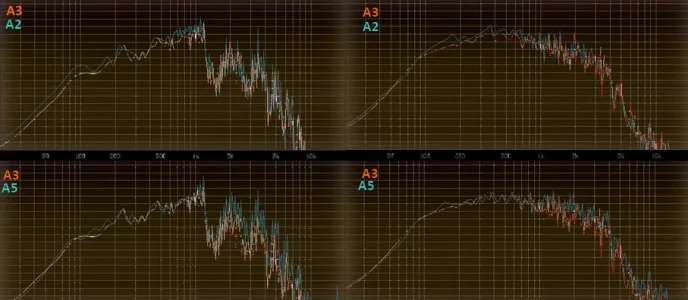
EDIT - A few months ago, I had shared a chart showing what was objectively going on, EQ wise, with A3 vs A2 and A3 vs A5 in a same neck pickup, played direct to the board. I paste the related screenshot below. Left column stacks the frequencies and shows the output level with single notes. Right column does the same with chords from unfretted strings to 12th fret.
These results were predictible since they matched the variations of Gauss levels + inductivity measured on the pickup with the magnets involved.

A3vsA2vsA5neckPU.webp
 
Last edited:
I'm quite partial to A3 over A2, particularly in the neck position.

I agree with the prior sentiment that it lessens the bass and increases the treble a bit, which to my ears, evens the response across the board (this might be what you mean by a "wider range?"). I also think there's a little bit less sag with an A3, so the feel is different as well (whether you perceive this as "more dynamic" or not will depend on you).

If you're someone who has used a lot of A2 mags, and you don't need extra compression / output but do what additional clarity, I'd definitely give A3 a try
 
Last edited:
i like a3 in the neck, usually prefer a2 in the bridge. i hear a3 as being a little clearer in the lows/low mids. i dont know if it is actually brighter than a2 or if the lower frequency differences make it seem that way, but i like it
 
Thanks all. Sounds like i should probably try in in the neck. I may do that when i have the time a drive to do so. I have A3 bars on hand. I've had a A3 set and didn't notice much difference in the low end in the neck but that could have been any number of reasons and i'd appriciate more mids and less lows in the neck.
 
going form a2 to a3, you wont get more mids in my experience, fairly similar with a flatter overall eq curve?
 
I've had a A3 set and didn't notice much difference in the low end in the neck but that could have been any number of reasons and i'd appriciate more mids and less lows in the neck.
That's where height settings might be rewarding. Should make more difference compared to a A2 since A3 is weaker magnetically (reason why users hear A3 as explained in various posts above and in each case, I get what the contributor said: being weaker and albeit it boosts a bit the inductance, typical A3 doesn't bump fundamental notes up to 1000 or 1100hz as much as typical A2, as illustrated by the screenshot that I've shared in post 5)...
 
Well, in topics created by gimmieinfo, I've rambled more than once about "dynamics" as largely related to stray capacitance of coils (usually affected by potting)... but this thread is about magnets, so it doesn't harm to recall that A3 is the weakest popular alloy "all other things being equal" : as it lowers the output level of an humbucker, it necessarily affects to some extent how the pickup behaves once the volume pot lowered...
 
A2 and A3 will respond differently to changes in the volume knob with gain, but it would be a complex combinatorial and hard to predict. The clean characteristics are A3 has about the same amount of mids as A2, but has less output, less bass, and is a bit snappier. So A2 bridge A3 neck is a great combo.
 
That's where height settings might be rewarding. Should make more difference compared to a A2 since A3 is weaker magnetically (reason why users hear A3 as explained in various posts above and in each case, I get what the contributor said: being weaker and albeit it boosts a bit the inductance, typical A3 doesn't bump fundamental notes up to 1000 or 1100hz as much as typical A2, as illustrated by the screenshot that I've shared in post 5)...

So I usually drop my neck pickups pretty low. Like with the A2 antiquity it seems to sound best to me slightly below my neck pickup ring. Would swapping in an A3 have much/any tonal difference if I need to raise it up a bit higher to keep the volume difference between bridge and neck from getting way too big?
 
So I usually drop my neck pickups pretty low. Like with the A2 antiquity it seems to sound best to me slightly below my neck pickup ring. Would swapping in an A3 have much/any tonal difference if I need to raise it up a bit higher to keep the volume difference between bridge and neck from getting way too big?
I think safe to say that theoretically, the difference should be really minor IF the flux measured from the strings by a magnetometer is identical with A2 PU down than with A3 PU up: in this case, the only remaining difference should be the slightly higher inductance due to more iron in A3.

Practically, it's another story to me: magnets made of a "same" alloy can vary (in dimensions, mass, charge, and even in actual composition, AFAIK). Such variations can blury the differences between different alloys. So I keep finding risky to generalize.

YMMV. :-)
 
But A2 sounds like degaussed A5, which is how DiMarzio has gotten away without using A2 until recently.
 
Back
Top