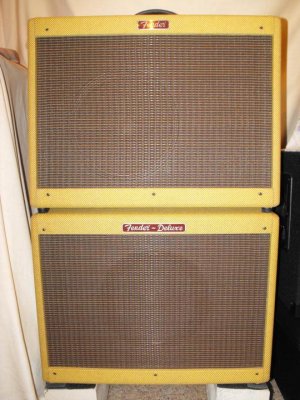
Re: Adding Cabinet to Combo Amp (creating a Stack)
Most of us would agree that a 212 combo just doesn't sound like a half stack. The combo of course, sits lower to the floor, and while that helps with bass response--the 412 closed back cab usually sounds a bit deeper and tighter in the low end. The closed back cab is probably more efficient, and projects better. But the combo has some advantages too: the sound is airier and more diffuse, and having sound waves coming out of the back of the cab can actually help the other band members hear you better on those tight, cramped stages. Some guys like the combo sound; others prefer closed back cabs.
I think I first read about combining open and closed back cabs in an early '70s Guitar Player Magazine article about Duane Allman, who'd have his techs cut a hole in the back of Marshall 412 top cabinets to get that airier tone. And I've seen some pics of his "Live At The Fillmore" rig with these cabs.
Then in the mid-'80s, Mesa comes up with their Half-Back cabs. I remember pouring over their catalogs and thinking that it was a cool idea at the time, though I certainly did not have a need for a big 412 cab at the time. These Mesa cabs are very compact and designed with an open-back top and a closed-back bottom. On the 212 version, the bottom part is Thiele-ported, for better efficiency and tighter control of the bass frequencies. And typically, these cabs used different speakers in the top and bottom sections. Most commonly, you'll find a Mesa-enhanced Celestion C-90 Black Shadow in the open top section. (All of the Mesa speakers that they doctor are referred to as "Black Shadows.) The closed part of the cab would have 212 EVMs. The EVMs are a fairly wide-range and neutral-sounding speaker, and they handle lots of low-end and are rated at 200wrms. The C-90 has that lovely British snarl and bite that Celestions are known for, so it's a very nifty combination. Mesa also used a 50-watt Jensen made speaker referred to as "Vintage", and then the Eminence-made MS-12 speaker, rated at 150-watts and known for it's smooth mid-range, ala the JBL-D/E-120s. Or you could order the Half-Back with all the same speakers. Keep in mind that these cabs were down-right revolutionary back in the day.
Fast Forward to the mid-'90s. Before I owned a Mesa amp and cab, I was using a Marshall JCM 800 for a while, the 4010, the 50-watt EL-34 112 combo with a single channel, MV, no reverb. Great sounding little amp, when cranked. Around this time, I bought a couple of mid-'60s BF Fender 212 cabs, a Bassman and a Band Master. The were unloaded, and I got them really cheap--but I had no idea what I was going to use them for. But I had owned a BF Band Master rig years before, and I knew these 212 cabs were some of the best around. I found a good deal on a pair of Dean Markley-branded Eminence speakers--the same speaker as Mesa's MS-12, and stuck them in the Band Master cab. They sounded great, but that cab now weighed 3,417 lbs.! And when my band did a gig in a larger, louder club--I decided to use the Marshall combo with that Band Master cab--and that was an EPIPHANY!! WOW! It just sounded so much deeper and fuller; and those smooth Eminence speakers combined with that single 12" Celestion--it was magic. The Marshall is one of those amps that really needs to be opened up and on a stage--and that night proved it.
Yet, for some of the things and gigs my band was doing, the Marshall just didn't deliver the tones I needed. I was so fortunate that I scored a FABULOUS deal on a Mesa Mark III 200-watt Coliseum head, and then three days later--I found a matching 412 C-90/EVM Half-Back cab. Sonic heaven!!! My other guitar player had gone through a bunch of amps: Super Reverb, Peavey Rock Master, Marshall, Ampeg, 5150, Fender--and still unhappy. And here I was just totally digging the Mesa. My playing dramatically improved, and I started getting compliments on my tone...which started pissing him off, and he finally quit the band. Good riddance.
But the Mesa half-stack was really too big for some gigs. I needed another combo. Well, again, God answered my prayers and dropped a nearly new Mesa DC-3 112 V30 Combo practically in my lap for an unbelievable price! It has a really different tone than the Mark III due mostly to the 4xEL84 design. It's rated at 35-watts, but it can easily compete with a bigger amp. And of course, now I'm running into gigs where the half-stack is too big, and combo not quite enough....and again, I found a deal on a Mesa 112 open-back cab to match the combo. Bingo!
Now, one of the big advantages of a half-stack over a combo is that the controls are much closer to eye level and easier to adjust. Some guys will deal with this by putting the combo on a stand or chair, and while this makes the knobs easier to see, there are drawbacks. Putting the amp higher is probably going to have your guitar amp leaking into the vocal mics; and you'll lose bass response with your amp off the floor. I can usually deal with the leakage problem with careful placement of my amp, but setting my combo amp on an extension cab gives me one speaker coupled to the floor boundary and helps reinforce the low-end. And with my near-sightedness and back problems, having the controls closer made having the combo+cab a total win.
I have to admit, the Mark III half-stack is still my favorite amp to play through, if I can get the Master Volume above 2.5. This amp is just so dynamic, full and punchy, and it sounds great with all of my guitars. And when a blonde Tolex Mark III 112 EVM combo popped up at my local Guitar Center, I pulled the trigger faster than Wyatt Earp at the OK Corral. AND, it had the matching 112 EVM Thiele cab. The big 200-watt head is all about power and punch, but this Simul-Class combo has a certain sweetness to it that is softer than the Coliseum head. And by itself, well--it sounds like a combo version--smaller, less bass, etc.
But add that 112 Thiele cab with the combo on top, and it is a whole different animal. With the two EVMs the sound is natural, open, full. The Thiele adds a lot of low end punch and projection, and it's coupled to the floor. I've got 75-watts of power, switchable to about 15; and my speakers can handle 400-watts efficiently...more than most full-stack cabs. I've got the low-end punch; I've got the airy top-end. And the stage footprint is smaller than that of a Deluxe Reverb; with the controls all nicely sitting at eye level. The guy at the jam that wants to get into a volume war pissing match with me and my little rig is in for a rude awakening. You want to assault me? Hello...meet my little Glock 30 with ten rounds of .45 caliber that fits in my pocket!
The Mark III combo led to an Mark IV with another matching Thiele, and now the Mark V. I tried the Mark V head but decided to get the combo, since I'm not doing many gigs where I need the 412 anymore. And as soon as I got it I started looking for the matching Mesa 112 Wide-body Closed Back cab, which is Thiele ported. Mine was ordered with the V30 speaker, and it really compliments the C-90 in the combo. Couldn't be more pleased--I actually like the tone better than the head on the 412 Recto cab.
So that's my journey. I am a HUGE fan of the combo on top of a extension cab. I'm surprised more guys don't do it. One of my friends was totally amazed with his DRRI on top of one of my EVM Thiele cabs. Several manufacturers make them for their amps: I know Marshall and Peavey did, but you really had to look for them. Peavey had/has a matching cab for the Classic 30, and the cool thing about the Peavey cab was you could use it closed back, or remove the top section and run it open-back. Running it closed really changes the character of that amp. They also do one for the Bandit, with the same feature, and I tell all my friends with Bandits to hunt down one of these cabs. I've known guys that used Ampeg VT-22s on Ampeg 412s; Music Man 210-130s on Music Man 212 or 412 cabs; Twin Reverbs on Bassman/Band Master cabs; and one of my favorite players used a Fender Pro Reverb with D-120s on top of a big Dual Showman 215 D-130 cab--AWESOME!!!
I really like what Mesa has done with this concept. It really allows you to mix and match speakers, getting the right speaker for the open-back combo, and the right speaker for the closed-back extension. It truly is the best of both worlds. And some companies take it even further, like Fender with the 310 Vibro King combo--it's matching extention cab is a 212. I've seen Pete Townsend using this rig, and it looks and sounds pretty formidable. I know guys that use their combos on top of 412s, or run a 312 rig like I did with that old Marshall. Honestly though, I have to admit I like the look of a matching cab, but not everyone will feel the need to do it that way. There are options--closed vs. open, different vs. same speakers, etc. Evaluate your needs and decide accordingly.
I think in the long run, having a matching extension cab adds a lot of value to your rig. Yes, it looks cool, and it makes it more desirable. No, you might not need to use it all the time, but when you need it, you'll REALLY need it, and having it on hand will prove to be a smart move.
I hope this helps. Good luck!
Bill