Another "why is this wiring diagram done like this?" question

Jack_TriPpEr

Well-known member
In the lower part of this diagram (the one that splits the humbucker to the adjustable/outer coil), would it make any difference if the Red and Green wires were swapped with each other? I am thinking "no" (?)
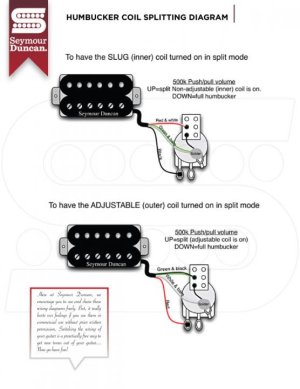
WD_Coil_Splitting.jpg
 
Re: Another "why is this wiring diagram done like this?" question

The two coils would then be out of phase with each other, right?
 
Re: Another "why is this wiring diagram done like this?" question

In the lower part of this diagram (the one that splits the humbucker to the adjustable/outer coil), would it make any difference if the Red and Green wires were swapped with each other? I am thinking "no" (?)

In a one pickup guitar, no. With two pickups swapping the red and green wires on one pickup will put it electronically out of phase with the other pickup.

Edit: When I wire a pickup to split to the screw coil, I use the typical red and white pair with the green grounded and black connected to the pot input lug. I then connect a jumper between the pot input and the closest switch lug. With the pot down, you get your usual series wiring. With the pot pulled, the red gets connected to the pot input and the slug coil is shorted start to finish.
 
Last edited:
Re: Another "why is this wiring diagram done like this?" question

The two coils would then be out of phase with each other, right?

Yes.

In a one pickup guitar, no.

No, no, no. You missed what he asked. On the bottom diagram, if you reverse red & green, that pup will be out-of-phase, (reverse polarity), with itself, in the normal series mode. It will be thin and lifeless when used by itself. When split, it will be ok by itself, but again, thin and weak when used with the other pup.

Which begs the question . . . why does the OP want to deviate from the original, (working), configuration?
 
Re: Another "why is this wiring diagram done like this?" question

In a one pickup guitar, no. With two pickups swapping the red and green wires on one pickup will put it electronically out of phase with the other pickup.

Edit: When I wire a pickup to split to the screw coil, I use the typical red and white pair with the green grounded and black connected to the pot input lug. I then connect a jumper between the pot input and the closest switch lug. With the pot down, you get your usual series wiring. With the pot pulled, the red gets connected to the pot input and the slug coil is shorted start to finish.

I am having trouble picturing the jumper setup you described.

"I use the typical red and white pair with the green grounded and black connected to the pot input lug." This sounds like what is depicted in the top half of the pic i posted (?) Also, which lug on the push-pull are you referring to as "the closest one"?
 
Re: Another "why is this wiring diagram done like this?" question

No, no, no. You missed what he asked. On the bottom diagram, if you reverse red & green, that pup will be out-of-phase, (reverse polarity), with itself, in the normal series mode. It will be thin and lifeless when used by itself. When split, it will be ok by itself, but again, thin and weak when used with the other pup.

Which begs the question . . . why does the OP want to deviate from the original, (working), configuration?

Good catch. I was thinking of what would happen with the green to hot, black to ground, and red/white together.
 
Re: Another "why is this wiring diagram done like this?" question

I am having trouble picturing the jumper setup you described.

"I use the typical red and white pair with the green grounded and black connected to the pot input lug." This sounds like what is depicted in the top half of the pic i posted (?) Also, which lug on the push-pull are you referring to as "the closest one"?

This is a Jimmy Page diagram, but the neck pickup is wired like I described:
adWOlOr.png
 
Re: Another "why is this wiring diagram done like this?" question

Yes.


No, no, no. You missed what he asked. On the bottom diagram, if you reverse red & green, that pup will be out-of-phase, (reverse polarity), with itself, in the normal series mode. It will be thin and lifeless when used by itself. When split, it will be ok by itself, but again, thin and weak when used with the other pup.

Which begs the question . . . why does the OP want to deviate from the original, (working), configuration?

Artie, thanks but no, i do not want to deviate. I just did not understand why red wire was being used as a hot lead instead of green..... and i can't say i actually understand yet why reversing red and green would make the humbucking mode out of phase other than you said it would... but i will ponder it further
 
Re: Another "why is this wiring diagram done like this?" question

Artie, thanks but no, i do not want to deviate. I just did not understand why red wire was being used as a hot lead instead of green..... and i can't say i actually understand yet why reversing red and green would make the humbucking mode out of phase other than you said it would... but i will ponder it further

SD's standard color codes are:
GREEN = start of adjustable/south coil
RED = finish of adjustable/south coil
BLACK = start of stud/north coil
WHITE = finish of stud/north coil

In their standard series humbucker wiring, they connect the to finish wires together, with one of the start wires(black) as output and the other(green) as ground. The diagram uses red as output because it's pairing the green and black together instead of the typical red and white pair.
 
Re: Another "why is this wiring diagram done like this?" question

SD's standard color codes are:
GREEN = start of adjustable/south coil
RED = finish of adjustable/south coil
BLACK = start of stud/north coil
WHITE = finish of stud/north coil

In their standard series humbucker wiring, they connect the to finish wires together, with one of the start wires(black) as output and the other(green) as ground. The diagram uses red as output because it's pairing the green and black together instead of the typical red and white pair.

Agreed, but i was wondering why the diagram was pairing black and green together in the first place, vs red and black. And Artie is saying the reason why, is in order to avoid phase issues. Which i am sure Artie is correct , i just need fo study it further in order to "see it".
 
Re: Another "why is this wiring diagram done like this?" question

Yes.


No, no, no. You missed what he asked. On the bottom diagram, if you reverse red & green, that pup will be out-of-phase, (reverse polarity), with itself, in the normal series mode. It will be thin and lifeless when used by itself. When split, it will be ok by itself, but again, thin and weak when used with the other pup.

Which begs the question . . . why does the OP want to deviate from the original, (working), configuration?

So, i looked at it further, and i don't get it. If in the first diagram where the pickup splits to inner coil -that one does not have phase issues if the North *start* wire is the one that is used as a Hot Lead, why is it a phase issue in the other diagram to use the other "start" wire (green) as the Hot lead?.. just trying to gain an understanding...
 
Re: Another "why is this wiring diagram done like this?" question

So, i looked at it further, and i don't get it. If in the first diagram where the pickup splits to inner coil -that one does not have phase issues if the North *start* wire is the one that is used as a Hot Lead, why is it a phase issue in the other diagram to use the other "start" wire (green) as the Hot lead?.. just trying to gain an understanding...

If you only flip the wires of one coil (red and green), but not the other (black and white) you will put one coil out of phase with the other coil.
 
Re: Another "why is this wiring diagram done like this?" question

If you only flip the wires of one coil (red and green), but not the other (black and white) you will put one coil out of phase with the other coil.

Yes, everyone has been saying that, but not *why* that is the case.

This article at 1728.com helped me understand why. Particularly, that the windings on each coil are NOT actually wound reverse to each other as i thought. Instead, it is how the current is directed through each coil via the wiring connection choices that determines whether the two coils are electrically reverse from each other or not. Note that the diagrams in this article use Dimarzio's wire coloring codes, not Seymour Duncan's

So in the part of the diagram i posted originally that i was asking about, if Green wire were made to be the hot lead, this would have the current travel clockwise through the South coil to reach the Red wire. The way current flows after that through the North coil because Red would be connected to Black would result in the North coil also having a clockwise direction of current travel. That would result in an out of phase result, because the direction of current travel through the two coils needs to be opposite /"reverse" of each other.
 
Re: Another "why is this wiring diagram done like this?" question

Yes, everyone has been saying that, but not *why* that is the case.
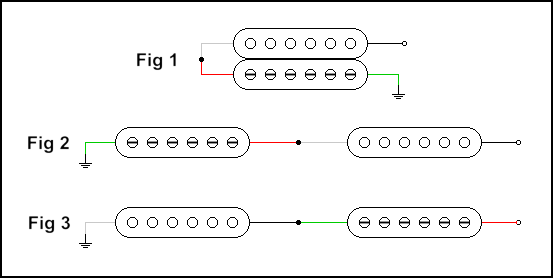
The only reason for the seemingly "reverse" wiring is to make it a teeny bit easier to wire the split switch. Doing it this way allows both pickups to be split by shorting the series link to ground, in order to split to the two different coils. The same thing could also have been accomplished by using the normal wiring, and shorting the red/white pair to "hot", or black.

Think of it like this. Fig 1 shows normal humbucker wiring. I can rotate the bottom coil around, (for illustration purposes), so that both coils are in a straight line. (Fig 2) I haven't changed anything electrically. Now I can change the physical position of the two coils as in fig 3. As long as both black and red point toward positive, and green and white point toward ground, I haven't changed anything electrically, or polarity. But now you can see that grounding the red/white of fig 2 shorts out the screw coil, and grounding the green/black of fig 3 shorts out the stud coil.

Does that make sense, or did I confuse you more? :)

Humbucker_split.png
 
Re: Another "why is this wiring diagram done like this?" question

The only reason for the seemingly "reverse" wiring is to make it a teeny bit easier to wire the split switch. Doing it this way allows both pickups to be split by shorting the series link to ground, in order to split to the two different coils. The same thing could also have been accomplished by using the normal wiring, and shorting the red/white pair to "hot", or black.

Think of it like this. Fig 1 shows normal humbucker wiring. I can rotate the bottom coil around, (for illustration purposes), so that both coils are in a straight line. (Fig 2) I haven't changed anything electrically. Now I can change the physical position of the two coils as in fig 3. As long as both black and red point toward positive, and green and white point toward ground, I haven't changed anything electrically, or polarity. But now you can see that grounding the red/white of fig 2 shorts out the screw coil, and grounding the green/black of fig 3 shorts out the stud coil.

Does that make sense, or did I confuse you more? :)

View attachment 99214

Artie, thanks, but honestly the transition from Figure 2 to Figure 3 in your example would not have made sense to me if i had not already read the 1728.com article that covers direction of current flow and how that impacts the "wind" result for each coil.
 
Last edited:
Re: Another "why is this wiring diagram done like this?" question

The two versions split to different coils, which keeps them humbucking if you have both pickups on and split. The other benefit of the two versions is by reversing the wires in the second drawing, now both splits are done by grounding, which means you could split to different coils using a simpler wiring of the same switch, eg one half of the switch splits the bridge to slug and the other side of the switch splits the neck to screw coil, both simply going to ground at the same time.
 
Re: Another "why is this wiring diagram done like this?" question

The only reason for the seemingly "reverse" wiring is to make it a teeny bit easier to wire the split switch. Doing it this way allows both pickups to be split by shorting the series link to ground, in order to split to the two different coils. The same thing could also have been accomplished by using the normal wiring, and shorting the red/white pair to "hot", or black.

Think of it like this. Fig 1 shows normal humbucker wiring. I can rotate the bottom coil around, (for illustration purposes), so that both coils are in a straight line. (Fig 2) I haven't changed anything electrically. Now I can change the physical position of the two coils as in fig 3. As long as both black and red point toward positive, and green and white point toward ground, I haven't changed anything electrically, or polarity. But now you can see that grounding the red/white of fig 2 shorts out the screw coil, and grounding the green/black of fig 3 shorts out the stud coil.

Does that make sense, or did I confuse you more? :)

View attachment 99214

This is one of the best diagrams (of the many) you’ve made. This made it instantly understandable when you originally posted it.
 
Re: Another "why is this wiring diagram done like this?" question

Thank you. They say a pictures worth 1000 words. ;)
 
Back
Top