
You are using an out of date browser. It may not display this or other websites correctly.
You should upgrade or use an alternative browser.
You should upgrade or use an alternative browser.
Any Guild Bluesbird people?
- Thread starter StratTom
- Start date

Chickenwings
Alnico 6/8
Re: Any Guild Bluesbird people?
i had one..this was is it:

Superb playing and sounding guitar. Pickups (SD59s) sounded perfect.
Why did i sell it?
I like a bigger body for my playing comfort so i got a 335, but the guild is a wonderful instrument. Incredibly resonant and responsive. Great controllable feedback too if you want it.
If you like small axes like les pauls then yeah, its a killer.
Also, people always asked me what was the killer axe. Not a common bird, so it gets great cred points too!
i had one..this was is it:
Superb playing and sounding guitar. Pickups (SD59s) sounded perfect.
Why did i sell it?
I like a bigger body for my playing comfort so i got a 335, but the guild is a wonderful instrument. Incredibly resonant and responsive. Great controllable feedback too if you want it.
If you like small axes like les pauls then yeah, its a killer.
Also, people always asked me what was the killer axe. Not a common bird, so it gets great cred points too!
Re: Any Guild Bluesbird people?
Hey Ismet,
Thanks for posting that Bluesbird routing illustration. That seems very accurate, whether pertaining to Corona (California) Bluesbirds or Westerley (Rhode Island) Bluesbirds, such as mine. However, I have seen numerous illustrations of Gibson Les Paul weight relief chambering and they are much different from what you have posted here. So, I am not sure if the one you posted was one particular model, or if it was the way it was done at one particular phase. The weight relief I have seen is done in smaller, circular routing through various parts of the mahogany, and according to Gibson, they researched the process for a long time, trying different sized and shaped routes through various locations throughout the body in an attempt to minimize any significant sound alterations. Despite that, if one listens closely, one will hear a difference in the routed and unrouted models.
I like the Guild Bluesbird and I like the Les Paul. They are quite different in sound and feel, in my opinion. I had one Bluesbird, a few years back, that had a very narrow neck. My current one has a bit more substantial neck, not too different from a Gibson ES-135 or ES-137 or a 59 profile neck.
In addition, most of the Bluesbirds I have owned came with slighter lower frets, leading me to believe that the Westerley models used a smaller fret crown; perhaps a residual of Guild's archtop "glory" days. I have had to refret both of the Bluesbirds I kept and played. Another thing, for some reason, I have found most Bluesbirds need to have the truss rod tightened almost to the maximum just to accomodate .011 strings. Perhaps that has been just my experience, but I have owned three and they all were that way. One I had to return to Buffalo Bros., just simply because I could not adjust the truss rod enough to accomodate .011s.
Every Bluesbird I have played, owned or heard had a much different tone than any model of Les Paul. They are brighter, snappier, and more resonant, and they lack the midrange power of the Les Paul.
Hey Ismet,
Thanks for posting that Bluesbird routing illustration. That seems very accurate, whether pertaining to Corona (California) Bluesbirds or Westerley (Rhode Island) Bluesbirds, such as mine. However, I have seen numerous illustrations of Gibson Les Paul weight relief chambering and they are much different from what you have posted here. So, I am not sure if the one you posted was one particular model, or if it was the way it was done at one particular phase. The weight relief I have seen is done in smaller, circular routing through various parts of the mahogany, and according to Gibson, they researched the process for a long time, trying different sized and shaped routes through various locations throughout the body in an attempt to minimize any significant sound alterations. Despite that, if one listens closely, one will hear a difference in the routed and unrouted models.
I like the Guild Bluesbird and I like the Les Paul. They are quite different in sound and feel, in my opinion. I had one Bluesbird, a few years back, that had a very narrow neck. My current one has a bit more substantial neck, not too different from a Gibson ES-135 or ES-137 or a 59 profile neck.
In addition, most of the Bluesbirds I have owned came with slighter lower frets, leading me to believe that the Westerley models used a smaller fret crown; perhaps a residual of Guild's archtop "glory" days. I have had to refret both of the Bluesbirds I kept and played. Another thing, for some reason, I have found most Bluesbirds need to have the truss rod tightened almost to the maximum just to accomodate .011 strings. Perhaps that has been just my experience, but I have owned three and they all were that way. One I had to return to Buffalo Bros., just simply because I could not adjust the truss rod enough to accomodate .011s.
Every Bluesbird I have played, owned or heard had a much different tone than any model of Les Paul. They are brighter, snappier, and more resonant, and they lack the midrange power of the Les Paul.
Re: Any Guild Bluesbird people?
Oh, and regarding chambering: If you read the history of Guild and how the Bluesbird came about, there was never an attempt to chamber a solid body for weight relief. Way back when they started (what would become) the Bluesbird, the Aristocrat (the name back then) was meant to be a smaller bodied archtop without f holes. It was, like other Guild models, essentially from a jazz tradition and it was designed to be a small archtop that was thin and easy to play standing up and so it would not feed back at higher volumes. That tradition held through the M-75 era and later into the Bluesbird era.
Oh, and regarding chambering: If you read the history of Guild and how the Bluesbird came about, there was never an attempt to chamber a solid body for weight relief. Way back when they started (what would become) the Bluesbird, the Aristocrat (the name back then) was meant to be a smaller bodied archtop without f holes. It was, like other Guild models, essentially from a jazz tradition and it was designed to be a small archtop that was thin and easy to play standing up and so it would not feed back at higher volumes. That tradition held through the M-75 era and later into the Bluesbird era.
I
iismet
Guest
Re: Any Guild Bluesbird people?
I am no Les Paul guru for sure. I've seen that picture on several Gibson forums. I am familiar with the lightening holes in the Les Paul.


I had read they started chambering. It seems like I once read the post where the owner had the guitar x-rayed and that is the chambered picture I posted. It is floating around the net at several locations. The wiring route is what lead me to belive it was a LP. Perhaps there is a LP person here that can set it straight.
Hey Ismet,
However, I have seen numerous illustrations of Gibson Les Paul weight relief chambering and they are much different from what you have posted here. So, I am not sure if the one you posted was one particular model, or if it was the way it was done at one particular phase. The weight relief I have seen is done in smaller, circular routing through various parts of the mahogany, and according to Gibson, they researched the process for a long time, trying different sized and shaped routes through various locations throughout the body in an attempt to minimize any significant sound alterations. Despite that, if one listens closely, one will hear a difference in the routed and unrouted models.
I am no Les Paul guru for sure. I've seen that picture on several Gibson forums. I am familiar with the lightening holes in the Les Paul.
I had read they started chambering. It seems like I once read the post where the owner had the guitar x-rayed and that is the chambered picture I posted. It is floating around the net at several locations. The wiring route is what lead me to belive it was a LP. Perhaps there is a LP person here that can set it straight.
I
iismet
Guest
Re: Any Guild Bluesbird people?
Found it -
http://www.gregterzian.com/2008/10/gibson-les-paul-chambering-my-verdict/
Found it -
http://www.gregterzian.com/2008/10/gibson-les-paul-chambering-my-verdict/

bluesbend
Lovely BIG Starologist
Re: Any Guild Bluesbird people?
Here's a couple of pics I found of some Bluesbirds. I never owned one but played one with P90's at a Musician's Friend store years ago and was impressed with it.
View attachment 25864
View attachment 25865
Here's a couple of pics I found of some Bluesbirds. I never owned one but played one with P90's at a Musician's Friend store years ago and was impressed with it.
View attachment 25864
View attachment 25865
Last edited:
Re: Any Guild Bluesbird people?
Responding to a fairly old thread here, but when searching the internet on the Guild Bluesbird, this page is one of the most frequent that shows up. The observations by emadis above are some of the best regarding the Bluesbird I have seen. Now in 2017 – 20 years after the first were produced – its important to note there are three versions of the Bluesbird – the Guild Westerly RI from 1997 to 1999 and then those produced in Corona Ca in the Fender factory. There is a new Korean production of a “Bluesbird” but it so different, and is more in the design of the earlier Guild Aristocrat, I do not think it really qualifies as the same instrument. What this is all about is the Westerly RI built BB and, to some extend the Fender Corona factor versions.
“What it is” or like is frequently asked by people interested in these. True, it has some archtop qualities and its important to note, Guild was never a big producer of solid body guitars – this guitar reflects that. I too find it to have a “punchy sound” and is a very dynamic guitar that can produce a wide range of sound through a modern amp – in some ways – more so than the Les Paul I play. My biggest embrace of the Bluesbird is the “definition” in the sound, being I can keep tone and distinction in the notes even with high distortion and volume. It has been noted to have a lack of midrange volume. I suspect this has to do more with the SD 59 pickup, which is the sound they were designed to produce. Adjusting the pole screws provided more balance on mine and with a modern amp (mine, like many, are now manipulated though a computer) midrange balance can be achieved. I would love to see what a Bluesbird would sound like with different pickup – but, I am not going to mess with a 20-year-old ax that sounds this good.
Some of the nuance of the BB – its big! A good bit bigger than a LP. The finger board has, what I would call a medium/small fret that is very good for chords and unbent notes. One place I prefer the LP – you can really bend the strings on a Les Paul -- like clubbing a Harp Seal and it just comes back barking for more. Part of this may be related to the relatively skinny neck of the BB. But this provides the advantage of reaching and striking base strings with your thumb. One thing about the neck, I can lower the action lower than any guitar I ever had and it will not buzz. So low, its too low and I have to raise it back up to make it more playable. Truly a first. Another issue I find is the bridge is a little far back and does not have a balanced cant angle. I can get all of my strings intonated, but some high strings are all the way forward. Overall, this guitar has a “delicate” feel to it and is a bit of a “lady” as compared to a Les Paul that is more of a Hell’s Angles biker. The workmanship on my Westerly is very high quality and more like a custom shop product - and that does not always mean perfect. It is a bit "no frills" with minimal inlays and extras. The look of the BB is , to me, is the sexiest guitar I have ever seen.
I would double up on the BB not being, as often described as a cross between a Les Paul and a 335. These are Gibson guitars, you cannot cross them and get a Guild. Again, Guild being more of an acoustic, arch top builder, Bluesbird is more of an evolution of Guild style into mainstream, pop culture guitar. The design evolution is tracks along the Guild Aristocrat -> Guild Nightbird -> Guild Bluesbird. So, hopefully, people will read this and stop using the LP/335 analogy that has become pervasive. Bluesbird is a "Guild." Best description you can make as to what it is like. Take a 335 and cover the sound holes -- that may give a fair sound comparison as to similarity. I have an LP and a BB that hand side by side and you can see the body styles are very different. Also, the BB has lower degree bend in the headstock, making it stronger and more likely to stay intune than the LP. If you have ever played both at the same time, you would see they are vastly different.
A part of the mystique of the BB is its historical origins as a company literally created as a rebellion to the Gibson, Epiphone merger. Up to 1999, was a uniquely American company operating in a small New England town. 20 years gone, it represents a part of music history that is lost to nostalgia.
Music? I can play most anything on this guitar and its range versatility is incredible. I can get it to sound virtually the same as an amplified acoustic. On the other side, the definition in this guitar is killer when put to heavy metal sounds – very unexpected – I preferred it over active pickups in an LP. Last, Guild was the primary producer of the authorized Brian May models that preceded the BB. The similarities are obvious (hollow/chambered) – playing on top of a Brian May track – I can get it almost identical.
People wonder why more musicians do not play a BB. The answer is simple, most people have never even seen one. When I had my frets filed, the top luthier in my city of a million people had never even seen one. Today on Reverb.com – there are over 4500 Fender Stratocasters for sale. There were 13 Guild Bluesbirds – only one was clearly a Westerly RI model. Not sure how many BB were made in total but my understanding there were only about 860 produced the first full year of production. So, it’s not common. Yes, it’s not a Fender or a Gibson – and in a Coke and Pepsi world it’s hard to get excited about more of the same. Because it's not a Gibson, and an exceptional musical instrument, is a great reason to buy one. If Gibson made a LP to the same standards today, it would be a $4000 instrument, or more.
I will say, BB is potentially one of the best guitars to move from clean sound to distortion, as is common in modern music. Check out this video of Eve 6 to see one in action:
https://www.youtube.com/watch?v=N09MJtWa198
The Bluesbird is a snappier, more resonant and far less dense of a sound than the Les Paul. ..<>.... It has a really good sound, but it is nothing like a Les Paul or an ES-335 even. It is much less dense and midrangey than even the ES-335.
<>.
Responding to a fairly old thread here, but when searching the internet on the Guild Bluesbird, this page is one of the most frequent that shows up. The observations by emadis above are some of the best regarding the Bluesbird I have seen. Now in 2017 – 20 years after the first were produced – its important to note there are three versions of the Bluesbird – the Guild Westerly RI from 1997 to 1999 and then those produced in Corona Ca in the Fender factory. There is a new Korean production of a “Bluesbird” but it so different, and is more in the design of the earlier Guild Aristocrat, I do not think it really qualifies as the same instrument. What this is all about is the Westerly RI built BB and, to some extend the Fender Corona factor versions.
“What it is” or like is frequently asked by people interested in these. True, it has some archtop qualities and its important to note, Guild was never a big producer of solid body guitars – this guitar reflects that. I too find it to have a “punchy sound” and is a very dynamic guitar that can produce a wide range of sound through a modern amp – in some ways – more so than the Les Paul I play. My biggest embrace of the Bluesbird is the “definition” in the sound, being I can keep tone and distinction in the notes even with high distortion and volume. It has been noted to have a lack of midrange volume. I suspect this has to do more with the SD 59 pickup, which is the sound they were designed to produce. Adjusting the pole screws provided more balance on mine and with a modern amp (mine, like many, are now manipulated though a computer) midrange balance can be achieved. I would love to see what a Bluesbird would sound like with different pickup – but, I am not going to mess with a 20-year-old ax that sounds this good.
Some of the nuance of the BB – its big! A good bit bigger than a LP. The finger board has, what I would call a medium/small fret that is very good for chords and unbent notes. One place I prefer the LP – you can really bend the strings on a Les Paul -- like clubbing a Harp Seal and it just comes back barking for more. Part of this may be related to the relatively skinny neck of the BB. But this provides the advantage of reaching and striking base strings with your thumb. One thing about the neck, I can lower the action lower than any guitar I ever had and it will not buzz. So low, its too low and I have to raise it back up to make it more playable. Truly a first. Another issue I find is the bridge is a little far back and does not have a balanced cant angle. I can get all of my strings intonated, but some high strings are all the way forward. Overall, this guitar has a “delicate” feel to it and is a bit of a “lady” as compared to a Les Paul that is more of a Hell’s Angles biker. The workmanship on my Westerly is very high quality and more like a custom shop product - and that does not always mean perfect. It is a bit "no frills" with minimal inlays and extras. The look of the BB is , to me, is the sexiest guitar I have ever seen.
I would double up on the BB not being, as often described as a cross between a Les Paul and a 335. These are Gibson guitars, you cannot cross them and get a Guild. Again, Guild being more of an acoustic, arch top builder, Bluesbird is more of an evolution of Guild style into mainstream, pop culture guitar. The design evolution is tracks along the Guild Aristocrat -> Guild Nightbird -> Guild Bluesbird. So, hopefully, people will read this and stop using the LP/335 analogy that has become pervasive. Bluesbird is a "Guild." Best description you can make as to what it is like. Take a 335 and cover the sound holes -- that may give a fair sound comparison as to similarity. I have an LP and a BB that hand side by side and you can see the body styles are very different. Also, the BB has lower degree bend in the headstock, making it stronger and more likely to stay intune than the LP. If you have ever played both at the same time, you would see they are vastly different.
A part of the mystique of the BB is its historical origins as a company literally created as a rebellion to the Gibson, Epiphone merger. Up to 1999, was a uniquely American company operating in a small New England town. 20 years gone, it represents a part of music history that is lost to nostalgia.
Music? I can play most anything on this guitar and its range versatility is incredible. I can get it to sound virtually the same as an amplified acoustic. On the other side, the definition in this guitar is killer when put to heavy metal sounds – very unexpected – I preferred it over active pickups in an LP. Last, Guild was the primary producer of the authorized Brian May models that preceded the BB. The similarities are obvious (hollow/chambered) – playing on top of a Brian May track – I can get it almost identical.
People wonder why more musicians do not play a BB. The answer is simple, most people have never even seen one. When I had my frets filed, the top luthier in my city of a million people had never even seen one. Today on Reverb.com – there are over 4500 Fender Stratocasters for sale. There were 13 Guild Bluesbirds – only one was clearly a Westerly RI model. Not sure how many BB were made in total but my understanding there were only about 860 produced the first full year of production. So, it’s not common. Yes, it’s not a Fender or a Gibson – and in a Coke and Pepsi world it’s hard to get excited about more of the same. Because it's not a Gibson, and an exceptional musical instrument, is a great reason to buy one. If Gibson made a LP to the same standards today, it would be a $4000 instrument, or more.
I will say, BB is potentially one of the best guitars to move from clean sound to distortion, as is common in modern music. Check out this video of Eve 6 to see one in action:
https://www.youtube.com/watch?v=N09MJtWa198
Last edited:
Re: Any Guild Bluesbird people?
TBH, when they first came out, I was a die hard Charvel/Jackson/kramer guy.. I had NO love for a "foggie" guitar like a LP or strat or tele. Especially a copy of one . But, since Ive seen the light and realized the sonic benefits of these classics, Ive grown to love em and really grown to love the bluesbirds.. Rarely do I see em up for sale. Ive never had the cnance to play one, but would love the chance. Its a shame they didnt "catch on" cuz it seem like those who did discover them are pretty rabid about them
TBH, when they first came out, I was a die hard Charvel/Jackson/kramer guy.. I had NO love for a "foggie" guitar like a LP or strat or tele. Especially a copy of one . But, since Ive seen the light and realized the sonic benefits of these classics, Ive grown to love em and really grown to love the bluesbirds.. Rarely do I see em up for sale. Ive never had the cnance to play one, but would love the chance. Its a shame they didnt "catch on" cuz it seem like those who did discover them are pretty rabid about them

Re: Any Guild Bluesbird people?
I used to sell these. They are not as midrange honky as a Les Paul. They do have a brighter more open tone. They do however sustain like a neck thru should. What I liked about them is this.............
With a high gain amp they work well because they don't really color the tone of the amp as much as per say a guitar with active pickups or a heavy mahogany body does.
they do have a cool jazz tone or bluesy tone. Its the way its built, its a lighter resonating and sustain tone. Thats not good or bad its just a cool different tone.
If you like the fat mahogany midrange tone this can get close but its never gunna be a Gibson SG or Les Paul crushing midrange tone. Its just a more open but still solid tone.
If you have a Les Paul already you may enjoy the tone spread between that and having this too as a Les Paul will never sound like this ether. Having both gives you a wide range of tones.
Some of the last ones made were not finished all that well, there is things like fret work or glue spots on the fret board. It can be fixed but its an added expense if it bugs ya.
It will never play Black Sabbath or Judis Priest like a solid Mahogany mid range monster does but it has a cool distinct voice like a lighter brighter tone not quite a strat but still lighter and more open than a Les Paul.
I used to sell these. They are not as midrange honky as a Les Paul. They do have a brighter more open tone. They do however sustain like a neck thru should. What I liked about them is this.............
With a high gain amp they work well because they don't really color the tone of the amp as much as per say a guitar with active pickups or a heavy mahogany body does.
they do have a cool jazz tone or bluesy tone. Its the way its built, its a lighter resonating and sustain tone. Thats not good or bad its just a cool different tone.
If you like the fat mahogany midrange tone this can get close but its never gunna be a Gibson SG or Les Paul crushing midrange tone. Its just a more open but still solid tone.
If you have a Les Paul already you may enjoy the tone spread between that and having this too as a Les Paul will never sound like this ether. Having both gives you a wide range of tones.
Some of the last ones made were not finished all that well, there is things like fret work or glue spots on the fret board. It can be fixed but its an added expense if it bugs ya.
It will never play Black Sabbath or Judis Priest like a solid Mahogany mid range monster does but it has a cool distinct voice like a lighter brighter tone not quite a strat but still lighter and more open than a Les Paul.
Corporal Clegg
New member
Re: Any Guild Bluesbird people?
I had one from 1975 to 1977. It was my second guitar after a Gretsch Korvette. Sunburst. I traded it as part of a deal for my first car--a 1970 Plymouth Road Runner meep-meep. Tje Blue Bird sounded good but the build was off where the bridge was not centered and the strings came close to the edge on the high E side. I'm sure it had bounced around before I got it. It wasn't new when I got it. Plus, obviously I didn't know my way around guitars yet or I would have spotted that flaw and balked. I also had a Guild Starfire Bass--acquired about 1980. It was a great short-scale bass that was perfect for the Clash's "The Magnificent Seven" from Sandinista which I did in a cover band at the time.
I had one from 1975 to 1977. It was my second guitar after a Gretsch Korvette. Sunburst. I traded it as part of a deal for my first car--a 1970 Plymouth Road Runner meep-meep. Tje Blue Bird sounded good but the build was off where the bridge was not centered and the strings came close to the edge on the high E side. I'm sure it had bounced around before I got it. It wasn't new when I got it. Plus, obviously I didn't know my way around guitars yet or I would have spotted that flaw and balked. I also had a Guild Starfire Bass--acquired about 1980. It was a great short-scale bass that was perfect for the Clash's "The Magnificent Seven" from Sandinista which I did in a cover band at the time.

 ... Well, of course this is "The Guitar Shop"...
Corporal Clegg
New member
Re: Any Guild Bluesbird people?
It's April 2017. I just took delivery of a new Guild Bluesbird "antique burst". I had a Bluesbird back in the day from '75-'77 and traded it with cash for my first set of wheels--a 1970 Plymouth "Road Runner"--from a close friend. I'm going on 62 now and seeing these Bluesbirds in action on YouTube, I was sold that I needed to come home to Guild. Let me tell you, these are knock out guitars. I have a nice Schecter A-6 and a G&L ASAT Classic in which I installed a Fishman Fluence Greg Koch signature "Gristle Tone" system of pups and guts and thought I had the bases covered. But this Bluesbird is so awesome (I think in largest part to the Seymour Duncan pups) that I'd go up against any Les Paul. I think South Korea must have put the best of their best to work on these. They are recording and performance ready. There is no want for anything. For $999 I feel I have a performer that can stand up against $3500 Americans.
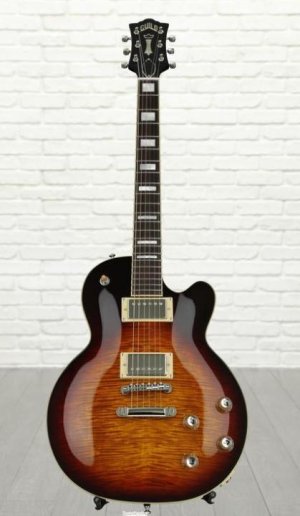
It's April 2017. I just took delivery of a new Guild Bluesbird "antique burst". I had a Bluesbird back in the day from '75-'77 and traded it with cash for my first set of wheels--a 1970 Plymouth "Road Runner"--from a close friend. I'm going on 62 now and seeing these Bluesbirds in action on YouTube, I was sold that I needed to come home to Guild. Let me tell you, these are knock out guitars. I have a nice Schecter A-6 and a G&L ASAT Classic in which I installed a Fishman Fluence Greg Koch signature "Gristle Tone" system of pups and guts and thought I had the bases covered. But this Bluesbird is so awesome (I think in largest part to the Seymour Duncan pups) that I'd go up against any Les Paul. I think South Korea must have put the best of their best to work on these. They are recording and performance ready. There is no want for anything. For $999 I feel I have a performer that can stand up against $3500 Americans.
Similar threads

- Replies
- 15
- Views
- 570
- Replies
- 7
- Views
- 239
- Replies
- 10
- Views
- 509


- Replies
- 37
- Views
- 2K
