ItsaBass
New member
Re: Any issues w converting a 500K pot into a 100K pot for use as a Spin-a-Split
As for what makes no load a redundancy, I would say it depends on the output of the pickup, but 500K is a safe starting value that seems to allow the full output of your typical humbucker without needing a no load pot.
I hear the split immediately when I roll down the 500K linear in my Jazz Bass, which is about 9K per coil, A5 powered. It's not bottom loaded at all. But again, you can choose your taper to suit your own taste. You have audio, reverse audio, and linear, which covers any tweaks you want to do to the taper.
It isn't a question of what's right, but of what gives you the result you want. You can use any resistance value and any taper. You just need to understand what each parameter does to change things, so you can build the split to your own taste.
If you find the control top loaded, then you probably want linear or reverse audio. If you find the control bottom loaded, then you probably want audio taper.
Resistance value has more to do with the "starting point" of the split than it has to do with the taper. Obviously the starting and ending points are points on the taper curve of a pot...but they are only the extreme end points. It's the taper that determines what falls where along the pot's sweep.
Summarizing -tell me if i am misconstruing here:
Clint and ItsaBass seem to confirm that 500K resistance is enough to allow both coils to be fully engaged in series mode - and hence no need for a No Load feature, but Clint says 500K is not enough resistance to have a normal taper. Clint says a higher pot value - like 50K - fixes the taper.
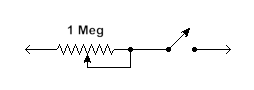
If i construed that correctly, then 1 Meg pot - without a No Load feature - seems to handle all concerns (?)
As for what makes no load a redundancy, I would say it depends on the output of the pickup, but 500K is a safe starting value that seems to allow the full output of your typical humbucker without needing a no load pot.
I hear the split immediately when I roll down the 500K linear in my Jazz Bass, which is about 9K per coil, A5 powered. It's not bottom loaded at all. But again, you can choose your taper to suit your own taste. You have audio, reverse audio, and linear, which covers any tweaks you want to do to the taper.
It isn't a question of what's right, but of what gives you the result you want. You can use any resistance value and any taper. You just need to understand what each parameter does to change things, so you can build the split to your own taste.
If you find the control top loaded, then you probably want linear or reverse audio. If you find the control bottom loaded, then you probably want audio taper.
Resistance value has more to do with the "starting point" of the split than it has to do with the taper. Obviously the starting and ending points are points on the taper curve of a pot...but they are only the extreme end points. It's the taper that determines what falls where along the pot's sweep.
Last edited: