Any issues w converting a 500K pot into a 100K pot for use as a Spin-a-Split

Re: Any issues w converting a 500K pot into a 100K pot for use as a Spin-a-Split

Summarizing -tell me if i am misconstruing here:
Clint and ItsaBass seem to confirm that 500K resistance is enough to allow both coils to be fully engaged in series mode - and hence no need for a No Load feature, but Clint says 500K is not enough resistance to have a normal taper. Clint says a higher pot value - like 50K - fixes the taper.

If i construed that correctly, then 1 Meg pot - without a No Load feature - seems to handle all concerns (?)

As for what makes no load a redundancy, I would say it depends on the output of the pickup, but 500K is a safe starting value that seems to allow the full output of your typical humbucker without needing a no load pot.

I hear the split immediately when I roll down the 500K linear in my Jazz Bass, which is about 9K per coil, A5 powered. It's not bottom loaded at all. But again, you can choose your taper to suit your own taste. You have audio, reverse audio, and linear, which covers any tweaks you want to do to the taper.

It isn't a question of what's right, but of what gives you the result you want. You can use any resistance value and any taper. You just need to understand what each parameter does to change things, so you can build the split to your own taste.

If you find the control top loaded, then you probably want linear or reverse audio. If you find the control bottom loaded, then you probably want audio taper.

Resistance value has more to do with the "starting point" of the split than it has to do with the taper. Obviously the starting and ending points are points on the taper curve of a pot...but they are only the extreme end points. It's the taper that determines what falls where along the pot's sweep.
 
Last edited:
Re: Any issues w converting a 500K pot into a 100K pot for use as a Spin-a-Split

No, the usual values of 250k, 500k, and 1 meg don't taper. You have to use smaller. 50k works the best. Then you have to no load it.

Oops, duh, i see, thanks. For some reason my mind was construing 50K as a higher value than 250K and 500K. Maybe not enough sleep last night, haha.
 
Any issues w converting a 500K pot into a 100K pot for use as a Spin-a-Split

The idea that a lower value pot increases the taper makes no sense. If it’s linear, it’s linear across whatever the resistance is, period. If it’s audio taper, it’s logarithmic across whatever the resistance is, period.
 
Re: Any issues w converting a 500K pot into a 100K pot for use as a Spin-a-Split

This is for the purpose of a spin a split, not a volume. A 10k resistor takes the coil to about half way down. 25k - 50k is just barely split. Anything above that is useless and so doesn't contribute to any useful sweep.
 
Last edited:
Re: Any issues w converting a 500K pot into a 100K pot for use as a Spin-a-Split

No, the usual values of 250k, 500k, and 1 meg don't taper. You have to use smaller. 50k works the best. Then you have to no load it.

Is it feasible to think i could DIY the No Load feature on a dual gang or concentric pot?.... i am not sure a pot like that will disassemble with enough gap on both pots, for me to have enough space to fit in an exacto knife to cut/scrape the carbon ring. The threads on the internet that talk about DIY No Loading that i have seen only concern single pots which are obviously easier to pull apart enough to form enough gap to fit in the knife....
 
Re: Any issues w converting a 500K pot into a 100K pot for use as a Spin-a-Split

Yes, I do that. It's not too hard.
 
Re: Any issues w converting a 500K pot into a 100K pot for use as a Spin-a-Split

This is for the purpose of a spin a split, not a volume. A 10k resistor takes the coil to about half way down. 25k - 50k is just barely split. Anything above that is useless and so doesn't contribute to any useful sweep.

I think you need to buy an electronics book. The Duncan diagram linked earlier shows the series link being sent to ground through the pot resistance, which is effectively a volume pot on a coil.
 
Re: Any issues w converting a 500K pot into a 100K pot for use as a Spin-a-Split

I think you need to stop commenting on things you've clearly never experimented with. Have a little respect.
 
Re: Any issues w converting a 500K pot into a 100K pot for use as a Spin-a-Split

I think you need to stop commenting on things you've clearly never experimented with. Have a little respect.

I don’t think you’re in a position to say what I’ve experimented with. But you could follow your own advice with that one.
 
Re: Any issues w converting a 500K pot into a 100K pot for use as a Spin-a-Split

Relax, dork.
 
Re: Any issues w converting a 500K pot into a 100K pot for use as a Spin-a-Split

To the OP, if there is some debate/question left in your mind at the end of this thread, you can do a little testing to figure out what value pot you want.

Get a six-way rotary switch. Get two leads with alligator clips. Get five fixed resistors: 50K, 100K, 250K, 500K, 1M (tested values). The red and black alligator clips are the input and output of the switch, respectively. Each of the resistors spans a matched set of lugs (ends up looking like an asterisk/butthole when assembled). One matched pair of lugs stays empty. Attach the clips to your pickup leads as if the switch assembly is your spin-a-split pot. Try all the resistors. Notice the first one that gives you an audible change in tone. The next highest resistance above that one is the pot value you want to use.

E.g. You try all the switch positions, and there is no noticeable tonal difference between no resistor (open switch, i.e. full humbucker), 1M, 500K, and 250K – they all sound the same to you. But when you click to 100K, you hear the humbucker just begin to thin out. So, 250K is the pot you want to use.

That gives you your resistance value. Then you experiment to find your favorite taper. I suggest starting with the middle of the road taper: linear. If the linear control is too top loaded (i.e. too much change happens on the high numbers on the knob, and not enough happens on the low numbers), you want reverse audio. If the linear control is too bottom loaded, you want audio taper. If it's just right (or close to it), then you keep the linear.
 
Last edited:
Re: Any issues w converting a 500K pot into a 100K pot for use as a Spin-a-Split

Knock it off, fellas.
 
Re: Any issues w converting a 500K pot into a 100K pot for use as a Spin-a-Split

Get a six-way rotary switch. Get two leads with alligator clips. Get five fixed resistors: 50K, 100K, 250K, 500K, 1M (tested values). The red and black alligator clips are the input and output of the switch, respectively.

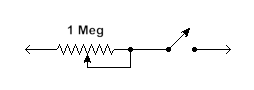
This is a good idea, but I think you're making it too complicated. Just use a 1-Meg pot in series with a switch. Start with the pot at max, then slowly turn it down bit by bit, flipping the switch in 'n out, 'til you hear a difference, when you do, measure the pot and round up to the next higher standard value pot. For example, if you can hear a difference at 68k, get a 100k pot. If you hear a difference at 34k, get a 47k or 50k.

Split-test.png
 
Back
Top