Bass pickup shape: does it affect tone?

Inflames626

New member
Hi friends,

Somebody probably has already addressed this in another thread. If so, I apologize.

As a guitar player who also dabbles in bass, I was wondering if bass pickup shape affects the tone of the pickup, or if the shape is simply the housing into which any kind of tone can be placed.

Now, this has exceptions, I realize, due to size of magnets and coils (especially in MM type pickups), placement of pickup along body (how a P Bass split coil emphasizes lows and highs by putting the bass side closer to the neck and the treble side closer to the bridge).

To my knowledge, the thinking used to be, if you wanted a fat rock tone with lots of lows, you needed a P Bass. If you wanted more versatility, with mids and a good fretless or slap sound, you wanted a Jazz bass. If you wanted a really hot, overdriven sound (say, Motorhead, but I know Lemmy uses a Rick) with a lot of switching options, you tried an MM. And if you wanted a good all rounder, you tried soapbars.

Do these relationships still hold true, or, like with guitars, are manufacturers now putting humbuckers into single coils, etc., and inexperienced ears can't tell the difference?

I've noticed more and more manufacturers moving toward soapbars, especially for six strings and above, instead of creating 6 string jazz bass housings, or P Bass style split coils for 6 strings, or MM style six strings.

I thought perhaps this might be because soapbars are easier to manufacture and adjust, especially for guitar players who are used to humbuckers (for example, I find P bass pickups, with their need for foam, to be a pain to adjust compared to a soapbar).

The entire point of this is, if a person wants a diversity of bass tones, are they better off getting a bass dedicated to each pickup shape, or is buying a bass based upon these criteria old fashioned thinking? Are different pickup form factors just for looks now, or do they make a tangible difference in tone assuming the pickups are equivalent in quality, hotness, etc.?

Also, I know that many basses, like a Stingray, are considered very versatile, but my thinking is that many basses that are versatile can do many things but are the master of none, or, at least, not as good as a pickup designed for a specific purpose.
 
Last edited:
Re: Bass pickup shape: does it affect tone?

Do these relationships still hold true, or, like with guitars, are manufacturers now putting humbuckers into single coils, etc., and inexperienced ears can't tell the difference?

Pretty much this. For example, the Jazz pickup, like the strat pickup, can be found in single coil, stacked humbucking, parallel-coil humbucking, or split-coil humbucking, (and perhaps other variations) in a variety of output strengths.

Certain pickup shapes lend themselves to certain uses, but they don't dictate anything.
 
Re: Bass pickup shape: does it affect tone?

I have both the EMG-P and EMG-35-P4 pickups. The internals are identical. The differences are the casing and the amount of epoxy resin required to fill the gaps inside. They sound the same.
 
Re: Bass pickup shape: does it affect tone?

Materials and construction play their part, but pickup position and sensing window also play their part. You're not going to get an EBO tone from the bridge position of a Jazz Bass or visa/versa.
 
Last edited:
Re: Bass pickup shape: does it affect tone?

It depends on what you're talking about as far as shape.

Different casing shape with identical components (coils, magnets, etc.) placed identically? No change in tone.

Different shape to the coils, magnets, etc.? Yes, different tone.
 
Re: Bass pickup shape: does it affect tone?

Any ideas why there aren't many 6 string+ (non unison) bass pickups in traditional shapes?

Also, why was there more experimentation with bass pickup shape than guitars? I realize this is changing with some guitar manufacturers adopting split pickups and tilted/multiscale arrangements, but it strikes me as a bit odd that, if the guitar humbucker/bass soapbar shape is so prevalent and practical, why didn't it win out early on?

Also, if one can simply get a variety of tones from multiple soapbars with sophisticated EQ or wiring options, there doesn't seem to be as much point to go with, say, a PJ bass, since pickup shape determines tone less and less, unless one just wants a vintage look or got used to a certain kind of neck, like a J Bass.
 
Re: Bass pickup shape: does it affect tone?

And Gilmour has a point. Obviously you're not going to be able to fit all the components of an MM humbucker into a split P bass pickup.
 
Re: Bass pickup shape: does it affect tone?

A side-by-side coil humbucker with magnets in both coils under all strings will still cancel out certain high frequencies. That always has an impact, and which overtones get cut depends on the distance on the coils and how flat the magnetic field is.

Like with guitar there is a huge difference between rod magnets on one hand and passively magnetic polepiece with the magnet on the bottom.

Overall pickup position is much more important for bass than for guitar (where it's pretty clear where things go).

The other thing that is very different in bass, compared to guitar, is that you blend several pickups much more, as opposed to just switching between them. Blending is very problematic for passive pickups and you have to connect the pots backwards like in a Jazz bass if you want the option of switching to a single pickup without a switch. That kills the resonance peak, which is OKish for bass, especially if the resonance peak was at a very high frequency anyway. But still, this is an important factor in using active basses, because now you can blend and mix without having to worry about any of this stuff - if you want to :)
 
Re: Bass pickup shape: does it affect tone?

All the below is my opinion and speculation. It would probably help if I knew what bass sound I was looking for, but, I like all kinds. Lot of stuff on my mind. Bear with me here, guys. :)

Wouldn't all this complexity partially be canceled out because, for most people, it's easier to hear midrange (say, from a guitar) than a bass's frequencies? You're missing more than you're hearing with a bass, in a way, especially once it is mixed into a song.

Also, while a bass is really dynamic compared to a guitar (strings are different volumes, requiring compression, low/high notes are different volumes, overtones/clarity for low notes), most of the time you're also not trying to do as much to a bass's sound--at least in rock or metal. It's just about a clean, clear, unprocessed signal that sits well between the guitar and the kick. Especially in metal, it might as well be the low end of the guitar (and it was in a lot of thrash metal--is that the bass, or just the rumble of the guitar speaker?)

I mean, think about all the worry in the guitar realm about gain staging, tube types, crunch vs. distortion, all these nit picky details--while for rock bass it seems like it's just amplifying a clean signal. The near complete death of the all tube bass head for the sake of MOSFET solid state solutions would seem to support this, yes? All while the guitar world remains mostly biased in favor of tubes because our ears pick up more on an unmusical guitar tone than an unmusical bass tone? Bass tone can be sacrificed to solid state limitations, while the guitar can't?

Obviously this oversimplification of bass doesn't apply for when you want to do stylistic things where the bass is a more important instrument--especially with jazz and funk--where you're biamping, putting in overdrive, effects, etc.

I guess I'm a bit overwhelmed by all the complexity. Obviously, you're going to want certain pickups for certain things (like I said above, a split P bass single isn't going to be a MM humbucker). But where it gets confusing for me is when you consider all the overlap in the middle created by new innovations (putting tones traditionally associated with one shape/type of pickup into another shape/type, especially when it comes to trying to build a versatile instrument that isn't just going to do a mediocre job of everything.)

It's like, hmm, do I want a real Jazz bass type pickup, or do I want a soapbar that gets pretty close to that but also does other things too that the Jazz can't? And so on.

For me, ideal bass tones might be Steve Harris, but also Steve DiGeorgio's fretless sound, Overkill's DD Verne (very bright bass with a lot of pick attack, almost like a guitar), older 90s Dark Tranquillity when Martin Henriksson was doing the bass, Lemmy if I wanted something sludgy in a Sabbath vein, and so on. It also depends on tuning and whether I'm doing Marshall type stuff or scooping.

Here's a good sample of the bass tone I like. The example also sounds slightly overdriven and warm. I'm guessing a P Bass style would do it (I currently have a P Bass copy with SPB3s).

http://www.youtube.com/watch?v=M3OJlkzw2-Q

I imagine I would like the new Harris pickups, but I normally don't jump on the designer custom pickups because they seem like little more than a rebranding of what has been on the market for years with endorsements to justify a higher price point. For example, Steve has his new SD pickup out, but for years he was using an SPB-1 I believe.

So then I guess it comes down to the old question of whether to build a Swiss army bass or to have dedicated basses. Not that that matters anymore, anyway, at least with recording, because all a pickup is is a preset EQ curve that you can later easily manipulate in a DAW.

I've never tried actives (but I nearly swear by them in guitars for scooped metal), but to me they always sounded too consistent to be musical. Too Seinfeldy (I know that was a synth).

Also, what's affecting my thinking is, lately, at least on guitar, I've fallen out of love with noiseless singles and other attempts to update old stuff without the limitations. "Vintage" is an overused word in music gear. I thought true vintage stuff might be too weak or noisy for me, but I'm leaning toward trying true singles so I don't have to make tone compromises.
 
Re: Bass pickup shape: does it affect tone?

Regarding tube vs ss for bass, you need much more power for a bass amp than a guitar amp - a 100w guitar amp will be overkill for a bar that seats 300 people, but a 100w bass amp in the same room is going to vanish on every kick and every palm mute. Unless you're the only amp in an acoustic gig.
There was a Guitar Player article I read many years ago that stated 80% or more of a 100w head's power is given off as heat, leaving about 20% actually going for sound, and that a truly efficient amp would be the size of a lunchbox and rock a stadium.

We see these micro-amps coming out year after year that inch closer to proving that theory. 1.5 watt mini-mes that annoy the neighbors and such.

Regarding "if the soapbar/humbucker was so great, why wasn't it adopted early on across the board":
-Tradition. Fender's signature tone was from the single-coil design. Gibson tried a fat single (P90s). Gretsch had their things. Once Seth Lover figured out that the opposing coil would eliminate the 60Hz electrical hum that a single-coil could not, it was too late for everyone to change. Those older designs were already traditional. Even today people will take the hum to get the tone.
Same for Split-P and J-bass pickups. By the time the soapbar/MM came out, those were classic tones used by big names on big songs.

But, not everyone followed the same formula: Jackson's standard split-P layout generally featured the bass-side closer to the bridge, and the treble-side closer to the neck.

As well, their old 80s/90s in-house pickups were used for both 4 and 5-string.

Something I'd be somewhat interested in is a split-P with a rail on the bass side and parallel axis on the treble. The rail would catch a floppy B or low E being pummeled in a Speed/Thrash/Death Metal context, while keeping the upper strings tight and articulate.
I'd also be interested in a split-P that could be slid along a track in the body for placement that suits the individual, but that's more of a body issue than a pickup issue.


Regarding making one pickup sound like another:
-SD has one of the best pickup winding geniuses in history - MJ.
If she says she can wind a split-P that sounds like a Jazz or a Jazz that sounds like a split-P or a lipstick that sounds like an EB0, I'd believe her.

She wound me 3 Lil/Jr pickups a few years back: CustomJr, JazzJr, DistortionJr.
The CustomJr sounds like an SH-5.
The JazzJr sounds like an SH-2.
The DistortionJr sounds like an SH-6.

Yet they all 3 look just like the JBJr, Lil59, LilScreaminDemon, etc.

"The Force is strong with this one."
 
Re: Bass pickup shape: does it affect tone?

Something I'd be somewhat interested in is a split-P with a rail on the bass side and parallel axis on the treble. The rail would catch a floppy B or low E being pummeled in a Speed/Thrash/Death Metal context, while keeping the upper strings tight and articulate.

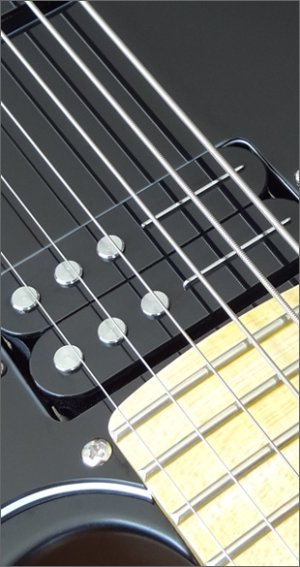
You mean something like this, only in a P?

tele_closeup.jpg
 
Re: Bass pickup shape: does it affect tone?

The shape of the coil definitely affects tone. All other aspects of a pickup's construction being equal, a tall and thin coil like a Strat, Tele or Jazz Bass yields a brighter sound. A low and fat coil like a P-90 gives more mids and power.

When Leo Fender wanted to create a guitar that could compete with Gibson jazz boxes, he designed the Jazzmaster. Its pickups are low and flat and are designed for the mellow mid range tone jazz players from the late '50s and early '60s loved so much. Ironically, the pickup and the guitar were never really used for jazz, but that's why he chose that shape for the pickup.
 
Re: Bass pickup shape: does it affect tone?

I'd also be interested in a split-P that could be slid along a track in the body for placement that suits the individual, but that's more of a body issue than a pickup issue.

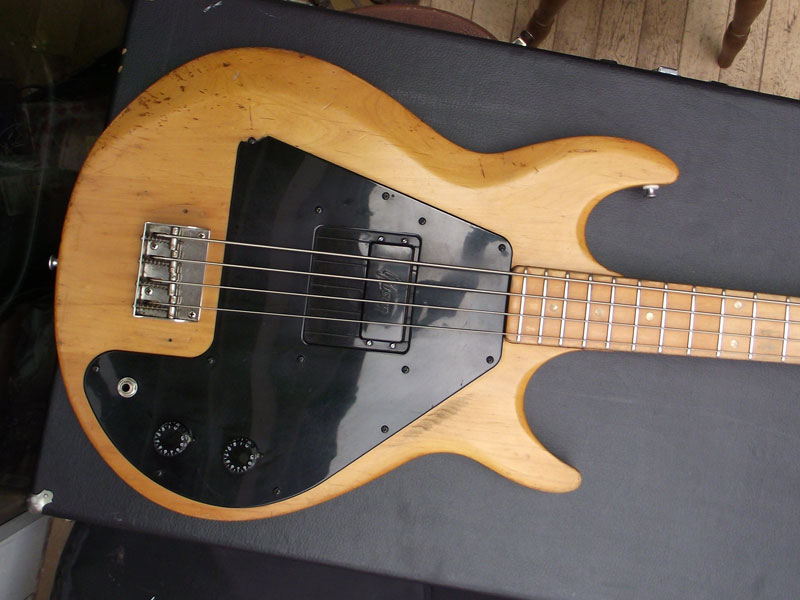
Not with the P-shaped pickup, but Gibson took a step in that direction with the Ripper bass:
Gibson-Ripper-Bass.jpg
 
Re: Bass pickup shape: does it affect tone?

The shape of the coil definitely affects tone. All other aspects of a pickup's construction being equal, a tall and thin coil like a Strat, Tele or Jazz Bass yields a brighter sound. A low and fat coil like a P-90 gives more mids and power.

And yet, also, if someone with a J style bass wants a P bass sound, the magnets and coils in a J bass coil housing can be modified to sound like a P bass coil?

My problem I'm running into is if it is worth it to have an arsenal of basses for the different sounds (mostly P, split P, J, P/J, soapbar, and MM). Then you add passive and active variations of these.

So what are some things to look for in bass pickup construction? Someone said stacked coils vs. side by side. Someone else said bar vs. pole piece vs. rail. Anything else?

Something else I'm thinking is, all things being equal, the difference in tone created by the shape of a pickup (say, a split P bass) can be mimicked in another style pickup housing simply by altering a few of the other components (unless of course there isn't physical room). For example, I use a late 90s Peavey Foundation 5 to track bass lines. Even though the housings are soapbars, the manual says they are high output single coils. They're also very quiet, so I assume they're hum cancelling and not true vintage. Anyway, it sounds very nice, deep, and full, better than a lot of P basses, but not as overwound or hot as an MM. It also has coils at the mid and the bridge, so it's a bit like a P, a PJ, a J, and an MM (due to the soapbar form factor being like a humbucker) all at once.

So, if one style pickup can imitate another by substituting internal changes for form factor, is there really any reason to invest in different form factors save for looks? It would seem wiser to go after a bass that deliberately makes a certain sound (P vs. J. vs. MM vs. active soapbars) than to simply say, "I need a P bass, a PJ, a Jazz, an MM, and a soapbar."
 
Back
Top