Bourns 95 and 82 vs standard pots

CarlosG

Member
Hi.
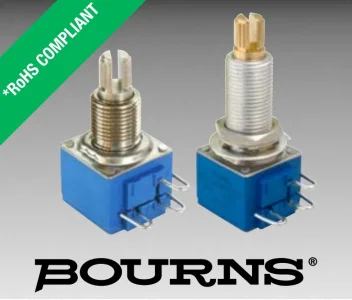
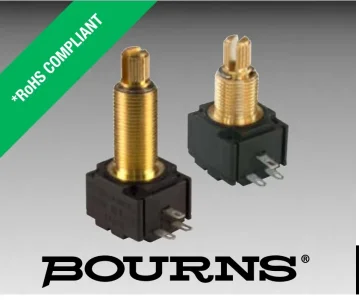
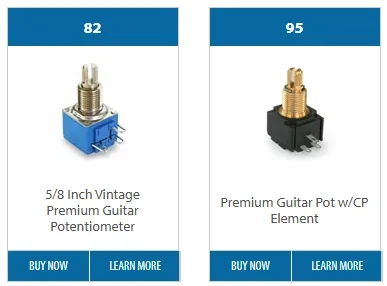
Apparently, metal film resistors have less noise than carbon. I see that the Bourns 82 and 95 have composite traces. Does this mean they will have less noise than traditional carbon potentiometers? Has anyone compared them?
Best regards! Screenshot_2025-11-25-11-24-33-36_40deb401b9ffe8e1df2f1cc5ba480b12.webp
Screenshot_2025-11-25-11-24-45-46_40deb401b9ffe8e1df2f1cc5ba480b12.webp
 
Those are not designed for use in a guitar. Any small amount of noise potentially reduced via trace composition will be more than made up for by the lack of metal cover on the pot.

Those are designed to be placed in a metal/shielded enclosure, not the wood of a guitar. Also you are more likely to burn the trace while soldering than with a normal pot.
 
Those are not designed for use in a guitar.
Hey Chist. I don't mean to be argumentive, but Bourns markets them specifically as guitar pots.

And Carlos, high carbon generates self-induced noise, by virtue of the electrons bouncing around. The more carbon, the more electrons. This might be critical in a $10,000 audio amp. In a guitar . . . not so much.

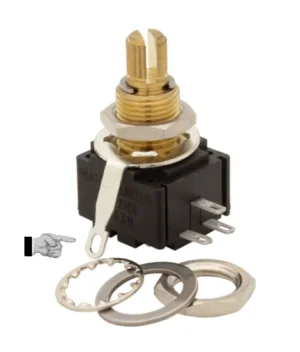
Having said that, I like the 95's. Silky smooth, tight tolerances. But you have to use the "star" washers with the solder lug, (supplied), in a guitar. I like them. I use them in my own "special" projects. YMMV.

P.S. They're conductive plastic. Not metalized. (Maybe that's the same thing.) :p
 

Attachments

  • Bourns_Pots.webp
    Bourns_Pots.webp
    9.8 KB · Views: 2
Last edited:
Woah, that's actually pretty crazy then. How do you ground the casing?
Like this.
You can also use contact with shielding.
Those are not designed for use in a guitar. Any small amount of noise potentially reduced via trace composition will be more than made up for by the lack of metal cover on the pot.

Those are designed to be placed in a metal/shielded enclosure, not the wood of a guitar. Also you are more likely to burn the trace while soldering than with a normal pot.

So, shielding is enough. And I think it's a matter of soldering skill; I have no problem soldering plastic miniswitches.
Hey Chist. I don't mean to be argumentive, but Bourns markets them specifically as guitar pots.

And Carlos, high carbon generates self-induced noise, by virtue of the electrons bouncing around. The more carbon, the more electrons. This might be critical in a $10,000 audio amp. In a guitar . . . not so much.

Having said that, I like the 95's. Silky smooth, tight tolerances. But you have to use the "star" washers with the solder lug, (supplied), in a guitar. I like them. I use them in my own "special" projects. YMMV.

P.S. They're conductive plastic. Not metalized. (Maybe that's the same thing.) :p
So you didn't notice the difference? Do you use the volume knob a lot? And I used the resistor as an example because I was curious if the composite traces were intended to provide a similar effect, or why they were introduced?
 
So you didn't notice the difference? Do you use the volume knob a lot? And I used the resistor as an example because I was curious if the composite traces were intended to provide a similar effect, or why they were introduced?
I rarely use vol or tone controls. I tend to sit close to my amp, and just adjust the volume at the amp itself. I mainly got these just to try them out. I do like how smooth they are though.

Bourns still shows them on their pot page, but when you click the "Learn More" button, you get an error. So not sure if Bourns has discontinued them. But they're still out there for purchase.

Bourns Pro Audio Pots
 
Back
Top