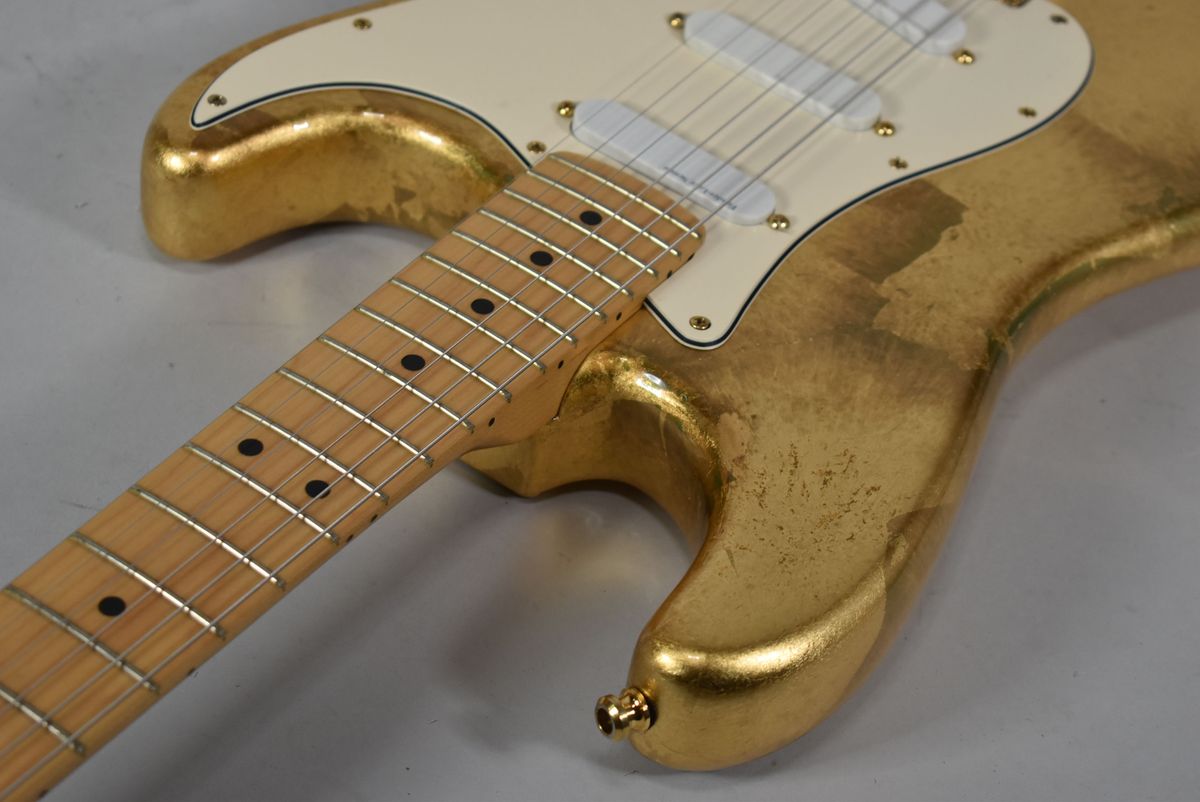
Bubbles in Paint

That is exactly what I used on this guitar and the finish seems to have come out fine. I think we have to agree that different people have different processes for getting things done that yield great results. I do not think there is a wrong or right process here just many different approaches.

fetch

You are absolutely correct. Some processes work perfectly fine for some people and others work fine for other people. And chemical strippers certainly have their place. But sometimes, actually, there is a right or wrong way of doing things.

You seem to have done a great job with that guitar. Very nice.

In this case, TCW used a lacquer finish so there is no need to use a stripper. It just introduces a bunch of other potential points where thing could go wrong. And strippers are dangerous as well as being messy. So...why bother?

By the way, That silver metal flake would make a great base for a trans or candy finish.
 
That is exactly what I used on this guitar and the finish seems to have come out fine. I think we have to agree that different people have different processes for getting things done that yield great results. I do not think there is a wrong or right process here just many different approaches.

fetch
Sorry for the detail.

What was your process on this? Did you do auto primer, base metallic, flake, clear, level and polish? Which paints?
 
Definitely DON"T use chemical paint stripper! That makes a horrible mess and leaves a residue that needs to be thoroughly rinsed off with water. With water...water on wood! Just asking for more problems. And since you've been using lacquer, there's absolutely no need for a stripper.

Agreed. I found my hot air stripper this morning. It's working a treat.

I've been doing this (finishing and refinishing with lacquer) for many years and can definitely help you to get a perfect finish, but I need to know a couple things first...
1. are you using solid color finish?
2. solid color covered with clear?
3. stain covered with clear?
4. Are they really bubbles or are they spots/spatters of paint/clear?

1. Yes. Solid gloss black RUstoleum lacquer. It says good for wood on the can.

https://www.homedepot.com/p/Rust-Ol...VOazgu1Z9ReLty-aWIEaAhqqEALw_wcB&gclsrc=aw.ds

2. Plan is / was to put a load of clear on top so when i sand super-smooth and polish, im taking off (probably excess) clear not solid color.

3. Thats plan B.

4. Yes, bubbles. I think whats been happening is that ive been putting it on too thick. The top sirface solidifies, preventing the solvent in the layes below venting evenly, creating solvent bubbles. Not only do I get bubbles, but little craters too.

not hard to fix your problem, but the solution will be different for each of the conditions I'm asking about.

I'll get you up and running (playing) as quickly and efficiently as possible. It IS possible to get excellent results with rattle cans...sometimes as good as with the best spray equipment, so take heart.[[/QOUTE]

In the meantime, there is a series of 3 videos on StewMac that actually are very good that take you thru the entire project. They are lengthy but there's good info in them for beginner AND pro. I've been doing this from before these guys were even born, but even I picked up some good tips.

https://www.stewmac.com/video-and-i...inish-repair/aerosol-guitar-finishing-course/

I'm stripping back now. Going to go stain then clear. I'm sick of trying with the black paint!
 
If the bubbles are tiny: you're spraying too much, too close to the body. That traps the gasses under a film of finish that's drying the fastest.

If the bubbles are bigger, it could be a reaction.

I always use a water based drying paste, polyester, and/or epoxy to seal the body. That stuff won't react, at all.
 
At this point, redoing black with a clear finish would be a piece of cake.

To do stain then clear is going to require sanding back to "clean" wood, then either staining or sealer then staining, then grain filler, several coats of sealer, level sanding, 6 coats of clear, light level sanding, 3-6 coats more clear, 2-4 weeks curing, final wet sanding (1200, 1500, 2000, 2500), then polishing.

If you want the guitar to be black, that's by far the easiest way to do it now. Just level sand, possibly 1 black coat to insure even color (may not be necessary if you have an even black color), 3-6 coats clear, light level sand to get rid of orange peel (1500 grit), a couple weeks cure, then final wet sand (2000) and polish.

What ever you want to do, I'll be glad to help you if you want me to.
 
Poly is a great finish. I don't think I'd ever want to use wipe-on. I'd be too afraid of getting lint in the finish.

Spray is simple. Just make sure everything is sanded smooth and dust-free first (use tack cloth then wipe with naphtha). Coleman camp stove fuel works great and is available anywhere. The naphtha/fuel will remove any remaining dust plus any residue from the tack cloth.

Spray a very even coat of poly, then in about an hour spray a second coat. That's it. The second coat needs to be sprayed before the first coat dries, while it is still just a bit tacky.
 
Sorry for the detail.

What was your process on this? Did you do auto primer, base metallic, flake, clear, level and polish? Which paints?

It was a long process. I stripped the body with a chemical stripper then sprayed the entire guitar with auto primer. Then a very fine iridescent silver coat was added. Once that dried the silver flakes were mixed with clear and several thin coats were sprayed. Then many coats of clear over those metal flake coats. It was finished off with some wet sanding and buffing. I did get an assist on this one from a buddy that I worked with in a body shop. The silver is hard to spray the flakes love to clog the gun.

It has been 15 years since I forgot the exact product we used. Some brand of enamel
 
It was a long process. I stripped the body with a chemical stripper then sprayed the entire guitar with auto primer. Then a very fine iridescent silver coat was added. Once that dried the silver flakes were mixed with clear and several thin coats were sprayed. Then many coats of clear over those metal flake coats. It was finished off with some wet sanding and buffing. I did get an assist on this one from a buddy that I worked with in a body shop. The silver is hard to spray the flakes love to clog the gun.

It has been 15 years since I forgot the exact product we used. Some brand of enamel

Once I get my feet wet with some solid colors I’m going to attempt a full on metal flake job. Roth Metal Flake has made it all accessible in rattle cans, which is pretty cool.
 
At this point, redoing black with a clear finish would be a piece of cake.

To do stain then clear is going to require sanding back to "clean" wood, then either staining or sealer then staining, then grain filler, several coats of sealer, level sanding, 6 coats of clear, light level sanding, 3-6 coats more clear, 2-4 weeks curing, final wet sanding (1200, 1500, 2000, 2500), then polishing.

If you want the guitar to be black, that's by far the easiest way to do it now. Just level sand, possibly 1 black coat to insure even color (may not be necessary if you have an even black color), 3-6 coats clear, light level sand to get rid of orange peel (1500 grit), a couple weeks cure, then final wet sand (2000) and polish.

What ever you want to do, I'll be glad to help you if you want me to.

It's back to bare wood virtually all over already. Just the annoying bits round the neck / body joint left to do.

I'm undecided what to do next.

On the one hand, stain then clear is going to take a while, but paint hasn't worked out for me, two or three times.
 
Last edited:
If you want to use rattle cans, go to an auto store and get the Dupli-Color paint in the color you want. I did that on my SG junior project and it came out great. That paint is acrylic lacquer it should be fine with what you have as far as sanding sealer or filler. Their universal black is great. You’ll want 3 to 4 cans and a bowl of warm water. Spray with one can, light coats and when you feel the can get cold in your hand switch to the next can and place the one you were using in the water. If you keep using the same can, it can cause it to spit which will cause you more problems. The nozzle on those cans is also fanned and you can change the direction to be vertical or horizontal. Spray 6 to 8 inches away from the surface. Good luck.
 
Last edited:
You mean that "the ones you've used" are not rinsed off with water.

Like many pros I use CitriStrip, and it says right on the bottle to use mineral spirits to clean up. Since I buy lacquer thinner and acetone by the gallon at my local wholesaler, that's what I use for cleanup.

Any idiot knows you don't use water on a guitar unless you are trying to raise the grain or soften the glue joints.
 
Look Goober, I'm not going to nit-pick with you. There are many water-based paint strippers on the market. I was merely advising NOT to use one of those.
"Any idiot knows you don't use water on a guitar". I guess I am an idiot, because I know you shouldn't use water on a guitar. I guess you also are an idiot.

Apparently, you agree with me. So, why all the arguing and name calling?!
 
Back
Top