
You are using an out of date browser. It may not display this or other websites correctly.
You should upgrade or use an alternative browser.
You should upgrade or use an alternative browser.
Caps
- Thread starter Sam SG
- Start date


beaubrummels
Well-known member
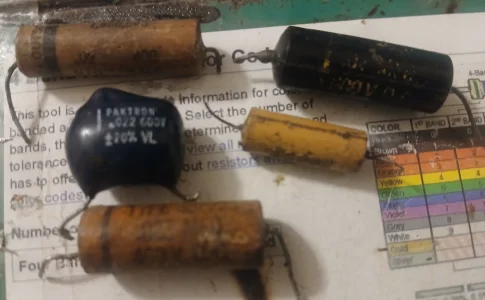
If they measure .022 then use 'em; though the legs don't quite look long enough to hook to anything.

freefrog
Well-known member
I'll have to find where I've read that the "Greasebucket" Fender circuit was inspired by old paper in wax caps that age had made defective... Anyway, I know for a fact that some old caps don't actually behave according to their measured capacitance: when time made them resistive, they give a lower Q factor than a normal (IOW: intact) capacitor and set the resonant peak of pickups at a higher frequency than expected. A bunch of lab tests have been done here about that a few decades ago...If they haven't drifted, yes. But old PIO / paper in wax caps often tend to exhibit a higher capacitance than announced.
Now, some also develop parasitic resistive properties, making them more musical when the tone control is lowered...

GuitarStv
Sock Market Trader
I am not someone that believes vintage caps 'sound better'. What is important is the true value.
I'm in this boat as well. If an old capacitor sounds different than a new one of the same value it's because it's defective. Which might be cool, or might not be . . . defective parts are a crapshoot.
Chistopher
malapterurus electricus tonewood instigator
I know half of you guys don't even use your capacitors anyway...

Yea my good DMM died so all I got isca Harbor Freight POS.
I haveca whole box of goodies.
I have 2 NOS .022 Philips Mustard caps Im saving for a Marshall plexi should I build one.
I have a bunch of brown bean caps that cane from Hammond Chassis' I built guitar amps out of.
I haveca whole box of goodies.
I have 2 NOS .022 Philips Mustard caps Im saving for a Marshall plexi should I build one.
I have a bunch of brown bean caps that cane from Hammond Chassis' I built guitar amps out of.
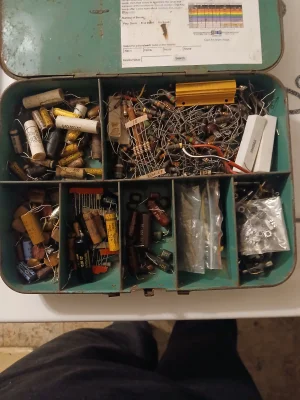
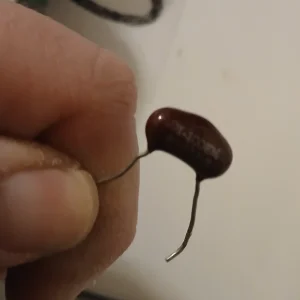

Me as well. I try to measure the ones I put in the guitar. But as far as type, I don't really care, as long as it measures correctly.im a heavy tone control user, so caps matter to me
freefrog
Well-known member
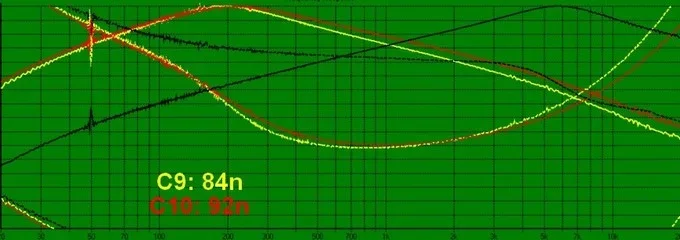
Below is an example of that. Raw resonant peak and phase response of a P90 with tone pot full up (black lines) then set @ 0 with different old tone caps in yellow and red.I know for a fact that some old caps don't actually behave according to their measured capacitance: when time made them resistive, they give a lower Q factor than a normal (IOW: intact) capacitor and set the resonant peak of pickups at a higher frequency than expected. A bunch of lab tests have been done here about that a few decades ago...
Both were meant to be 100nF but these two specimens (among a few dozens measuring up to 110nF) had drifted toward a lower capacitance.
The 92nF cap should have set the resonant peak at a lower frequency than the 84nF. As shown by the pic, that's not what happened for the reasons explained in my previous answer above.
IOW, the capacitance displayed by a lab meter doesn't necessarily gives the whole picture when it comes to tone capacitors. ;-)
beaubrummels
Well-known member
Empirical observation is still technical science.Wow you guys are gettin technical. Lol
Think ill just solder one in and see what it does


uOpt
Something Cool
I know this isn't what I typically write like, but I believe tone pot capacitors sound different by type, and not strictly by what they measure.
I verified this as follows:
It's the most "voodoo" guitar thing I believe in.
I verified this as follows:
- a 12-position rotary switch with various types of capacitors, all the same stated value
- there is a pretty clear difference, e.g. the ceramic disks sound more "driven", they have more of a "roar"
- of course all these capacitors have slightly different measured values
- so I went back to a 100-pack of ceramic disks and picked one that was exactly the measured value of the orange drop in there
- the new ceramic disk sounded more like the other ceramic disk than the orange drop, although its measured value was closer to the orange drop
It's the most "voodoo" guitar thing I believe in.
Chistopher
malapterurus electricus tonewood instigator
Below is an example of that. Raw resonant peak and phase response of a P90 with tone pot full up (black lines) then set @ 0 with different old tone caps in yellow and red.
Both were meant to be 100nF but these two specimens (among a few dozens measuring up to 110nF) had drifted toward a lower capacitance.
The 92nF cap should have set the resonant peak at a lower frequency than the 84nF. As shown by the pic, that's not what happened for the reasons explained in my previous answer above.
IOW, the capacitance displayed by a lab meter doesn't necessarily gives the whole picture when it comes to tone capacitors. ;-)
View attachment 6326295
How would putting a resistor in series with a capacitor emulate old caps?
GuitarStv
Sock Market Trader
How would putting a resistor in series with a capacitor emulate old caps?
If the old cap is defective, it could be introducing resistance into the circuit.
Similar threads
- Replies
- 3
- Views
- 220

