
You are using an out of date browser. It may not display this or other websites correctly.
You should upgrade or use an alternative browser.
You should upgrade or use an alternative browser.
Do combo amps ruin the wave form
- Thread starter solspirit
- Start date

PFDarkside
of the Forum
I mean if you are talking about a hifi system then is trying to accurately reproduce source audio, then maybe. As a guitarist you are looking for all the nasty things that guitar amps do to your guitar signal.

solspirit
Ultimate Post Liker
I mean if you are talking about a hifi system then is trying to accurately reproduce source audio, then maybe. As a guitarist you are looking for all the nasty things that guitar amps do to your guitar signal.
I think we should be modeling after hifi systems, somewhat. I mean if I could afford anything I want I would go for a rig that, first expresses the guitar then the head through an unencumbered cabinet.
PFDarkside
of the Forum
I think we should be modeling after hifi systems, somewhat. I mean if I could afford anything I want I would go for a rig that, first expresses the guitar then the head through an unencumbered cabinet.
The sound of Greenbacks being taken to the limit is the sound of rock and roll to me. EVs have their place, is that your preferred sound?

beaubrummels
Well-known member
Whether the combo is open back or closed has a much bigger affect on the resulting sound. Ideally, the speaker would be in it's own enclosed chamber that is sized to match it's design, but if the combo cab contains the same airspace that the speaker design calls for, the irregularity of the amp shape in there shouldn't change the sound too notably; no more than the dampening packing that typically goes in cabinets (but isn't used in guitar cabs). Eric Johnson might hear it. But whether one of us can remains to be tested.

eclecticsynergy
Well-known member
I've heard people say combos are better because the the tubes resonate with the speaker.
FYI, I'm not one of those people. Just putting the idea out there,
FYI, I'm not one of those people. Just putting the idea out there,

NegativeEase
New member
Open back designs work better for combos IME, if Im wanting a punchy closed back sound -give me a separate cabinet and head please.
The physics of it is that yes, it does change the way the speaker sounds. Now, if it is for the better, or if it is worse is 100% subjective.
Combo amps with open backs have a more di-pole acoustic output. I.E. it sends energy nearly equally forward and backward. The amp inside the combo does reflect and garble up some of that rearward energy, and the rearward energy also is impacted by the size of the enclosure and how the cabinet is built around the speaker. The energy is reflected off the walls of the inside of the cabinet, which does have an impact.
Some people really love combos because the open-back design lends to exciting more of the space they are playing in. That added interaction is what makes combos seem bigger than they really are, and is probably why they are the most popularly recorded style of amp ever. They do a thing, that closed-back designs do not.
Closed-back cabinets are more hit and miss. The cabinet should be designed within the Thiele-small parameters of the speaker/s to really perform their best, but many are simply made to a convenient size. If you change the speaker, again you change the performance characteristics. I have a love-hate with closed-back cabinets. In the single speaker variety, they are very narrow dispersion, the sound is very direct and in the room, they sound like a very small point source. This is good and bad. Great for micing and keeping stage levels down, bad if you are a guitarist that relies on stage volume and moves around a lot. Larger 4x12" cabinets are very beamy ( a nature of the way the speakers are arranged ), but sound HUGE, and you generally get better coverage ( as opposed to a single speaker cabinet ). The phase interaction between the speakers is a large part of what makes a 4 x 12" cabinet have its thing. Where you are off-axis it will have an effect on the sound you hear, but it is not necessarily bad, just different, which makes it a good tool for room micing them, there are an infinite number of places to put a mic that you can get a different sound.
This leads me to what I feel is the ultimate compromise. 2 x 12" closed-back cabinets have a thing they do. They have just enough oomph and power to move air and get the sound out, don't have a crazy amount of phase issues, and sort of hit in between a combo and a 4 x 12" monster. I am not a fan of open-back designs, mainly because I play in smaller spaces these days, so I don't want the room all excited with my guitar, I tend to go with 2 single 12" ported cabinets, or a 2 X 12" cabinet. I have laid my 4 x 12" cabinet to rest in the garage for practicing. The other nice thing about 2 x 12" is that you can orient the cab vertically or horizontally, which gives a different sound and yet another option with a single cabinet.
Combo amps with open backs have a more di-pole acoustic output. I.E. it sends energy nearly equally forward and backward. The amp inside the combo does reflect and garble up some of that rearward energy, and the rearward energy also is impacted by the size of the enclosure and how the cabinet is built around the speaker. The energy is reflected off the walls of the inside of the cabinet, which does have an impact.
Some people really love combos because the open-back design lends to exciting more of the space they are playing in. That added interaction is what makes combos seem bigger than they really are, and is probably why they are the most popularly recorded style of amp ever. They do a thing, that closed-back designs do not.
Closed-back cabinets are more hit and miss. The cabinet should be designed within the Thiele-small parameters of the speaker/s to really perform their best, but many are simply made to a convenient size. If you change the speaker, again you change the performance characteristics. I have a love-hate with closed-back cabinets. In the single speaker variety, they are very narrow dispersion, the sound is very direct and in the room, they sound like a very small point source. This is good and bad. Great for micing and keeping stage levels down, bad if you are a guitarist that relies on stage volume and moves around a lot. Larger 4x12" cabinets are very beamy ( a nature of the way the speakers are arranged ), but sound HUGE, and you generally get better coverage ( as opposed to a single speaker cabinet ). The phase interaction between the speakers is a large part of what makes a 4 x 12" cabinet have its thing. Where you are off-axis it will have an effect on the sound you hear, but it is not necessarily bad, just different, which makes it a good tool for room micing them, there are an infinite number of places to put a mic that you can get a different sound.
This leads me to what I feel is the ultimate compromise. 2 x 12" closed-back cabinets have a thing they do. They have just enough oomph and power to move air and get the sound out, don't have a crazy amount of phase issues, and sort of hit in between a combo and a 4 x 12" monster. I am not a fan of open-back designs, mainly because I play in smaller spaces these days, so I don't want the room all excited with my guitar, I tend to go with 2 single 12" ported cabinets, or a 2 X 12" cabinet. I have laid my 4 x 12" cabinet to rest in the garage for practicing. The other nice thing about 2 x 12" is that you can orient the cab vertically or horizontally, which gives a different sound and yet another option with a single cabinet.

JamesPaul
Well-known member
All good stuff and room for both combos and heads/cabs in my book! Nothing is wrong with either in the appropriate setting.
My only 2x12 cab is an Avatar loaded with G12H30's. It is my only 8 ohm cab, and it was used heavily in the Punk band I subbed for. Lately, my back has also had success with my closed back (no pun intended) 112 cab.
My only 2x12 cab is an Avatar loaded with G12H30's. It is my only 8 ohm cab, and it was used heavily in the Punk band I subbed for. Lately, my back has also had success with my closed back (no pun intended) 112 cab.

ThreeChordWonder
New member
Hifi amps, the good ones, anyway, are all about reproducing the studio or live recording sounds as with as much "fidelity" as possible, distorted guitars and all.
NegativeEase
New member
Man, you want to talk ruined waveforms? Any amp that pushes into distortion ruins a waveform much worse than a combo vs emptier cab.
I think the word "alters" or modulates the original waveform is what you mean -not ruin.
Almost every mastered audio product since the 70s, most everything you've ever heard played through the radio ever has been purposely put through an additional distortion phase or 2 (Aural Exciter) in order to make it sound better through harmonic emphasis.
So I'm not sure distortion should even be categorized as ruins.


JamesPaul
Well-known member
Do you guys ever play your combo amps?
Or just talk about them?
"Tips and Clips"
Just saying.
Sent from my SM-A115A using Tapatalk
Yeah, but sometimes I cheat and put my combo on a cab...
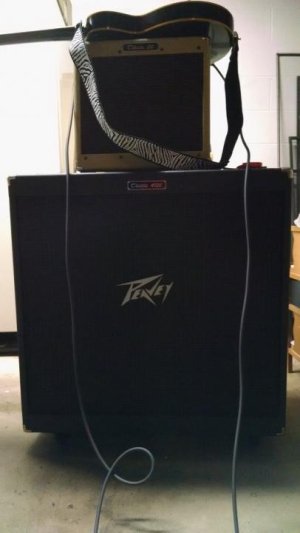

Seriously, I will have to hook all my recording gear up and see what I can put together. Lately I have been lazy and just use the USB interface on my VIP when I need to record.

GuitarStv
Sock Market Trader
im guessing stvs comment was directly pulled from the language of the thread topic. alters is much more accurate for most things discussed here. and altering the waveform can be a glorious thing!
Yep . . . that's the point I was trying to get across. Once you start distorting the waveform you've already altered things way past the effect of a cab vs combo. And most of us play with gain most of the time, so I think the OP's point is largely moot.
NegativeEase
New member
Yep . . . that's the point I was trying to get across. Once you start distorting the waveform you've already altered things way past the effect of a cab vs combo. And most of us play with gain most of the time, so I think the OP's point is largely moot.
This is a good point. add pedals and whos ever going to know the difference in if you chose a cab or combo

alex1fly
Well-known member
I've actually A/Bed this experiment. Years ago I chopped the amp part out of a 2x12 Pignose combo and used the 2x12 just as a cabinet with the amp in another DIY enclosure. Reason being, loved the sound of the combo amp but it was just a bit too heavy to lug to rehearsals. So yeah, pulled 20 pounds out of the thing. Can't say I ever noticed any difference in sound whatsoever, and for the band I was in I was playing mostly clean.
Flip side was that now the guts of the amp were TOO accessible and I shocked myself several times even with the amp unplugged. Once the kiddo arrived, the chopped up amp had to go
Flip side was that now the guts of the amp were TOO accessible and I shocked myself several times even with the amp unplugged. Once the kiddo arrived, the chopped up amp had to go
Similar threads

- Replies
- 26
- Views
- 2K


- Replies
- 13
- Views
- 106
- Replies
- 32
- Views
- 217

- Replies
- 13
- Views
- 244