

J E C
New member
Well, I've been kicking around an idea for a fixture to scalloping finger boards after Kramersteens inquiry, and this is what I came up with. It can also be used to radius a FB that is glued to a neck or by its self, and be used to surface a piece of stock to, 1) prep it for another operation, 2) thin it, 3) taper it 4) ?.
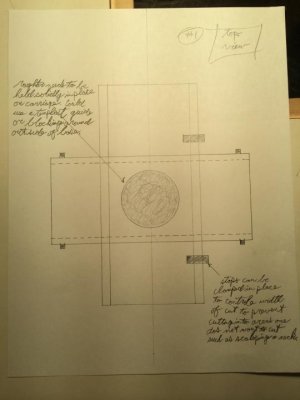
These drawings ARE NOT TO SCALE, and you will need to look at all of them carefully to get all the notes.
It would be best to make it out of a high quality 3/4" plywood like 7 ply Apple/Birch for rigidity and stability, but other materials could also be used.
Pic #1 shows looking down on it.
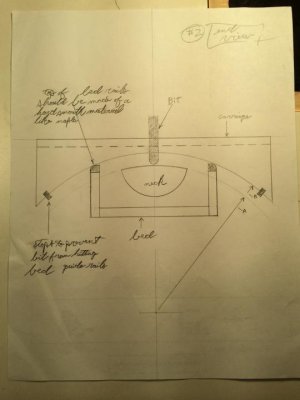
Pic #2 is an end view showing it with the carriage for FB radiusing and scolloping.
For radiusing and scalloping, the carriage slides in an arc across the bed and lengthwise side to side.
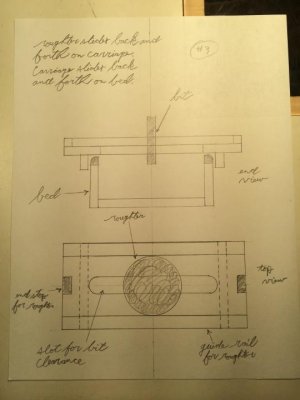
Pic #3 shows the carriage that would be used for surfacing. This carriage slides along the beds length and the router slides across the top of the carriage side to side.
Various parts would be best made by use 2 thicknesses of the plywood (such as the bed rails) to further increase rigidity and stability.
The top of the bed rails should be made of a smooth hard material like Maple and be waxed, as should all other surfaces that will ride on them to ensure a smooth action and reduced ware.
For radiusing and scalloping the neck needs to be held solidly in the bed and so the relationship of A) the finger board radius and B) the carriage rail bottom radius is maintained along the FB length.
To cut various different FB radiuses one could make different carriages or make a carriage that had interchangeable guide rails.
One could cut a compound/conical radius on a FB by making a carriage that was as long as the bed and had a different size radius for each carriage rail bottom. This carriage would only moved in an arc across the bed but not along the beds length. To cut in that direction the router would move along the carriages length in the same manner as it dos crosswise on the surfacing carriage. This style of carriage can be used to cut a non-compound/conical radius also by making the carriage rail bottoms the same radius.
To machine various different items (necks, FBs, stock, ?) one would need to make different interchangeable holding/clamping fixtures that mite incorperate clamps, screws, bolts, double stick tape and or even glue or vacuum.
Please excuse my spelling errors. If you would like I can do a drawing of the carriage for cutting a compound/conical radius.
Any questions please ask. John
These drawings ARE NOT TO SCALE, and you will need to look at all of them carefully to get all the notes.
It would be best to make it out of a high quality 3/4" plywood like 7 ply Apple/Birch for rigidity and stability, but other materials could also be used.
Pic #1 shows looking down on it.
Pic #2 is an end view showing it with the carriage for FB radiusing and scolloping.
For radiusing and scalloping, the carriage slides in an arc across the bed and lengthwise side to side.
Pic #3 shows the carriage that would be used for surfacing. This carriage slides along the beds length and the router slides across the top of the carriage side to side.
Various parts would be best made by use 2 thicknesses of the plywood (such as the bed rails) to further increase rigidity and stability.
The top of the bed rails should be made of a smooth hard material like Maple and be waxed, as should all other surfaces that will ride on them to ensure a smooth action and reduced ware.
For radiusing and scalloping the neck needs to be held solidly in the bed and so the relationship of A) the finger board radius and B) the carriage rail bottom radius is maintained along the FB length.
To cut various different FB radiuses one could make different carriages or make a carriage that had interchangeable guide rails.
One could cut a compound/conical radius on a FB by making a carriage that was as long as the bed and had a different size radius for each carriage rail bottom. This carriage would only moved in an arc across the bed but not along the beds length. To cut in that direction the router would move along the carriages length in the same manner as it dos crosswise on the surfacing carriage. This style of carriage can be used to cut a non-compound/conical radius also by making the carriage rail bottoms the same radius.
To machine various different items (necks, FBs, stock, ?) one would need to make different interchangeable holding/clamping fixtures that mite incorperate clamps, screws, bolts, double stick tape and or even glue or vacuum.
Please excuse my spelling errors. If you would like I can do a drawing of the carriage for cutting a compound/conical radius.
Any questions please ask. John
Last edited:


