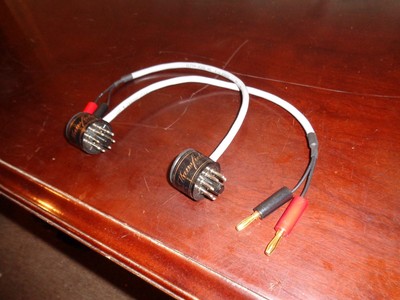
Re: First time biasing an amp - is this procedure correct?
Ok, here it goes. It's obligatory to say - you know about the filter caps, AND make sure you don't touch anything connected to the mains power (on or off; the amp is plugged in). It's common sense: you don't want to be a pussy about it, but you don't want to be a moron about it either. Wear rubber soled shoes, work with dry hands in a dry workplace (moisture lowers the body's resistance, with the largest resistor being skin), and treat everything as if it's "live" at all times. The reason you work with one hand is so that if you do get bit, the circuit only closes through your hand and no permanent damage is done (whereas the circuit closing through your chest can be dangerous). Just respect the electricity, and remember that you need voltage to carry a current through a resistor (the body). 1000 Amps through 1mV will do nothing. 2 Amps though 1kV can kill you with ease. As for draining caps, you can do a half-ass drain by playing it, and then shutting the power off without going to standby first, or you could short the caps in a controlled manner (an inline resistor) or short the caps with a metal screwdriver (with a non-conductive handle, and this method causes sparks).
On your multimeter, connect the black (negative) to the chassis, and clip it. Work with one hand just holding the red probe.
1) First, which model is this a clone of again? Check the bias input voltage. If this is a 1959 Plexi clone for example, the negative bias input would be between the 47K resistor (on the 27K-L bias pot) and the two 220K resistors (one 220K resistor going to pin 5 - the bias input grid - of each power tube). Refer to a schematic if you have one, or ask the builder what the voltage should be around (it's a negative number; on a 1959 Plexi it should be around -63V IIRC). You want to make sure it hasn't drifted too far off, otherwise you won't have the correct biasing range. This can be done on standby.
2) Now, if you haven't done this already (or the builder for whatever reason didn't build it this way to begin with - I can't tell from the picture), the ground wire from the cathode (pin 8) should be removed and replaced with a 1 ohm resistor (*NOT* 1K ohm; 1 ohm) between pin 8 and the same chassis ground point as the original wire. The 1 ohm resistor should preferably with a very tight tolerance (like below +/- 2% if you can) and with a rating of more than 3 Watts (to be on the very safe side). I'll get to why this is done in a bit, and once it's done you can leave the resistor in place and never have to change it again (unless it goes bad). You want the tightest tolerance resistor you can find, as this gives you a smaller margin of error in your bias reading. This should be needless to say, but the amp should be completely off when doing this.
3) Turn the amp on, speaker load connected, standby in the "play" position, all knobs on zero. Measure the plate voltage (pin 3) of each tube. This should be around 400v for a 1959 Plexi, but it varies from different amp models/tubes type. For example, my '77 Bassman 70 that I converted to a dual-bias control (I may do a write-up on how to do that for Silverface Fenders), the plate voltages for both of my 6L6GC's were around 515V (part of the reason these plate voltages are so high, even for 6L6GC's, is because the amp is ultra-linear by design). Once you have your plate voltages, use a bias calculator like
this one, set it to Class AB/EL34/Recorded Plate Voltage and hit go. I personally like 70% dissipation, but you may like something different.
4) Carefully (one at a time) connect the black multimeter probe to the grounded side of the 1 ohm resistor, and the red probe to the other side of the resistor which connected to the cathode (pin 8). You can select either tube to do this. Set your multimeter to the 0-200 mV range. The reason the multimeter is in mV, but we're measuring mA, is because of the equation V=IR. If for example, I=40 mA and R = 1 ohm (this is why it is so important to have a tight tolerance on the resistor), then V=40 mV. The voltage and current readings will be the same - assuming the resistor is exactly 1 ohm. Adjust the bias control pot until you have the desired current reading/voltage reading across the cathode and ground. Once that is done, check to make sure the other tube has a similar reading (if it's completely different, your tubes aren't matched and they'll hum). If it checks out OK, you can shut everything down, reassemble the amp, and piss off the neighbors (because attenuators are for pussies).
If you're moving the bias pot across it's entire range, and it's not getting the reading you want, then you'd need to change the 47K resistor in-line with the 27K-L pot (or get a pot with a wider range, with the trade off being a less accurate bias with the higher range you have). This would require a bit of experimenting, and is a bit of a PITA (I had to do it for the dual-bias conversion).
I know my instructions look like a wall of text, but I just tried to be as detailed as possible to help avoid making mistakes. It really isn't too hard, and after you've done it once, you'll never really forget how to do it.


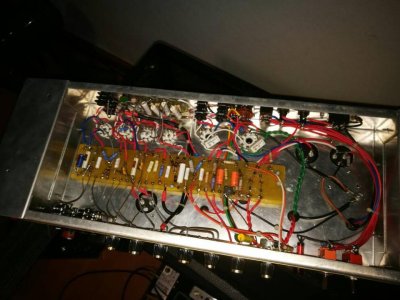
 plate voltage