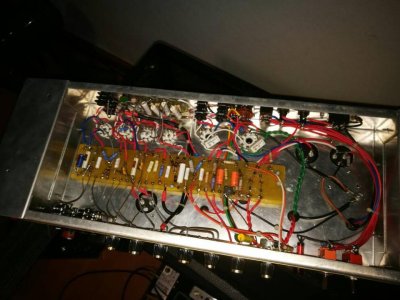
First time biasing an amp - is this procedure correct?

Archer250

Well-known member
After a full year and a quarter of daily 4-hour use, the EL-34s in my amp are dying on me. I've been experiencing volume drops, crackling sounds and loud pops. Asked 3 different techs what they think and they all said it's time I get new tubes.

So, new Tung-Sols are on the way (I'm currently using JJs, but want to try something new), and I'm here watching amp biasing videos.

I'm also practicing pulling the chassis out of the head and reassembling the amp afterwards.
IMG_20160927_115813.jpg

I'm gonna need someone to confirm or correct this:

0)Install new tubes
1)Take chassis out of head
2)Insert speaker load and power cable
3)Setting the multimeter to highest, check the plate voltage at pin 3, with black wire grounded to chassis
4)Calculate dissipation, blah blah blah, get numbers
5)set multimeter to 200mv, check the bias point (in this case, a resistor to ground)
6)adjust bias trim pot to no more than 70% dissipation ➗ plate voltage

Am I missing anything?
Also, as long as I don't **** with the caps, I won't get fried, right?

Sent from my EVA-L19 using Tapatalk
 
Last edited:
Re: First time biasing an amp - is this procedure correct?

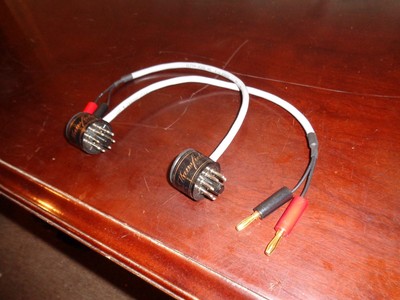
Years ago, I invested in a pair of bias probes like this and they've served me well. I still use the external bias points on amps that have them, but if not... then I just plug these in-line and go at it that way.

EVERY newly-built tube amp should have external bias points IMO (unless their self-biasing).

$_1.JPG


And yes... I make sure to stay away from those caps as well when I do have to go inside the chasis.
 
Re: First time biasing an amp - is this procedure correct?

I like the probes for plate voltage setting, I have test points on the dsl so thats nice
 
Re: First time biasing an amp - is this procedure correct?

I like the hook type test leads. They let you monitor the tubes and keep your hands clear. Like these http://www.ebay.com/itm/1Pair-For-M...Test-Hook-Clip-Probe-Lead-Wire-/172309246747?

I use two meters as well so I can monitor the tubes without moving leads around. At any rate, you pretty much have it covered. Only thing I would do is check bias as it is right now just to see where you are. Then shut it back down, let things cool down. Then crank bias pot down (counterclockwise) before turning back on with the new tubes installed. Get bias in ball park and then let the tubes heat up thoroughly and tweak. I give them 30 minutes, but that's just me.
 
Last edited:
Re: First time biasing an amp - is this procedure correct?

I like the hook type test leads. They let you monitor the tubes and keep your hands clear. Like these http://www.ebay.com/itm/1Pair-For-M...Test-Hook-Clip-Probe-Lead-Wire-/172309246747?

I use two meters as well so I can monitor the tubes without moving leads around. At any rate, you pretty much have it covered. Only thing I would do is check bias as it is right now just to see where you are. Then shut it back down, let things cool down. Then crank bias pot down (counterclockwise) before installing and biasing new tubes. Let the tubes heat up thoroughly. I give them 30 minutes, but that's just me.
Do I let them heat up on standby?

Oh and I'm using alligator clips. Gotta turn the amp on standby before removing them, right?

Sent from my EVA-L19 using Tapatalk
 
Re: First time biasing an amp - is this procedure correct?

Do I let them heat up on standby?

Oh and I'm using alligator clips. Gotta turn the amp on standby before removing them, right?

Sent from my EVA-L19 using Tapatalk

No, after you get them installed turn the amp on ... you can keep it in standby for a minute or so like you usually do before flipping the switch, but you need to bias with the amp out of standby. What I'm talking about is watching for the bias to drift as the tubes get hot. It will drift a little bit as they get hotter. Alligator clips will work. I like the hook clips because they are small.

I shut everything down when I'm done and then remove the leads and meter. But you can do it with the amp on standby or even on. You just need to be careful about shorting something and keeping hands out of there. Even with amp off because the big caps hold a charge. For reference ... You can drain the caps by clipping a lead from a V1 plate resistor to the chassis/chassis ground. It takes a few minutes but easy to do when you need to get your hands in to work on the amp. Just use a meter to monitor when the voltage has dissipated.
 
Last edited:
Re: First time biasing an amp - is this procedure correct?

Will do. Thanks

Sent from my EVA-L19 using Tapatalk
 
Re: First time biasing an amp - is this procedure correct?

Will do. Thanks

Sent from my EVA-L19 using Tapatalk

No problem. Don't sweat it, it's easy. Keep hands out and you'll be fine. Make sure that you have either a speaker a cabinet or a dummy load connected to the output.
 
Re: First time biasing an amp - is this procedure correct?

Ok, here it goes. It's obligatory to say - you know about the filter caps, AND make sure you don't touch anything connected to the mains power (on or off; the amp is plugged in). It's common sense: you don't want to be a pussy about it, but you don't want to be a moron about it either. Wear rubber soled shoes, work with dry hands in a dry workplace (moisture lowers the body's resistance, with the largest resistor being skin), and treat everything as if it's "live" at all times. The reason you work with one hand is so that if you do get bit, the circuit only closes through your hand and no permanent damage is done (whereas the circuit closing through your chest can be dangerous). Just respect the electricity, and remember that you need voltage to carry a current through a resistor (the body). 1000 Amps through 1mV will do nothing. 2 Amps though 1kV can kill you with ease. As for draining caps, you can do a half-ass drain by playing it, and then shutting the power off without going to standby first, or you could short the caps in a controlled manner (an inline resistor) or short the caps with a metal screwdriver (with a non-conductive handle, and this method causes sparks).

On your multimeter, connect the black (negative) to the chassis, and clip it. Work with one hand just holding the red probe.

1) First, which model is this a clone of again? Check the bias input voltage. If this is a 1959 Plexi clone for example, the negative bias input would be between the 47K resistor (on the 27K-L bias pot) and the two 220K resistors (one 220K resistor going to pin 5 - the bias input grid - of each power tube). Refer to a schematic if you have one, or ask the builder what the voltage should be around (it's a negative number; on a 1959 Plexi it should be around -63V IIRC). You want to make sure it hasn't drifted too far off, otherwise you won't have the correct biasing range. This can be done on standby.

2) Now, if you haven't done this already (or the builder for whatever reason didn't build it this way to begin with - I can't tell from the picture), the ground wire from the cathode (pin 8) should be removed and replaced with a 1 ohm resistor (*NOT* 1K ohm; 1 ohm) between pin 8 and the same chassis ground point as the original wire. The 1 ohm resistor should preferably with a very tight tolerance (like below +/- 2% if you can) and with a rating of more than 3 Watts (to be on the very safe side). I'll get to why this is done in a bit, and once it's done you can leave the resistor in place and never have to change it again (unless it goes bad). You want the tightest tolerance resistor you can find, as this gives you a smaller margin of error in your bias reading. This should be needless to say, but the amp should be completely off when doing this.

3) Turn the amp on, speaker load connected, standby in the "play" position, all knobs on zero. Measure the plate voltage (pin 3) of each tube. This should be around 400v for a 1959 Plexi, but it varies from different amp models/tubes type. For example, my '77 Bassman 70 that I converted to a dual-bias control (I may do a write-up on how to do that for Silverface Fenders), the plate voltages for both of my 6L6GC's were around 515V (part of the reason these plate voltages are so high, even for 6L6GC's, is because the amp is ultra-linear by design). Once you have your plate voltages, use a bias calculator like this one, set it to Class AB/EL34/Recorded Plate Voltage and hit go. I personally like 70% dissipation, but you may like something different.

4) Carefully (one at a time) connect the black multimeter probe to the grounded side of the 1 ohm resistor, and the red probe to the other side of the resistor which connected to the cathode (pin 8). You can select either tube to do this. Set your multimeter to the 0-200 mV range. The reason the multimeter is in mV, but we're measuring mA, is because of the equation V=IR. If for example, I=40 mA and R = 1 ohm (this is why it is so important to have a tight tolerance on the resistor), then V=40 mV. The voltage and current readings will be the same - assuming the resistor is exactly 1 ohm. Adjust the bias control pot until you have the desired current reading/voltage reading across the cathode and ground. Once that is done, check to make sure the other tube has a similar reading (if it's completely different, your tubes aren't matched and they'll hum). If it checks out OK, you can shut everything down, reassemble the amp, and piss off the neighbors (because attenuators are for pussies).

If you're moving the bias pot across it's entire range, and it's not getting the reading you want, then you'd need to change the 47K resistor in-line with the 27K-L pot (or get a pot with a wider range, with the trade off being a less accurate bias with the higher range you have). This would require a bit of experimenting, and is a bit of a PITA (I had to do it for the dual-bias conversion).

I know my instructions look like a wall of text, but I just tried to be as detailed as possible to help avoid making mistakes. It really isn't too hard, and after you've done it once, you'll never really forget how to do it.
 
Last edited:
Re: First time biasing an amp - is this procedure correct?

2) Now, if you haven't done this already (or the builder for whatever reason didn't build it this way to begin with - I can't tell from the picture), the ground wire from the cathode (pin 8) should be removed and replaced with a 1 ohm resistor

Thankfully he doesn't have a fancy bias probe and installed those resistors into the amp already.

Thanks a ton for your instructions!
 
Re: First time biasing an amp - is this procedure correct?

Thankfully he doesn't have a fancy bias probe and installed those resistors into the amp already.

Thanks a ton for your instructions!

No problem, and you're lucky. I had to install them, and the area by the power tubes is really crammed on my amp. I could barely fit the resistor in, and then I had to actually try and solder the thing without the iron hitting a bunch of wires.
 
Re: First time biasing an amp - is this procedure correct?

Just bought a multimeter. Checking the old tubes... either the bias drifted quite a bit after 16 months, or the builder biased it on the hot side. Plate voltage is right around 450V. With EL34s, bias should be around 38.8mv per valve (according to the Weber calculator)... the actual bias is 41mv. Injured myself reassembling the head. I'm taping the edges of the chassis now.
 
Re: First time biasing an amp - is this procedure correct?

Just bought a multimeter. Checking the old tubes... either the bias drifted quite a bit after 16 months, or the builder biased it on the hot side. Plate voltage is right around 450V. With EL34s, bias should be around 38.8mv per valve (according to the Weber calculator)... the actual bias is 41mv. Injured myself reassembling the head. I'm taping the edges of the chassis now.

Could have drifted. As long as the bias pot is not near the extreme ends of it's travel, the new tubes should bias up fine without changing out a resistor. Looks like just one bias pot, so you may need to be a bit flexible with your desired target bias point. Just depends on how closely the new tubes are matched. I fairly recently got two sets, in a row, that were out by over 8mv between tubes. One pair was factory matched. The next was from a popular tube dealer, burned in and matched. Both got sent back. The dealer admitted poor matching and the replacement pair from the dealer were ok at about 3mv apart ... but took 2+ weeks for them to get around to checking the returned tubes and sending me replacements. Best luck I've had recently in terms of getting really well matched tubes has been from Tube Depot and the Apex Matched Tubes from AES/Amplified Parts. Pretty small sample size though so it may have been good luck.
 
Re: First time biasing an amp - is this procedure correct?

Tubes are coming tomorrow. Can't wait lol

Sent from my EVA-L19 using Tapatalk
 
Re: First time biasing an amp - is this procedure correct?

Could have drifted. As long as the bias pot is not near the extreme ends of it's travel, the new tubes should bias up fine without changing out a resistor. Looks like just one bias pot, so you may need to be a bit flexible with your desired target bias point. Just depends on how closely the new tubes are matched. I fairly recently got two sets, in a row, that were out by over 8mv between tubes. One pair was factory matched. The next was from a popular tube dealer, burned in and matched. Both got sent back. The dealer admitted poor matching and the replacement pair from the dealer were ok at about 3mv apart ... but took 2+ weeks for them to get around to checking the returned tubes and sending me replacements. Best luck I've had recently in terms of getting really well matched tubes has been from Tube Depot and the Apex Matched Tubes from AES/Amplified Parts. Pretty small sample size though so it may have been good luck.

I'm lucky, because I'm friends with my electronics supplier and I can hand-pick and test my tubes on the spot and then pay for them at cost. That, and my Silverface had the output tubes matching + hum balance controls, so I could replace the hum balance control with fixed resistors and cannibalize those two holes for a fixed-bias control for each power tube. That way any working 6L6GC can be used with another regardless of matching from the factory and simultaneously control the dissipation for each individual tube. It's a really nice setup that I think every amp should have.
 
Re: First time biasing an amp - is this procedure correct?

I hate it when I prefer the amp's tone biased hot, but don't want to finance new tubes every year.

Sent from my EVA-L19 using Tapatalk
 
Re: First time biasing an amp - is this procedure correct?

I usually don't think it's too bad buying new tubes every year (in addition to a spare backup set), but then again, I don't know how much they cost in Thailand/if there's a serious markup or anything. What's it like after the currency conversion? I've the same tubes in my Bassman for over a year (they were in the amp when I bought it), and aesthetically, the tubes look like they were used a lot before I even bought the amp (but it's really a mystery). The pair I'm using are Groove Tubes 6L6GC GE reproductions, and I can't remember what those cost, but they seem to be holding up pretty well since I've been running the amp hot for a couple months on top of over a year's use. I don't know if most GTs are like that, or if it's just the GE reproduction. My spares are JJs. Sometimes I'm also tempted to try the absolute cheapest no-name tubes I can find, just to take a risk and see if I'd be pleasantly surprised.
 
Last edited:
Re: First time biasing an amp - is this procedure correct?

I usually don't think it's too bad buying new tubes every year (in addition to a spare backup set), but then again, I don't know how much they cost in Thailand/if there's a serious markup or anything. What's it like after the currency conversion? I've the same tubes in my Bassman for over a year (they were in the amp when I bought it), and aesthetically, the tubes look like they were used a lot before I even bought the amp (but it's really a mystery). The pair I'm using are Groove Tubes 6L6GC GE reproductions, and I can't remember what those cost, but they seem to be holding up pretty well since I've been running the amp hot for a couple months on top of over a year's use. I don't know if most GTs are like that, or if it's just the GE reproduction. My spares are JJs. Sometimes I'm also tempted to try the absolute cheapest no-name tubes I can find, just to take a risk and see if I'd be pleasantly surprised.
Going by tubedepot's prices, a new JJ EL34 costs roughly the same as does the list price of new production Mullard.

That's around a $7 difference, not too much, but you know, 3rd world country with low HDI and standard of living.

Sent from my EVA-L19 using Tapatalk
 
Back
Top