First time user of oil that is tru

Re: First time user of oil that is tru

As far as I remember, tru oil is polymerised tung oil

As far as I know, "tru oil" is boiled linseed oil + shellac + secret sauce + solvent. In other words, it is resin in drying oil, which makes it a varnish by definition. Polymerized tung oil in reality, is smelly jelly. Rather disgusting one, I'd add.

The irony is Tru Oil is not true oil, but a varnish.
 
Re: First time user of oil that is tru

As far as I know, "tru oil" is boiled linseed oil + shellac + secret sauce + solvent. In other words, it is resin in drying oil, which makes it a varnish by definition. Polymerized tung oil in reality, is smelly jelly. Rather disgusting one, I'd add.

The irony is Tru Oil is not true oil, but a varnish.
I had a tub that I had put some tung oil in when I finished a neck. I left it in the garage on a shelf and found it quite some time later. Since it was so thick it was still somewhat soft feeling to the touch even after hardening for months. It wasn't gooey or anything, but I could push real hard and make an impression in it.
 
Re: First time user of oil that is tru

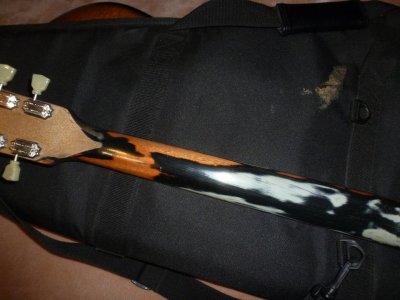
Heres the Biitchwood Casey Tru oil job I did on my 90's LP.Jr. Spcl. neck . Took me about ten days applying a medium thickness coat w/cotton Fruit of the Loom rag( drenched the rag, then wiped quickly or it would gum fast). Let dry 24hrs with fan on it, and then fine steel wool'ed it, use tack cloth and repeat.

After that it set up for 4 another 12 days, at which time I waxed the *** out of it, with BC Wax. Turned out amazing. FEELS LIKE A DIAMOND IMPREGNATED SURFACE;

003.jpg
 
Last edited:
Re: First time user of oil that is tru

Heres the Biitchwood Casey Tru oil job I did on my 90's LP.Jr. Spcl. neck . Took me about ten days applying a medium thickness coat w/cotton Fruit of the Loom rag( drenched the rag, then wiped quickly or it would gum fast). Let dry 24hrs with fan on it, and then fine steel wool'ed it, use tack cloth and repeat.

After that it set up for 4 another 12 days, at which time I waxed the *** out of it, with BC Wax. Turned out amazing. FEELS LIKE A DIAMOND IMPREGNATED SURFACE;

View attachment 62574

Why does this neck look more like a cow hide stretched over some wood?
 
Re: First time user of oil that is tru

I'm not sure that's the best example of what TruOil ends up looking like.

This is my red Tele's AllParts TMO-V finished with TruOil and frets dressed by Brian Mason (atrox over at Harmony Central, when it was alive).

6515abc2bc2a91f4520553bfa30c4b9e.jpg

f82c7d8ae6630a4284d058bda3e256fa.jpg

fd6733f2ad82b425dcb16a4743bb3a9a.jpg

5451ed181b6c62ca0f5800b61c5de2d3.jpg


I tried to capture what the finish looks like as best I could. He didn't apply a lot but it's definitely not raw wood. It's a softer, satiny finish as he applied it.

The body was done by me with Formby's tung oil over StewMac cherry red dye (Warmoth ash body).
 
Re: First time user of oil that is tru

TOh i see

The only other oil i have used was a solvent based minwax oil that came in a can. Its funny the one that comes in the tin doesn't respond to automotive polishes etc but the water based one does.

Customer was happy with it.
 
Re: First time user of oil that is tru

I've tried the cloth method and it works fine if you're looking for a minimalist application and want to do a million coats, but I really like rubbing the TruOil in by hand. I can't really explain it, but it feels good and you have a lot of control over how it lays. You can do nice, thin, even coats and it requires minimal sanding for smoothness. I can do just a few coats this way for a satin finish or several for the more glossy finish in that picture I posted.

Doing it by hand, you can feel the coats blending as you rub and, while the coats may go on a little bit heavier than with the cloth method, they are certainly not "thick" by any means. This also limits the "witness lines" you hear others encountering when they sand through those many ultra-thin layers.

I don't wait days between coats, either, only hours, but I live in Arizona where the humidity is low and it remains rather warm most of the year. I think the key is figuring out the proper time between coats based on the climate you're in without waiting too long.

The one part I do give extra time is the curing phase. After the final coat, once I have the finish and smoothness I want, I let the neck cure for close to 2 weeks before I do anything to it. This results in a rock hard finish that has held up very well so far.

One tip about the fingerboard...after the TruOil cures, you can go over it with a wipe-on poly for extra protection. Also, if you plan on putting any type of decal on the headstock, I suggest applying wipe-on poly to the headstock face, as well, prior to attaching the decal.
 
Re: First time user of oil that is tru

Once I have a free day I'm going to be finishing this with some stain then applying TruOil over it.

bb21e4089a7cd18bd4eb773e411e78ca.jpg


A sample of the stain, applied lightly as a test.

c48c527858fc8fc6a57ff9be297d76ce.jpg
 
Re: First time user of oil that is tru

I've tried the cloth method and it works fine if you're looking for a minimalist application and want to do a million coats, but I really like rubbing the TruOil in by hand. I can't really explain it, but it feels good and you have a lot of control over how it lays. You can do nice, thin, even coats and it requires minimal sanding for smoothness. I can do just a few coats this way for a satin finish or several for the more glossy finish in that picture I posted.

Doing it by hand, you can feel the coats blending as you rub and, while the coats may go on a little bit heavier than with the cloth method, they are certainly not "thick" by any means. This also limits the "witness lines" you hear others encountering when they sand through those many ultra-thin layers.

I don't wait days between coats, either, only hours, but I live in Arizona where the humidity is low and it remains rather warm most of the year. I think the key is figuring out the proper time between coats based on the climate you're in without waiting too long.

The one part I do give extra time is the curing phase. After the final coat, once I have the finish and smoothness I want, I let the neck cure for close to 2 weeks before I do anything to it. This results in a rock hard finish that has held up very well so far.

One tip about the fingerboard...after the TruOil cures, you can go over it with a wipe-on poly for extra protection. Also, if you plan on putting any type of decal on the headstock, I suggest applying wipe-on poly to the headstock face, as well, prior to attaching the decal.

Thanks for the advice. Do you use gloves?
 
Re: First time user of oil that is tru

tru-oil finish:

IMG_0525-1 copy.jpg


in my experience DO NOT WET SAND!!!

start building up layers until its noticeable on the wood
you can probably do 2-3 coats per day. leting it sit for a few hours between applications

don't know how many coats this will take. but once it starts showing up, then 2-3 coats over 48 hours. then let it sit for 2 days to dry.

then buff with 0000 steel wool, then 2-3 coats over 48 hours. let dry for 2 days. steel wool.

keep going like this

keep going

nope, you're not done yet. keep going.

then, when you've got a nice build up. then you let dry for 2-3 weeks.

then you use FINESE-IT 2

take a clean cloth. put a little bit on the rag and smear it into the rag. you don't want to glop that stuff onto the finish.

then start buffing to a high-gloss finish.

you can do the finese-it a few times. each time getting glossier and glossier
 
Re: First time user of oil that is tru

I've done a bunch of necks, and a Tele body with Tru Oil. I just never had good luck using cloth to apply it-no matter what I tried, I'd get lint/hairs/crud in the finish, plus the cloth would get all gummy and leave bits of semi-hard TO all over. What I ended up using was coffee filters-they don't shred or come apart, they don't leave anything behind on the wood and you can get a pack of them for, like, a couple bucks. I've oiled over paint and stains, it seems to stick to anything, but getting stuff to stick to the oil (to bury decals and the like) is hard. Shellac seems to be the best thing I've found for that. Also, the oil seems to really bring out figure in the wood, I have a neck that just looked totally plain when I started, and now it has a bit of flame going on (not a lot, but it's definitely there.) As far as polishing it, just using worn denim seems to really make a nice sheen, and is super easy, compared to sanding/steel wooling. I dig using the oil, it just seems really easy and leaves a nice, hard finish.
 
Re: First time user of oil that is tru

Having finished furniture, use steel wool for finishing wood. I use sandpaper for prep only. And yes, many thin coats are better than one thick one. If you Do use paper, go with finer grits each coat 400, then 600, then 800 etc.. and onnly use the paper when you poly or clear it. Use steel wool on the stain to help take care of a raised grain.
 
Last edited:
Re: First time user of oil that is tru

Steel wool can leave behind microscopic particles. I would recommend auto grade wet/dry sandpaper. You can get it as fine as 7000 grit.
 
Re: First time user of oil that is tru

Steel wool can leave behind microscopic particles. I would recommend auto grade wet/dry sandpaper. You can get it as fine as 7000 grit.

that might be a good alternative.
you have to make sure the last coating of tru oil is completely dry before using the steel wool (or 4000+ wet/dry sand paper), and wipe off the surface thoroughly. i've used a cloth moistened with lemon oil to get the surface 100% clean of dust and debris.
i think the idea with the steel wool is to get a physical bond between the layers.

the finese-it WORKS!!!
just don't apply it directly to the surface. that was my mistake a number of times. apply the finese-it (or its equivalent) to a rag, and rub it into the rag. then rub it on the finish.
use a medium amount of pressure. you don't want to rub through any layers of tru oil. but let that last application of tru oil sit for a couple weeks before finese-it'ing it.
do a few applications of finese-it, going lightly at first and see how it works. its fun stuff to use.
i thought the first application made the finish "pop"... then i tried a second, and HOLY CRAP!!! even glossier.
then i thought "a third finese-it buffing wont do anything at all, i'm just going to screw up again chasing after that last 5%..."
but that is what you see above.
it really looks liquidy in real life.
 
Last edited:
Back
Top