First trip ever to Luthier

Re: First trip ever to Luthier

I have various sizes of abrasive cord. I use it for flossing my nuts :banana:
Seriously, it works really well for cleaning/smoothing the slots or maybe opening them up a hair, if needed. Or just taking a hard back edge off of a slot where the string breaks at an angle to the tuning machine and is binding on that edge.
Wont take the place of real slotting files, but works good for tweaking.
 
Re: First trip ever to Luthier

Not Hijacked at all. Have at r.

I collected the guitar for the luthier. He spent a great deal of time correcting the problems with the guitar.
It now has pretty low action, I'd guess it to be around 3/64" on the low E, without measuring. He ended up having to remove, clean the slots and reset at least half doz loose frets. He might of even done a very mild re-leveling of the frets. The guitar plays extremely well now. N.C. for all that extra work. Not that he charged me a lot to begin with. I'm quite sure it would of added greatly to the cost of work completed earlier. Yet again very nice finish on the work. i'm very happy pleased with the condition of the guitar now. It is very obvious just how straight the neck is now. I'm tempted to say he bent over backwards solve the problems. Strange as it might sound; seeing the finished work; He stood behind his work and i would have to recommend him.

He's willing to do this much work to correct the problem. In one sense that's a good thing. But...why couldn't/didn't he do it in the first place?!! It would have been better for the customer, better for his reputation, and better for his business with lots of referrals.

As it is, even though he corrected the issues, I wouldn't go back to him again because I couldn't trust that he would do things right the first time and I'd have to take it back (at least once) to get it right. My time and my sanity and peace of mind are too valuable for that kinda treatment.

It's like he was testing you to see what he could get away with.
 
Re: First trip ever to Luthier

D and G strings are tricky on Les Pauls because of the angle. The slot has to be both angled and gradually larger at the exit to prevent binding.

The one thing that many techs lose sight off is the slot only need be deep enough to keep the string in place. So think "notch" over "slot."

The tell tells pinging is more a sign the slot is too deep that too small.

How I do mine

View attachment 86626

View attachment 86627

That first nut appears to be superb. Great job. I would personally like the slots a bit deeper on that Strat, looks like the lower strings could pop right off during string bends.
 
Re: First trip ever to Luthier


Didn't mean to hurt your feelings at all!

Just checked that link. It seems to work, it just looks a little shallow to me. I usually like to get the slots half the thickness of the string deep. On a Les Paul there is more downward force of the string on the nut so it will stay in place better. Even on a Strat there is a lot of force on the low "E" string so I guess it's ok. As long as it works and doesn't come out while playing we're good.
 
Re: First trip ever to Luthier

I view the nut slot just like a saddle notch, just enough to keep the string in place. Why make it deeper and risk binding if you don't have to?

Yes, they will work for saddle notches.
 
Re: First trip ever to Luthier

Now I have to ask. If the nut is too shallow, doesnt the string have to move farther to be fretted? Some people dont like super big frets for the same reason? I am no expert by a long shot, but couldnt the nut being shallow make the notes sharp near the nut? Isnt that the reason for a compensated nut? Just trying to learn something
That Schecter I just bought that sounds thin, I will give it this. An F Barre chord sounds balls on to me, at least closer than any other guitar i have, 1st fret of course
 
Last edited:
Re: First trip ever to Luthier

Doc was saying he thought the walls were too shallow, not the slot itself. However, you are correct that a slot that is too tall can pull the note sharp and throw off intonation. A compensated nut slightly changes the breakpoint of the string in an effort to improve overall intonation.

Most new guitars have nuts that need some work to suit the final user's playing style or strings.

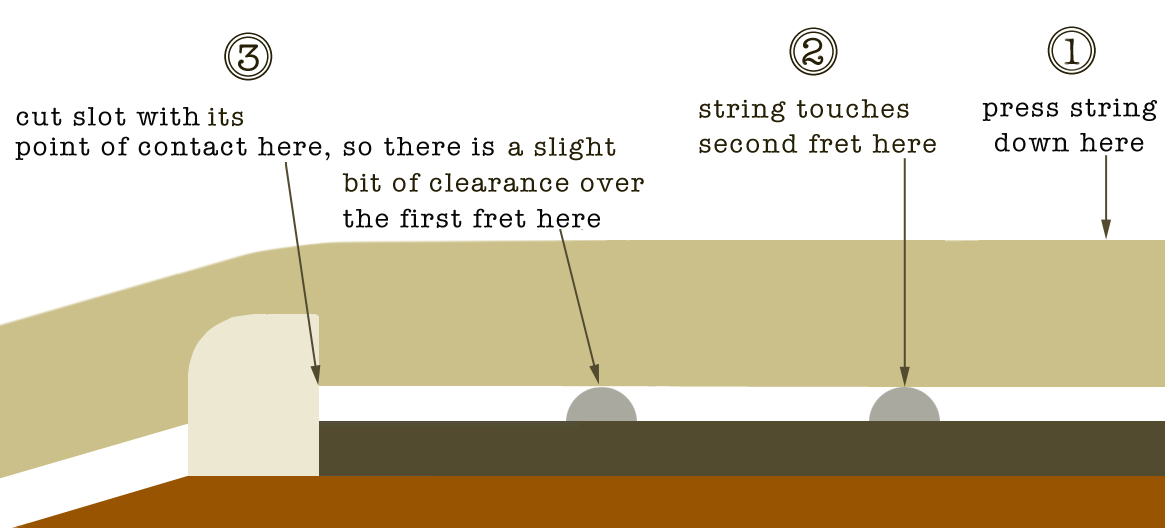
Fret your Schecter at the third fret and look at the gap between the string bottom and the first fret.

nutslot4b.jpg
 
Re: First trip ever to Luthier

I think it's best to use feeler gauges to be more precise. I like 0.022" E - 0.018" e height at the 1st fret for medium nut action with some string to push against but won't push your notes sharp. 0.020" E - 0.016" e is low for effortless playing but will not buzz.
 
Re: First trip ever to Luthier

Now I have to ask. If the nut is too shallow, doesnt the string have to move farther to be fretted? Some people dont like super big frets for the same reason? I am no expert by a long shot, but couldnt the nut being shallow make the notes sharp near the nut? Isnt that the reason for a compensated nut? Just trying to learn something
That Schecter I just bought that sounds thin, I will give it this. An F Barre chord sounds balls on to me, at least closer than any other guitar i have, 1st fret of course

There's a difference between a shallow "slot" and a "tall" nut. You can have a short nut with very shallow string slots that leaves the strings almost resting on the first fret (requiring almost NO stretching of the string to fret them). And you can have a very tall nut with very deep slots that still leaves the strings high off of the first fret (requiring a lot of string stretching even though the slots are deep).
 
Re: First trip ever to Luthier

I think it's best to use feeler gauges to be more precise. I like 0.022" E - 0.018" e height at the 1st fret for medium nut action with some string to push against but won't push your notes sharp. 0.020" E - 0.016" e is low for effortless playing but will not buzz.

Perhaps those measurements work, but all things need to be taken into consideration (fret leveling, neck bow, string gauge, player's style, etc). A specific measurement is only a good place to START when doing nut filing as part of a complete setup.
 
Re: First trip ever to Luthier

Frets and neck bow are set beforehand and so are irrelevant. As to playing style, that's why I listed 2 heights. Like you say, my way isn't the only way, but my descriptions of the heights are accurate. Lower than my low measurement will feel low and much higher than my high measurement will border on pushing notes sharp.
 
Re: First trip ever to Luthier

Frets and neck bow are set beforehand and so are irrelevant. As to playing style, that's why I listed 2 heights. Like you say, my way isn't the only way, but my descriptions of the heights are accurate. Lower than my low measurement will feel low and much higher than my high measurement will border on pushing notes sharp.

Why would you say that how level and how high the frets are and how much bow is in the neck are "irrelevant"? Of course they're relevant! Yes, they are generally set before you finalize the nut, but they are NOT the same for every guitar/playing style, so they absolutely have an affect on string height.

And string gauge? Do you consider THAT irrelevant too?

And by giving a specific range of string heights, then you are admitting that those are only a good starting point and that a players style will dictate the end result (like I said in my post). So why are you even responding to my post?!

ps: even with strings so low that they buzz on every fret, a heavy-handed player can still push the notes sharp between the frets, especially if they are tall frets. That's one reason why fret leveling can be player specific and definitely an important part of the equation. Just thought I'd mention that in case you hadn't noticed it yourself.
 
Re: First trip ever to Luthier

No, they're not only a good starting point. They'll work for any set up. I don't know why you're bringing up all these semantics. Are you really going to tell Ben, who needs help with his nut action, to eyeball it?!
 
Re: First trip ever to Luthier

Are you really going to tell Ben, who needs help with his nut action, to eyeball it?!

Yes, the strings only need be just above the fret as in the illustration. You can use a feeler gauge if you want, but most techs will do the final set up based on sight and feel.
 
Re: First trip ever to Luthier

What heights above the 1st fret when not held does that method yield?
 
Back
Top