Gibson wiring: Modern, 50's, but what is this?

beaubrummels

Well-known member
I'm well aware of "Modern wiring", "50's wiring" and the "independent volume" mod, but I've noticed my recent SGs have a flavor I don't recognize. What is it when the caps go from the PUP input to the outside lug of the tone pot? (Keep in mind, these are audio taper pots, for whatever affect that has on going to the outside vs the wiper.)

Compare my SG wiring:
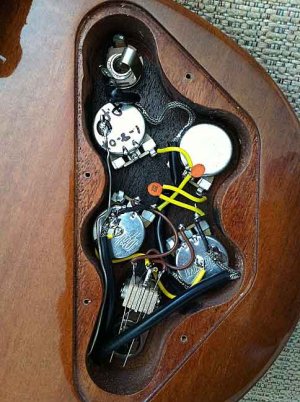
SG_wiring.jpg

...with my Les Paul wiring, which is typical Modern wiring:
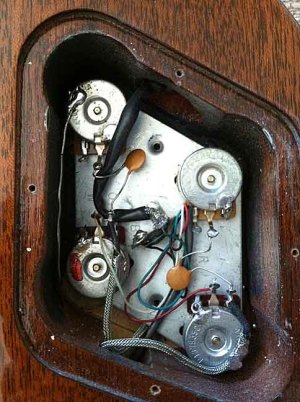
LP_wiring.jpg
 
Re: Gibson wiring: Modern, 50's, but what is this?

There are 8 different ways to wire a tone pot, that are electrically and mechanically identical:

Tone Pots
 
Re: Gibson wiring: Modern, 50's, but what is this?

Yep, its the attachment to the volume pot that is important.
 
Re: Gibson wiring: Modern, 50's, but what is this?

So I'll follow up with a dumb question: How is it that having the resistor before the cap is identical to having it after?

Mathematically, I can see yes, but functionally I would expect if the signal is being resisted prior to entering the cap, that something would be different on the output compared to when the signal is being resisted coming out of the cap. Maybe I'm overthinking/not thinking.
 
Re: Gibson wiring: Modern, 50's, but what is this?

The resistor is the 'degree of difficulty for entry'. The cap is like a bouncer on the door that only lets the hot girls through. Either way, the bouncer ain't gonna let you through if you're an ugly git, but if there's a big crowd blocking your way you won't get in even if you're hot.
 
Re: Gibson wiring: Modern, 50's, but what is this?

What you have is electronically the same as modern wiring. The tone pot is in series with the volume control. If the capacitor leg connected to the volume pot's outer lug was swapped to the volume's wiper lug, the tone control would be in parallel with the volume control - making it '50s wiring.
 
Re: Gibson wiring: Modern, 50's, but what is this?

So I'll follow up with a dumb question: How is it that having the resistor before the cap is identical to having it after?

Mathematically, I can see yes, but functionally I would expect if the signal is being resisted prior to entering the cap, that something would be different on the output compared to when the signal is being resisted coming out of the cap. Maybe I'm overthinking/not thinking.

The signal out of a guitar pickup is AC. (Alternating current.)

Did you stroke "down", or stroke "up" on your 1st pick attack? ;)

That's why it doesn't matter which comes 1st. There is no "1st".
 
Back
Top