Guitar Neck Pitch/Angle

ryanrobles

New member
I am planning to begin a guitar build from scratch, and need some advice.

Some guitars feature a neck which is angled back in relation to the body e.g. Gibson Les Pauls whose necks are at 17 degrees to the body. Why??

I have found 2 answers on the net...
(1) Whether a neck angle is required is driven by the hieght of the bridge/trem. A tune-o-matic bridge is higher than a Fender trem, therefore neck pitch is necessary to achieve proper action. I understand this, but why do PRS Trem guitars have a neck angle?? The PRS trems appear to be fairly low profile. Can someone explain?

(2) Neck angle effects neck/body resonance and, to some extent, tone. I.e. the greater the neck angle, the greater the transfer of energy. I dont understand this - can someone explain?? Should I build in a slight angle (5 degrees?) even though it is not necessarily needed to achieve proper action?

Any advice or discussion would be appreciated!

Ryan UK
 
Re: Guitar Neck Pitch/Angle

I am planning to begin a guitar build from scratch, and need some advice.

Some guitars feature a neck which is angled back in relation to the body e.g. Gibson Les Pauls whose necks are at 17 degrees to the body. Why??

I have found 2 answers on the net...
(1) Whether a neck angle is required is driven by the hieght of the bridge/trem. A tune-o-matic bridge is higher than a Fender trem, therefore neck pitch is necessary to achieve proper action. I understand this, but why do PRS Trem guitars have a neck angle?? The PRS trems appear to be fairly low profile. Can someone explain?

(2) Neck angle effects neck/body resonance and, to some extent, tone. I.e. the greater the neck angle, the greater the transfer of energy. I dont understand this - can someone explain?? Should I build in a slight angle (5 degrees?) even though it is not necessarily needed to achieve proper action?

Any advice or discussion would be appreciated!

Ryan UK
Those are two different neck angles and they're both correct.
The first is talking about the neck pocket joint.
The second, I think, is referring about the headstock angle.
Compare a Les Paul headstock to a Tele/Strat headstock and you'll see what they are referring to.
Tele/Strats use a no-angle headstock and need string trees to get that energy transfer.

Which PRS guitars are you referring to?

Have you picked up any good "how to build a guitar" books?
I'm at work so I can't dig up the titles of the ones I've got, but they tend to explain those sorts of things pretty well.

Good luck.
And post pics of your build. :)
MM
 
Re: Guitar Neck Pitch/Angle

neck angle CAN be a factor in string tension. Jag owners know this a bit :D

angle.jpg


More neck angle means more tension, all other things being equal, because when the bridge is raised, the string angle becomes steeper.
 
Re: Guitar Neck Pitch/Angle

Gibson's neck/body angle puts additional pressure on the bridge, along with the sharp angle of the bridge to the stop bar, which transfers more vibrations to the body, and more of the wood's tone to the PU's.

Fender went the other direction & put everything in the same plane to simplify production, and used a longer scale length to get more pressure & vibration to the body (strings have to be tighter to reach the same pitch). It doesn't push the bridge into the wood as strongly as a Gibson though.

Obviously both ways work.
 
Re: Guitar Neck Pitch/Angle

PRS guitars are more like Fenders in that regard... there is no noticeable angle on the neck/body joint, but there is a headstock angle from the nut to the tuners.

I don't think a Tune-O "needs" a neck angle to work though... I don't think Schecters have a lot of angle... and my '03 LP Special has practically no pitch either so the Tune-O sits waaaaaaay low.
 
Re: Guitar Neck Pitch/Angle

I am planning to begin a guitar build from scratch, and need some advice.

Some guitars feature a neck which is angled back in relation to the body e.g. Gibson Les Pauls whose necks are at 17 degrees to the body. Why??

I have found 2 answers on the net...
(1) Whether a neck angle is required is driven by the hieght of the bridge/trem. A tune-o-matic bridge is higher than a Fender trem, therefore neck pitch is necessary to achieve proper action. I understand this, but why do PRS Trem guitars have a neck angle?? The PRS trems appear to be fairly low profile. Can someone explain?

(2) Neck angle effects neck/body resonance and, to some extent, tone. I.e. the greater the neck angle, the greater the transfer of energy. I dont understand this - can someone explain?? Should I build in a slight angle (5 degrees?) even though it is not necessarily needed to achieve proper action?

Any advice or discussion would be appreciated!

Ryan UK

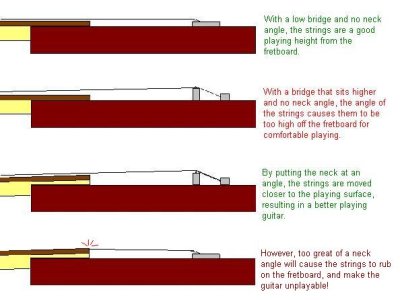
first: that 17 degree angle on gibsons is the HEADSTOCK angle, not the neck angle. The actual neck angle on a Les Paul is about 4.5 degrees (so the neck is angled at 4.5 degrees in relation to a flat plane that hits the body at the peak of the carved top, and then the headstock is another 17 degrees in relation to the neck itself). Why? (read on)

second: yes, the neck angle on a gibson is definitely tied to the height of a tuneomatic. However, it is possible to build in a neck angle even with a lower bridge like the PRS trem which partially explains why on a PRS, the neck angle is a bit less, I think it's 3 degrees, and the PRS headstock is 10 or 11 degrees in relation to the neck. You could still use a tuneomatic and not have a neck angle at all, but if you want to keep the fretboard flat on the body, like a les paul, then you need to build in a neck angle to save your string action. Otherwise, to have consistent action and no neck angle, you would have to raise the entire neck and have the fretboard standing proud of the guitar's top. That way it would look more like a fender, except with the bridge height being that much higher than a fender style bridge, the neck would also have to be significantly higher than a fender neck usually is.

Perhaps this will help to illustrate it:

NeckAngle.JPG


I'm not entirely sure I believe that a change in neck angle equals a change in tone. More likely it's a question of how the neck is jointed to the body. An angled set neck sounds pretty different than a flat bolt on neck, but that has very little to do with the angle and a lot to do with the construction method, the geometry of the joint, and the quality of the joint.
 
Last edited:
Re: Guitar Neck Pitch/Angle

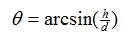
in terms of figuring out your neck angle...


if you take a flat plane at the same level as the base of your bridge ie at the peak of the carved top, and you figure out where you want the strings to intersect that plane, then your neck angle is: neckangle.jpg, where h is the bridge height, and d is the string distance from the intersection of the string and bridge plane, to the top of the saddle
 
Back
Top