Help trying to understand this wiring diagram

Jack_TriPpEr

Well-known member
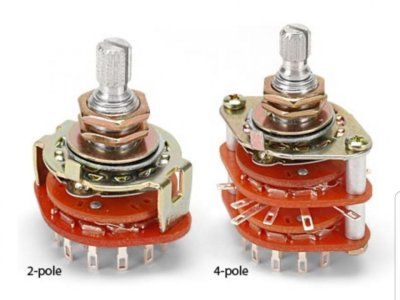
Since I am considering using a 4 pole rotary switch available from StewMac.com like this in an upcoming project:
20190528_081355.jpg

.. i have been trying to get educated on how Rotary Switch wiring works.

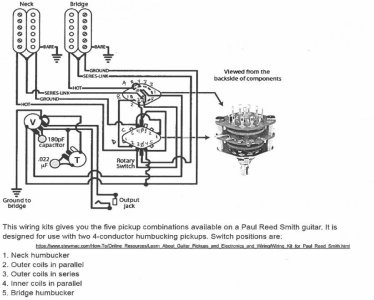
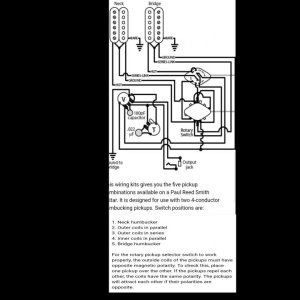
I have come across a few questions while trying to understand this wiring diagram on StewMac.com:
PicsArt_05-29-10.49.32.jpg

Following are my questions so far:

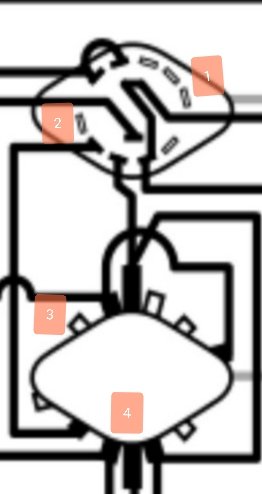
1. The diagram depicts the rotary switch as broken out to a "knob end" wafer with two poles and then below that a "back end" wafer that consists of another two poles.
Going in sequence from top to bottom, let's call each of these Pole 1, 2, 3 and 4.
20190529_231838.jpg

I cannot tell if this diagram treats Pole 1's 5 contacts and Pole 3's 5 contacts as (going left to right) being numbered 1 to 5? or 5 to 1?

2. The diagram depicts Pole 1's #0 (common) contact having both a direct connection to the Volume Pot's 1st lug, and an indirect connection to the Neck pickup's Hot wire, via jumpers from Pole 2's #2 contact (or #4 contact depending on the answer to my Question #1 above), and a jumper to Pole 4's #3 contact. My question is: is that connection to Neck pickup Hot Wire active all the time, or only some of the time (e.g. only when the Rotary Switch is turned to Positions 2, 3 and 4.)?

Thanks in advance
 
Last edited:
Re: Help trying to understand this wiring diagram

Decades ago is messed around with these kind of stacked rotary switches. I hated them, they make a very hard clicking noise which comes thru the amp. Nowadays there better devices on the market. Have you ever looked at Freeway switches?
 
Re: Help trying to understand this wiring diagram

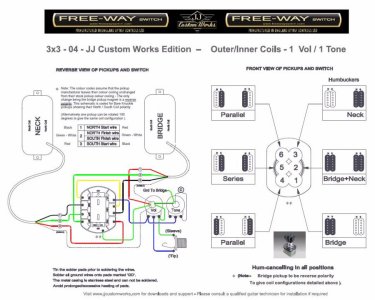
2E52EB82-4C8B-46BE-B097-8B4802AE11D6.jpgJust get the JJ Customworks version of the Freeway Switch. It does 6 positions. Does all the prs positions except the inner coils are in series instead of the outer coils being in series. You need to rotate the magnet or the pickup to get humcancelling though.
 
Last edited:
Re: Help trying to understand this wiring diagram

Regardless of how they are depicted, they all follow the same sequence. So if common "1" is at position "1", then all the commons are on position "1". Then they'd follow the sequence of 1-2-3-4-5 etc. However, the absolute best way to understand how a switch works, is to buy one and study it as you click through the positions. This is important because sometimes, some switch manufacturers do strange things.
 
Re: Help trying to understand this wiring diagram

Decades ago is messed around with these kind of stacked rotary switches. I hated them, they make a very hard clicking noise which comes thru the amp. Nowadays there better devices on the market. Have you ever looked at Freeway switches?

Yes, last year i read through posts about the Freeway switches here on the SD forum. It seemed the majority of members here claimed that the Freeway was a pain to work with/solder onto because the contact points are so small. Also, there were a fair amount of responses claiming quality issues/the switch would fail after not a lot of use.

Also, from what i read here on the SD forum and reviewing the Freeway site, those switches do not seem to support any and all custom switching schemes one may dream up, unlike a superswitch or a 4 pole rotary.
 
Re: Help trying to understand this wiring diagram

Regardless of how they are depicted, they all follow the same sequence. So if common "1" is at position "1", then all the commons are on position "1". Then they'd follow the sequence of 1-2-3-4-5 etc. However, the absolute best way to understand how a switch works, is to buy one and study it as you click through the positions. This is important because sometimes, some switch manufacturers do strange things.

I think my question #2 is more universal - not specific to just rotary switches. I.e. How do connections made via jumper wires work, regardless of whether they appear on a rotary or a 4 way switch or a 5 way switch or a superswitch, etc. Since in this case the jumper attaches to a Common lug, is that indirect/jumpered connection live/active in all 6 positions of the switch? Or only when the switch is in positions that touch the non-common contacts that the jumper runs through?
 
Re: Help trying to understand this wiring diagram

View attachment 98728Just get the JJ Customworks version of the Freeway Switch. It does 6 positions. Does all the prs positions except the inner coils are in series instead of the outer coils being in series. You need to rotate the magnet or the pickup to get humcancelling though.

Thanks. I just read up on the JJ Customworks switch. Unfortunately it does not fit the bill for me because it is not freely customizable in how each of the 6 positions can be assigned.... i am not actually interested in the 6 positions in that PRS/StewMac diagram that i referenced. I was only studying it to get an understanding of how to wire up a 4 pole rotary. And, as of now, i am not yet decided on what i want each of the 6 positions to do. That it is one reason i was considering the rotary, since it purportedly is 100% customizable in that regard.
 
Last edited:
Re: Help trying to understand this wiring diagram

Decades ago is messed around with these kind of stacked rotary switches. I hated them, they make a very hard clicking noise which comes thru the amp. Nowadays there better devices on the market. Have you ever looked at Freeway switches?

The noise you describe during switching must be a problem with older designs of this switch. I read through all 25 reviews on the StewMac site of this particular design, and none mentioned such a noise. One review even explicitly said the switch was quiet when moving through the 6 positions.

https://www.stewmac.com/Pickups_and_Electronics/Components_and_Parts/Switches/Rotary_Switches.html
 
Re: Help trying to understand this wiring diagram

2. The diagram depicts Pole 1's #0 (common) contact having both a direct connection to the Volume Pot's 1st lug, and an indirect connection to the Neck pickup's Hot wire, via jumpers from Pole 2's #2 contact (or #4 contact depending on the answer to my Question #1 above), and a jumper to Pole 4's #3 contact. My question is: is that connection to Neck pickup Hot Wire active all the time, or only some of the time (e.g. only when the Rotary Switch is turned to Positions 2, 3 and 4.)?

Thanks in advance

I think my question #2 is more universal - not specific to just rotary switches. I.e. How do connections made via jumper wires work, regardless of whether they appear on a rotary or a 4 way switch or a 5 way switch or a superswitch, etc. Since in this case the jumper attaches to a Common lug, is that indirect/jumpered connection live/active in all 6 positions of the switch? Or only when the switch is in positions that touch the non-common contacts that the jumper runs through?

I think I understand what you're asking. There's really no "indirect" connection. Every point that's connected with a wire is directly shorted together all the time. And the sequence of those connections is determined simply by what's convenient inside the guitar. For example, in that first diagram, you could disconnect the neck hot wire from the rotary switch and solder it instead to the hot lug of the volume control and it would make no difference in the functionality of that circuit. A short is a short. Anything hard-wired together is connected all the time.

Is that what you were asking?
 
Re: Help trying to understand this wiring diagram

If you read my answer well, you noticed its not a electrical but mechanical issue. You have to isolate the switch mechanically against the wood. Second i did not like the way it switched, its a hard stop.
If you read on this subject, you will see that folks tell the same about the Duncan Triple shots. Those guys imo simply can't solder delicate pieces of electrical connections. I guess they take 60 watt or more solder guns and put it to long onto such a joint.
 
Last edited:
Re: Help trying to understand this wiring diagram

I think I understand what you're asking. There's really no "indirect" connection. Every point that's connected with a wire is directly shorted together all the time. And the sequence of those connections is determined simply by what's convenient inside the guitar. For example, in that first diagram, you could disconnect the neck hot wire from the rotary switch and solder it instead to the hot lug of the volume control and it would make no difference in the functionality of that circuit. A short is a short. Anything hard-wired together is connected all the time.

Is that what you were asking?

Yes - that was it - Thank you ArtieToo!
 
Re: Help trying to understand this wiring diagram

I think I understand what you're asking. There's really no "indirect" connection. Every point that's connected with a wire is directly shorted together all the time. And the sequence of those connections is determined simply by what's convenient inside the guitar. For example, in that first diagram, you could disconnect the neck hot wire from the rotary switch and solder it instead to the hot lug of the volume control and it would make no difference in the functionality of that circuit. A short is a short. Anything hard-wired together is connected all the time.

Is that what you were asking?

By the way, in regards to question #1, after having mapped out the live connections in each scenario, i am fairly confident that this wiring diagram has been designed so that each of Pole A and Pole C's 5 contacts are treated as sequentially running from 5 to 1 (going from left to right), vs running 1 to 5.
 
Last edited:
Re: Help trying to understand this wiring diagram

I think I understand what you're asking. There's really no "indirect" connection. Every point that's connected with a wire is directly shorted together all the time. And the sequence of those connections is determined simply by what's convenient inside the guitar. For example, in that first diagram, you could disconnect the neck hot wire from the rotary switch and solder it instead to the hot lug of the volume control and it would make no difference in the functionality of that circuit. A short is a short. Anything hard-wired together is connected all the time.

Is that what you were asking?

I haven't had time to get back to this until now. I have another question. It is once again related to how the rules/physics of connections work and don't work.

For orientation, following is a pic where I have labeled each of the poles and their contacts...

PRS Wiring Scheme using Rotary Switch - per StewMacDotCom - w Poles and Contacts labeled.jpg

Taking A0 as an example... my question arises when i see that contact B4 is jumpered to A0.... does that mean that B0 and and all its connections get connected to A0 as well? And similarly, since B4 runs to D3 - does D0 and all its connections also get connected to A0?

So, below is what I see as the two possibilities for what is connected and live in A0...

Interpretation #1 (no, the commons affiliated with B4 and D3 do NOT get connected to A0)
A0. B4 to D3 to Neck Pup Hot wire to Volume Pot Input Lug

Interpretation #2 (yes, the commons affiliated with B4 and D3 DO get connected to A0).
A0. B4 (to B0 to Neck Pup SeriesLink) to D3 (to D0 to Bridge Pup SeriesLink) to Neck Pup Hot to Volume Pot Input Lug

Sorry if this is a stupid question, haha.
 
Re: Help trying to understand this wiring diagram

I haven't had time to get back to this until now. I have another question. It is once again related to how the rules/physics of connections work and don't work.

For orientation, following is a pic where I have labeled each of the poles and their contacts...

View attachment 98909

Taking A0 as an example... my question arises when i see that contact B4 is jumpered to A0.... does that mean that B0 and and all its connections get connected to A0 as well? And similarly, since B4 runs to D3 - does D0 and all its connections also get connected to A0?

So, below is what I see as the two possibilities for what is connected and live in A0...

Interpretation #1 (no, the commons affiliated with B4 and D3 do NOT get connected to A0)
A0. B4 to D3 to Neck Pup Hot wire to Volume Pot Input Lug

Interpretation #2 (yes, the commons affiliated with B4 and D3 DO get connected to A0).
A0. B4 (to B0 to Neck Pup SeriesLink) to D3 (to D0 to Bridge Pup SeriesLink) to Neck Pup Hot to Volume Pot Input Lug

Sorry if this is a stupid question, haha.

I had an idea: could the answer be "it depends"?... specifically: when the rotary switch is in Positions 1, 2, and 5, no, the B and D commons are not connected to A0... but yes they are when the switch is in Positions 3 and 4?
 
Re: Help trying to understand this wiring diagram

I had an idea: could the answer be "it depends"?... specifically: when the rotary switch is in Positions 1, 2, and 5, no, the B and D commons are not connected to A0... but yes they are when the switch is in Positions 3 and 4?

Figured it out with help from another forum. My confusion was that i had totally forgotten that it is the switch position that makes the link btw the Pole and one its contacts... for some reason i was thinking each contact was hardwired to the common (0) for that pole... silly oversight.
 
Back
Top