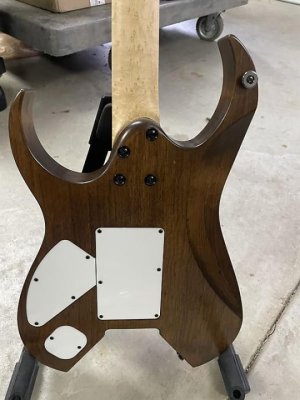
Ibanez (not Kramer) Voyager

Inflames626

New member
I'm digging everything but the brown. Walnut stripes would have helped a lot.

This seems to be a logical way to build a Floyd Rose body to cut costs. Instead of routing the bridge into the body, simply cut the body away completely where the sustain block will be.

The pictures in the Reverb listing don't show the back at a good angle, but if there's nothing back there but air, that would seem to lower costs by requiring less wood and permit more room for the bridge to move on pull ups.
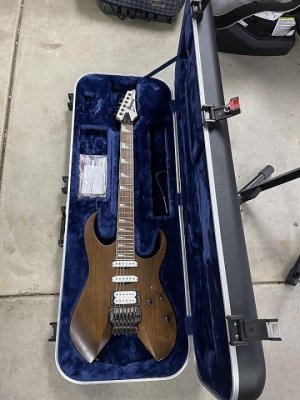
ikgxho0hhnrltnberbdn.jpg
 
I like the idea of there being nothing back there to infringe upon the movement of the bridge. Wish I could see a little better below and behind the guitar.

Obviously, I'm not a tone wood guy. That's what fine pickups like those made by Seymour Duncan are for.
 

Attachments

  • lb16pjfz3jyzlwjsqe0q.jpg
    lb16pjfz3jyzlwjsqe0q.jpg
    46.5 KB · Views: 0
Guitars aren't priced by the weight of the wood, so it doesn't matter how much is cut away. They are already routing for pickups, so routing for a Floyd doesn't add cost.
 
Guitars aren't priced by the weight of the wood, so it doesn't matter how much is cut away. They are already routing for pickups, so routing for a Floyd doesn't add cost.

beaubrummels , I would think requiring less wood would lower costs depending upon species. That's a sizeable chunk of mahogany to take off the tail assuming the body is back there. So I'd think the guitar body would require a smaller cut to draw from.

Also, I would think routing for a Floyd Rose bridge would immediately increase cost because it is an additional step. This is why you usually see cheaper guitars ($200-300 and under) without floating bridges or with cheap vintage style Strat bridges while Floyd Roses are considered a valuable feature that adds cost, usually beginning around the $300-600 mark. That could probably be attributed to the cost of the hardware, though.

I thought that's why more radical and aggressive body designs like stars tend to be more expensive. They have to make more precise shapes, whereas they can crank out LP and Strat shapes all day without having to reprogram or retool anything complicated.
 
Except on Reb's original models, like here, there is still wood under the trem tail, it's not completely cut out. So the trem cavity is routed as normal. Still, probably among the nicest guitars Ibanez made back in the day - mahogany body, koa top and solid r/w neck, as well as being one of first guitars (after the Maxxas) to get the aanj, everything was else still had the square heel at the time.

You can see it here on the RBM400.
29204_Used_Reb_Beach_RBM400_SOL_Natural_F418332_1_4000x@2x.progressive.jpg
 
This is probably identical to the Reb Beach body. If the sustain block were just behind the cutout as I'm imagining when you pull the bar up the sustain block would swing forward and touch the body. You'd have to make clearance for that.

I was thinking everything in front of the sustain block would be removed, but you would be able to see the springs then.

Is that a concentric pot on the Reb Beach model?
 
This is probably identical to the Reb Beach body. If the sustain block were just behind the cutout as I'm imagining when you pull the bar up the sustain block would swing forward and touch the body. You'd have to make clearance for that.

I was thinking everything in front of the sustain block would be removed, but you would be able to see the springs then.

Is that a concentric pot on the Reb Beach model?

It's similar, but the aanj on the one in your initial post is more like Indo and Chinese RGs to accept a 24 fret neck; the original RBs are 22 frets and have a different shape aanj and screw pattern.

With the cut-out, the RB style body is extra work, if anything, since they probably cut out the guitar shape and routes as per normal, then did the butt cut and bevel on top.

It's a normal knob with rubber grips. In the Ibz sphere, they're called beehive knobs and are quite desirable; they came on a few models in the late 80s-early 90s, have been discontinued for a long time.
 
Thanks all. This has been a really enlightening post.

I'd rethink the jack placement and probably put it in a traditional Strat position at the very least. V players seem to be divided over whether they like the jack on the lower or upper horn. I thought the upper tended to win out because it lifts the cable up and out of the way when walking. The RB would seem to be like putting the jack on the lower horn again.

I was basically imagining this as the wood stopping at the bridge posts and then there being absolutely nothing under it.

Based on the RB, looks like the trem is recessed on the Voyager, making that elaborate tail notch kind of cool but unnecessary.

I am tempted to extend those rear horns out to a V so you have a King V with a Strat front end. Would probably look terrible. Something Dean-ish.
 
Back
Top