Ideal cover band axe?

Re: Ideal cover band axe?

How heavily do you think that would compromise neck single-coil tone?

Currently I'm thinking the most iconic/prevalent tones are:

1) Bridge humbucker (LP treble position)
2) Neck SC (Strat/Tele neck position)
3) Neck SC + bridge SC (Tele middle position)

Seems like those three sounds would cover most stuff. You could use a split HB in the neck, but are neck HB tones really used that much compared to neck SC tones?

Most hard rock/metal guys (slash and kirk hammett for obvious examples) and many blues guys use a full humbucker in the neck. Its also nice to have the option of both to flip back and forth between a full powered lead tone and a more chilled out one (can also be accomplished with switching between series and parallel wiring). The issue of sacrificing a real single coil tone is one of the many reasons i recommended bkp juggernauts. Great stratty snap when split.
 
Re: Ideal cover band axe?

I guess for me it also starts with the amp. I've been using Mesa Mark Series amps since about 1994. My current band goes across multiple decades of pop, rock, country and a little jazz...and bluegrass! The Mark IV and V easily handle this material.

I typically gig with 5 to 7 guitars. Number One is a stock G&L Legacy. I also take either a 2HB Les Paul, or if I expect the gig to be a little mellower, a 335, to use on 12-15 songs. I always take a backup for the Legacy, and I favor the Legacy Special model for this. It has dual-blade pickups and can actually get close to the single-coil Strat tones and the thick humbucking tones. I might have an acoustic, 5-string banjo, electric 12-string or acoustic 12-string.

And if I can only take ONE guitar, I'm probably going to take a G&L Comanche. Strat ergonomics, great vibrato, powerful humbucking MFD pickups, and the slick PTB tone controls that globally control Treble and Bass. Works great in those clubs with neon signs all over place and wiring built to code...in 1922.

I don't believe in one guitar that can do it all; maybe for certain kinds of music, yes. Some cats can do it all with a vintage, unmodified Telecaster, but I prefer the multi-guitar approach.

Bill
 
Re: Ideal cover band axe?

* "Variax" is not the answer.

Well, it depends...

I've a Variax 500 that I've fitted with two rails PU, each being linked to a series/parallel switch. It also has a GK3 transducer.

It's the instrument that I use for covers (and for anything else) when I can't take several guitars and/or amps on stage. It has served me well these last 15 years.

My other go to multipurpose guitar is an old Charvel superstrat with a complex wiring involving a dummy dual humbucking coil and a Q filter, in order to emulate single coils with the stock humbuckers. The GK3 on it is there for acoustic guitar tones and for other Roland guitar modeling options if needed.

If I had to select a Swiss army axe, I'd probably take my "experimental guitar" (a home built and customized to death Superstrat) as it is now: two "hot" humbuckers in neck and bridge positions (they must be beefy enough to sound good once splitted so, their total inductance must be above 6H), a mid single coil, a 5 ways switch and a few other controls to enable other options (neck // to bridge + a phase inverter for the mid PU + a series /parallel selector for it + a 3 ways toggle activating the HB's in series, or their inner coils, or their outer coils). It's not intuitive to use on stage, though...

Now, my most satisfying gigs with cover bands typically involved 2 amps and 3 guitars (a Gibson, a Fender and "something else", depending on the playlist). YMMV.

Good luck in your quest...
 
Re: Ideal cover band axe?

Thought exercises are tough here, no one wants to play by the rules. We’ll all say a variation of “JB/Jazz and take all three to the gig!”. Then when you insist, no I’m looking for a single pickup setup to be a do-it-all guitar, we’ll say “no Guitar is going to be able to cover the Surfer Strat and the Les Paul!”

That being said, I think you are asking the right questions, are you prioritizing full neck HB tones or Strat neck tones, and how authentic do you need positions 2/4 to be?

Depending on those answers I’d probably start with something like one of the following, chosing stacked or standard SCs depending on the wiring scheme.

-Custom Custom; STK-S4; STK-S7
-JB ; SSL-1; Jazz
-Custom/59; SSL-1; SSL-1 (add Ilitch Backplate)
-HSH Parallel Axis setup

Then use a variation of a Superswitch and S-1 switch to get the most combos. On an HSH I’d probably try to get:
S-1 up
Bridge HB
Bridge + Neck; Outer Split
Bridge + Neck; Full
Bridge + Meck; Inner Split
Neck HB

S-1 Down
Bridge Split
Bridge Split + Middle
Middle
Neck Split + Middle
Neck Split

Basically Humbucker variations with S-1 up and Strat variations with S-1 down.

For HSS, I’d probably try one of the schemes where it puts the neck and middle in series for a little more beef for faux neck HB tones.

Have fun and expect to be tweaking and exchanging to get where you want to be. It’s probably not going to be a home run on the first try.
 
Re: Ideal cover band axe?

I will say, I was able to pull an amazing number of tones out of my friends Charvel with a CC/SSL-1/SSL-1 with Parallel/Full/Split switch into a TS-9, BD-2 and Blues Jr by stacking drive pedals and using the volume and tone controls on the guitar.
 
Re: Ideal cover band axe?

P-Rails bridge and Stag Mag neck with STK-S4 middle might work for you.
 
Re: Ideal cover band axe?

I guess for me it also starts with the amp. I've been using Mesa Mark Series amps since about 1994. My current band goes across multiple decades of pop, rock, country and a little jazz...and bluegrass! The Mark IV and V easily handle this material.

I typically gig with 5 to 7 guitars. Number One is a stock G&L Legacy. I also take either a 2HB Les Paul, or if I expect the gig to be a little mellower, a 335, to use on 12-15 songs. I always take a backup for the Legacy, and I favor the Legacy Special model for this. It has dual-blade pickups and can actually get close to the single-coil Strat tones and the thick humbucking tones. I might have an acoustic, 5-string banjo, electric 12-string or acoustic 12-string.

And if I can only take ONE guitar, I'm probably going to take a G&L Comanche. Strat ergonomics, great vibrato, powerful humbucking MFD pickups, and the slick PTB tone controls that globally control Treble and Bass. Works great in those clubs with neon signs all over place and wiring built to code...in 1922.

I don't believe in one guitar that can do it all; maybe for certain kinds of music, yes. Some cats can do it all with a vintage, unmodified Telecaster, but I prefer the multi-guitar approach.

Bill

Whoa, those G&L MFD pickups weren't on my radar at all... seem very interesting. And there's a whole new rabbit hole for me to go down =/

Thought exercises are tough here, no one wants to play by the rules. We’ll all say a variation of “JB/Jazz and take all three to the gig!”. Then when you insist, no I’m looking for a single pickup setup to be a do-it-all guitar, we’ll say “no Guitar is going to be able to cover the Surfer Strat and the Les Paul!”

That being said, I think you are asking the right questions, are you prioritizing full neck HB tones or Strat neck tones, and how authentic do you need positions 2/4 to be?

Depending on those answers I’d probably start with something like one of the following, chosing stacked or standard SCs depending on the wiring scheme.

-Custom Custom; STK-S4; STK-S7
-JB ; SSL-1; Jazz
-Custom/59; SSL-1; SSL-1 (add Ilitch Backplate)
-HSH Parallel Axis setup

Then use a variation of a Superswitch and S-1 switch to get the most combos. On an HSH I’d probably try to get:
S-1 up
Bridge HB
Bridge + Neck; Outer Split
Bridge + Neck; Full
Bridge + Meck; Inner Split
Neck HB

S-1 Down
Bridge Split
Bridge Split + Middle
Middle
Neck Split + Middle
Neck Split

Basically Humbucker variations with S-1 up and Strat variations with S-1 down.

For HSS, I’d probably try one of the schemes where it puts the neck and middle in series for a little more beef for faux neck HB tones.

Have fun and expect to be tweaking and exchanging to get where you want to be. It’s probably not going to be a home run on the first try.

Yea, spending more time switching between my Strats and LP's... definitely would prioritize the Strat neck tone. In fact, even for jazz I've known for a while that I *much* prefer the 1950's P90 tone you see on a lot of the Blue Note releases. Not as much of a fan of the 1960's+ bloated neck humbucker jazz sound. Part of this is also the switch from Fender tweeds to, in many cases, solid state.

So I think that settles on HSS.

I think you've got the right idea both with the stacks and with the Ilitch. From my understanding of the Ilitch it can't be wired to be hum-cancelling in the single positions and in 2 and 4, right? While the single positions are more important to me, I'd obviously like to have as many noiseless positions as possible. On my Strat with Antiquity Surfers + spin-a-split Pearly Gates I find that I end up avoiding the noisy positions even if they otherwise sound good... I think its because its affects my playing and pushes me away from passages with soft picking dynamics.

For neck and middle I'm thinking either Dimarzio Areas or the newest (Gen 4) Fender noiseless, since they're apparently pretty good and sell for cheapish.

What do people think would be closer to a Tele middle position: neck single + split bridge HB or neck single + full bridge HB? Common sense says neck single + split bridge HB, but maybe not because a Tele bridge pickup is meaty. Unfortunately my Strat isn't wired in a way where I can test this, and my Tele is in California.

I also think your S-1 wiring scheme is spot on, and is probably identical to the scheme shown here: https://www.premierguitar.com/articles/24551-mod-garage-strat-prs-crossover-wiring
How do you think you'd go about adapting this to stacks in the neck and middle instead of an HB in the neck and SC in middle?

I don't know why manufacturers aren't using this setup. PRS keeps monkeying around with their control scheme every few years, so clearly they haven't quite nailed it yet. Even their most versatile current guitar, the 509, uses two additional switches but fails to cover as much ground and is missing that key neck SC + bridge SC sound. Similarly the new HSS Elite Strat adds two buttons without covering neck SC + bridge SC, misses other sounds, and is more confusing too.

Surprisingly, the most versatile yet simple switching scheme I'm seeing is in the new HH Charvels. 6 sounds, all of them useful.
 
Re: Ideal cover band axe?

Yea, spending more time switching between my Strats and LP's... definitely would prioritize the Strat neck tone. In fact, even for jazz I've known for a while that I *much* prefer the 1950's P90 tone you see on a lot of the Blue Note releases. Not as much of a fan of the 1960's+ bloated neck humbucker jazz sound. Part of this is also the switch from Fender tweeds to, in many cases, solid state.

So I think that settles on HSS.

I think you've got the right idea both with the stacks and with the Ilitch. From my understanding of the Ilitch it can't be wired to be hum-cancelling in the single positions and in 2 and 4, right? While the single positions are more important to me, I'd obviously like to have as many noiseless positions as possible. On my Strat with Antiquity Surfers + spin-a-split Pearly Gates I find that I end up avoiding the noisy positions even if they otherwise sound good... I think its because its affects my playing and pushes me away from passages with soft picking dynamics.

For neck and middle I'm thinking either Dimarzio Areas or the newest (Gen 4) Fender noiseless, since they're apparently pretty good and sell for cheapish.

What do people think would be closer to a Tele middle position: neck single + split bridge HB or neck single + full bridge HB? Common sense says neck single + split bridge HB, but maybe not because a Tele bridge pickup is meaty. Unfortunately my Strat isn't wired in a way where I can test this, and my Tele is in California.

I also think your S-1 wiring scheme is spot on, and is probably identical to the scheme shown here: https://www.premierguitar.com/articles/24551-mod-garage-strat-prs-crossover-wiring
How do you think you'd go about adapting this to stacks in the neck and middle instead of an HB in the neck and SC in middle?

I don't know why manufacturers aren't using this setup. PRS keeps monkeying around with their control scheme every few years, so clearly they haven't quite nailed it yet. Even their most versatile current guitar, the 509, uses two additional switches but fails to cover as much ground and is missing that key neck SC + bridge SC sound. Similarly the new HSS Elite Strat adds two buttons without covering neck SC + bridge SC, misses other sounds, and is more confusing too.

Surprisingly, the most versatile yet simple switching scheme I'm seeing is in the new HH Charvels. 6 sounds, all of them useful.

That Dirk Wacker link is wild, I’ve been dreaming of that setup for a few years now but never put in the time to draw up a wiring diagram. Now I have no excuses! It seems very logical to me, having a “Strat” mode and a “PRS” mode. For HSS, I’d have to brainstorm a little bit.... what combinations would you want in replacement for the Humbucker modes? You could just substitute the single for the HB. Alternatively have you looked at the stock Fender S-1 HSS arrangement?

Regarding Stacks and the Ilitch system, I think Stacks are easier (and cheaper) to work with. Ideally you’d have them split when combined with the split HB to keep noise cancelling. For cover band usage, the latest generation of Stacks (Dimarzio, Duncan, etc.) should get the job done. The Ilitch can work with positions 2/4, you’d just keep all your singles non-RWRP so you can keep the backplate engaged all the time. Same with combining with split Humbuckers, keep them all the same magnetic polarity and wind direction so there is hum to cancel.

Lots of options, and I think many would work well.

I agree with the Charvel scheme, pretty simple but versatile.
 
Re: Ideal cover band axe?

Fender Roadhouse Stratocaster. S1 and V6 (no, not talking sports cars) plus N4s. 35 actually useful tones when catalogued for specific purposes.
 
Re: Ideal cover band axe?

Interesting discussion- I'm surprised that there's a lot about pups and platforms, but less about the wiring necessary- with that said:

1. If you don't want to mod, as mentioned before a tele is one of the few out of the box guitars that really can cover most everything as long as you are willing to do a lot of amp and effects to beef up the sound when needed- Nashville tele is the one guitar that covers most everything if you like 25.5

2. Dual humbuckers (especially Les Pauls) are good at covering humbucker type songs, but are incredibly challenged getting anything like a tele or strat out of the box- So Jimmy Page mods are a good place to start- (I prefer parallel pup to self to remain noise canceling instead of splits) There are lots of variations, bass roll off is wonderful to get thinner 2nd guitar overdubbed sounds- Here's an LP with a P90 neck and a Pearly Gates bridge example- covers a lot of ground.

https://forum.seymourduncan.com/sho...e-mod-with-Diagram-and-Vid&highlight=les+paul

3. My favorite answer is an HSS strat with heavy mods-

1. A bridge bucker that covers lots of space and splits well for 2 position- I've got a JB in the bridge of my cover guitar (Parker NF) and it' fits perfectly from ACDC to Dire Straights/Clapton in the 2nd position. There are lots of good alternative pups for brighter or warmer strats.

2. I like Blade humbuckers in middle and neck for a cover guitar for 2 reasons-
a. Spin a split can take a blade down to a bighty, thin teleish sound
b. Or at full spin some get as fat as a mini-humbucker.
c. You can keep noise canceling through most settings
d. I like the Dimarzio cruiser as a center pup- Low power encourages quack in 2nd and 4th
e. I use a cool rail in the neck because it can drive like a humbucker, but easy to back off for strat like tones

3. Last but not least, a blend circuit that gives neck + bridge as well as series sounds covers, so , so much ground
a. Neck plus bridge for classic tele
b. Series for darker, more powerful Les Paul Deluxe leads
c. I end up getting rid of both strat tone pots-
i. 1. Is spin a split- activated by pullpot
ii. 2. Is Blender activated by pullpot

4. Forgot to mention bridge piezo to cover accoustic
a. For me it requires heavy strings, but I like heavy strings
b. Happens to be built into my Nitefly, so one less thing for me to do

Of course, everything is a compromise, and I will use dedicated guitars for recording,to get pristine sounds. However, these approaches helped me thin down from 3 guitars to 1 for most gigs.
 
Re: Ideal cover band axe?

That Dirk Wacker link is wild, I’ve been dreaming of that setup for a few years now but never put in the time to draw up a wiring diagram. Now I have no excuses! It seems very logical to me, having a “Strat” mode and a “PRS” mode. For HSS, I’d have to brainstorm a little bit.... what combinations would you want in replacement for the Humbucker modes? You could just substitute the single for the HB. Alternatively have you looked at the stock Fender S-1 HSS arrangement?

Regarding Stacks and the Ilitch system, I think Stacks are easier (and cheaper) to work with. Ideally you’d have them split when combined with the split HB to keep noise cancelling. For cover band usage, the latest generation of Stacks (Dimarzio, Duncan, etc.) should get the job done. The Ilitch can work with positions 2/4, you’d just keep all your singles non-RWRP so you can keep the backplate engaged all the time. Same with combining with split Humbuckers, keep them all the same magnetic polarity and wind direction so there is hum to cancel.

Lots of options, and I think many would work well.

I agree with the Charvel scheme, pretty simple but versatile.

Glad you found the link useful. When I stumbled across it I was floored that I had never seen anything like that before! I've had many guitars with loads of switches and push-pulls, and with a single switch that mod seems to get just about everything. I've looked at the control schemes of all the major "non-heritage" brands: Suhr, PRS, Ibanez, Music Man. Its obvious that they're all usually trying to crib the best of LP, Strat, and Tele, and not a one of them achieves it with that elegance. I'll always have my LP's and Strats, but this EMG-loaded Charvel seems the ideal vehicle to build a mongrel, especially as I'm increasingly convinced I have no taste for hot/modern/whatever pickups, even in Soldano or Diezel patches on my Axe-FX.

I'm really not sure what I would sub up on an HStkStk arrangement. I guess the obvious option would be replace neck HB mode with Neck + Middle in series with each other.

If using regular HSH I think the only improvement I could see to the wiring would be splitting to the bridge screw coil instead of the slug coil, for a more middle-Tele-like sound in S-1 position 4 and more Stratty position 2. I assume they went with the slug coil to slightly fill out Strat position 1?

I still think a key question is whether a neck Strat pickup will sound more like a Tele mid position when paired with a bridge humbucker or paired with a split coil from a bridge humbucker. This is only really relevant because we can now get good stacked coils, negating the need to pull a single humbucker coil to noise cancel against.

With today's stacks, on an HSS maybe its better just not to bother with coil splitting at all?

The only usability issues that stands out to me with this wiring are 1) no way to go from neck SC to bridge HB in a single motion, which is my most common change, and 2) I've gotten pretty accustomed to the LP approach of dialing an amp dirty and independently setting volume for each pickup to treat the pickup switch as a crude channel-switcher, which you can't do on this (in fairness, that's true for almost any non-Gibson)

Interesting discussion- I'm surprised that there's a lot about pups and platforms, but less about the wiring necessary- with that said:

1. If you don't want to mod, as mentioned before a tele is one of the few out of the box guitars that really can cover most everything as long as you are willing to do a lot of amp and effects to beef up the sound when needed- Nashville tele is the one guitar that covers most everything if you like 25.5

2. Dual humbuckers (especially Les Pauls) are good at covering humbucker type songs, but are incredibly challenged getting anything like a tele or strat out of the box- So Jimmy Page mods are a good place to start- (I prefer parallel pup to self to remain noise canceling instead of splits) There are lots of variations, bass roll off is wonderful to get thinner 2nd guitar overdubbed sounds- Here's an LP with a P90 neck and a Pearly Gates bridge example- covers a lot of ground.

https://forum.seymourduncan.com/sho...e-mod-with-Diagram-and-Vid&highlight=les+paul

3. My favorite answer is an HSS strat with heavy mods-

1. A bridge bucker that covers lots of space and splits well for 2 position- I've got a JB in the bridge of my cover guitar (Parker NF) and it' fits perfectly from ACDC to Dire Straights/Clapton in the 2nd position. There are lots of good alternative pups for brighter or warmer strats.

2. I like Blade humbuckers in middle and neck for a cover guitar for 2 reasons-
a. Spin a split can take a blade down to a bighty, thin teleish sound
b. Or at full spin some get as fat as a mini-humbucker.
c. You can keep noise canceling through most settings
d. I like the Dimarzio cruiser as a center pup- Low power encourages quack in 2nd and 4th
e. I use a cool rail in the neck because it can drive like a humbucker, but easy to back off for strat like tones

3. Last but not least, a blend circuit that gives neck + bridge as well as series sounds covers, so , so much ground
a. Neck plus bridge for classic tele
b. Series for darker, more powerful Les Paul Deluxe leads
c. I end up getting rid of both strat tone pots-
i. 1. Is spin a split- activated by pullpot
ii. 2. Is Blender activated by pullpot

4. Forgot to mention bridge piezo to cover accoustic
a. For me it requires heavy strings, but I like heavy strings
b. Happens to be built into my Nitefly, so one less thing for me to do

Of course, everything is a compromise, and I will use dedicated guitars for recording,to get pristine sounds. However, these approaches helped me thin down from 3 guitars to 1 for most gigs.

Yea, if I was passing advice to a non-tinkerer guitarist I'd say get a Nashville Tele and be done with it. But... I've got the disease =(

I think LP's having trouble with Strat tones more than the other way around is a lot like how its easier to get modern sounds with vintage guitars than the other way around. I've done the Jimmy Page thing on guitars in the past. Its flexible, but kind of a pain. Parallel is a step in the right direction, but not as good as the coil split. And then the coil split is both noisier and worse tone than a good stack. You probably agree since you like HSS best too...

Total tangent, but something else this exercise has really helped me explore: I really play very differently on different guitars. I find that Strat-style guitars make me play more creatively, covering more area on the neck, which I don't understand. Strats, especially Floyd Rose Strats, also make me automatically switch to more hybrid pick+finger techniques, obviously because of the increased string spacing. On the other hand LP-style guitars make me riff more aggressively on low notes, and my hand gravitates closer to the bridge overall and I have much stronger control over nuanced muting techniques, I think because my palm can use the tune-o-matic breakover angle as a good reference point. In fact, I almost find the (decked) Floyd to be awkward to palm mute on.
 
Re: Ideal cover band axe?

Floyd Rose Strats, also make me automatically switch to more hybrid pick+finger techniques, obviously because of the increased string spacing. On the other hand LP-style guitars make me riff more aggressively on low notes, and my hand gravitates closer to the bridge overall and I have much stronger control over nuanced muting techniques, I think because my palm can use the tune-o-matic breakover angle as a good reference point. In fact, I almost find the (decked) Floyd to be awkward to palm mute on.

Twins sons from different mothers- feel is the primary reason I have too many guitars- as you say, each do something the other don't-

But back to the cover guitar, I believe you are right, a Strat is far more likely to sound like a LP than an LP like a Strat- I think some of that is scale length- in my experience, scale length followed by neck/fingerboard, followed by body wood are the main reason strats sound chimey and articulate-

You can roll some of that fast attack and chime off with the right pups and wiring, but that aspect can't be 'rolled into' an LP.

Can't wait to hear where your project takes you-
 
Re: Ideal cover band axe?

A lot of people are putting a lot of thought into this. But to come from a different angle I say:

An L500XL in the bridge and an L500R in the neck with an L200S in the middle can be the perfect set for versatility. Wire it up with auto splits in the 2 and 4 position with a kill switch on the volume pot and a TBX modded to work as a high pass(treble cut)/low pass (bass cut) with cap values chosen to be able to create usable tones throughout the entire range of the pot and then you will have almost every tone worth having in your hands without complex switching.

You get plenty volume, low noise, versatility, and simplicity, so why not? The pickups are also plenty cheap to boot.
 
Re: Ideal cover band axe?

Hrm, I really should have named this thread "Ideal cover band pickup arrangement/wiring" instead, since that's really what I meant more than comparing specific guitars.

Ok then, pickups only, for me it would be any of

Pearly Gates B + Jazz N, standard 3-way wiring (all other sound mods can be had with pedals and amp)
Whole Lotta Humbucker set, full 6-switch Jimmy Page wiring
Broadcaster bridge + late 60's Strat neck, 3-way PU selector, blend pot on the neck, 3-way Gretsch tone switch with Esquire dark, Tele tone pot, and straight out

... because I used each of the above for this very purpose for a number of years playing out.

One I haven't personally used but believe would work based on above experiences:
59/Custom B + late 60's Strat neck, 3-way with split on the bridge


What do people think would be closer to a Tele middle position: neck single + split bridge HB or neck single + full bridge HB? Common sense says neck single + split bridge HB, but maybe not because a Tele bridge pickup is meaty. Unfortunately my Strat isn't wired in a way where I can test this, and my Tele is in California.

IMHO/IME - Full bridge HB and neck single. If the bridge HB is hot (like JB), then split. You can even get there with HH, for example, the Jazz N is the most strat-like I've played - has a bottom thump and bright top end and dip in the mids like a single coil. I can get a similar vibe on my Les Paul as my 50's spec Telecaster in the middle position.


Surprisingly, the most versatile yet simple switching scheme I'm seeing is in the new HH Charvels. 6 sounds, all of them useful.

Might have just answered your own question and made this whole thread moot.
 
Re: Ideal cover band axe?

Might have just answered your own question and made this whole thread moot.

You ain't kidding. Seriously impressive.


But I really think that if you're right about neck SC + bridge HB for that middle Tele sound, it seems like you could get an extremely comprehensive setup very easily and 100% hum-cancelling across all positions by simply using stacks in neck and middle, a PAF in the bridge, and a switch that adds the bridge HB to the neck stack (which I guess could also be used to do neck + middle + bridge for whatever that's worth).

Not having to worry about schemes for cancelling hum dramatically streamlines things...

EDIT: Orrrr..... maybe the new Charvel wiring isn't as smart as I thought? Apparently that middle position is not hum cancelling http://www.metalguitarist.org/forum...-and-diy/83338-charvel-socal-2016-wiring.html
 
Last edited:
Re: Ideal cover band axe?

Beware complicated switching schemes on a guitar you play live. You need to be able to change FAST, and some don't allow for that; some actually suck tone, and some can screw you up when you hit the wrong combo and the guitar cuts out.

About as complicated as I want to get is a five-way strat switch with the so-called "sweet switch" that allows for seven combinations (adding all-on and neck+bridge) to the 5-way.

For me, the JP wiring on a Les Paul is too complicated, has options that I would have little use for.

Bill
 
Re: Ideal cover band axe?

Beware complicated switching schemes on a guitar you play live. You need to be able to change FAST, and some don't allow for that; some actually suck tone, and some can screw you up when you hit the wrong combo and the guitar cuts out.

About as complicated as I want to get is a five-way strat switch with the so-called "sweet switch" that allows for seven combinations (adding all-on and neck+bridge) to the 5-way.

For me, the JP wiring on a Les Paul is too complicated, has options that I would have little use for.

Bill

The key to JP usage is settling on the 2-4 combos that work the best. For example, I tended to keep the neck in parallel coils all the time, and occasionally split the bridge in the middle position, but other than that just used the 3-way as is. The benefit of having the other options was for edge cases where I'm playing through someone else's amp, or playing in a room that sounds terrible and needed a way to pull out some treble or alternatively thicken the sound.
 
Re: Ideal cover band axe?

With all the various switches/pots/wiring options out there it's possible to get some seriously versatile set-up, but for me it has to be simple, especially in a gig situation. I don't want to be messing with multiple push-pull/mini switch/pickup switch options in addition to any pedalboard switching I'd have to do. For me I'd either go with '59/C Hybrid/Jazz combination with an STK-S4 in the middle position. Wired to a 5-way with a push-push pot to split the humbuckers. I might even go for the WLH set for the 'buckers. I have the WLH set in a PRS McCarty that gives glorious single tones, and the '59/C Hybrid/Jazz pairing in an all mahogany Fret-King Esprit 5 that gives great split tones too. At a push I might add something to give me bridge/neck as an option to get that chirpy middle position for the 'buckers and a Tele-esque option when they're split.
 
Re: Ideal cover band axe?

The key to JP usage is settling on the 2-4 combos that work the best. For example, I tended to keep the neck in parallel coils all the time, and occasionally split the bridge in the middle position, but other than that just used the 3-way as is. The benefit of having the other options was for edge cases where I'm playing through someone else's amp, or playing in a room that sounds terrible and needed a way to pull out some treble or alternatively thicken the sound.

Yea, this is exactly the way I used the JP wiring, and it worked ok. But there's still two issues: 1) a lot of complication for a bunch of sounds you'll never really use, and 2) Neck HB parallel still isn't as good as a good neck SC or stack.

Beware complicated switching schemes on a guitar you play live. You need to be able to change FAST, and some don't allow for that; some actually suck tone, and some can screw you up when you hit the wrong combo and the guitar cuts out.

About as complicated as I want to get is a five-way strat switch with the so-called "sweet switch" that allows for seven combinations (adding all-on and neck+bridge) to the 5-way.

For me, the JP wiring on a Les Paul is too complicated, has options that I would have little use for.

Bill

With all the various switches/pots/wiring options out there it's possible to get some seriously versatile set-up, but for me it has to be simple, especially in a gig situation. I don't want to be messing with multiple push-pull/mini switch/pickup switch options in addition to any pedalboard switching I'd have to do. For me I'd either go with '59/C Hybrid/Jazz combination with an STK-S4 in the middle position. Wired to a 5-way with a push-push pot to split the humbuckers. I might even go for the WLH set for the 'buckers. I have the WLH set in a PRS McCarty that gives glorious single tones, and the '59/C Hybrid/Jazz pairing in an all mahogany Fret-King Esprit 5 that gives great split tones too. At a push I might add something to give me bridge/neck as an option to get that chirpy middle position for the 'buckers and a Tele-esque option when they're split.

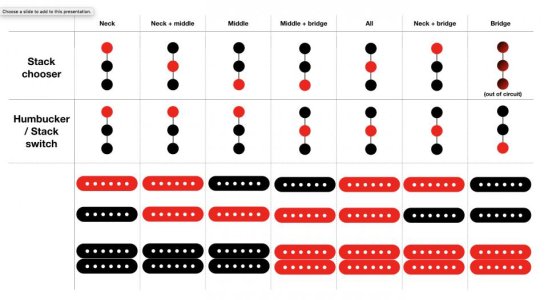
Yea, I've been thinking about this. Standard 5-way mostly does everything, but leaves the neck + bridge combo out, and so you need a solution for that. I actually think I came up with a simpler solution using 2 3-way switches, that should allow for a lot of quick switching options. I actually think this would be easier than the 5-way to reliably hit the notch positions. This assumes stacks, so you don't need to worry about any coil splitting/etc for hum-cancelling operation. All positions are low noiseless.

Screen Shot 2018-02-20 at 8.43.15 AM.jpg
 
Last edited:
Back
Top