Re: Installing a roller nut
Do you really want me to answer that?

Okay, I'll start by saying that in spite of what I view as a significant amount of ignorance on part of the inventors when they first came up with the idea, it can still manage to work out just fine in the end for some instruments and players. The majority of my issues with systems like this are perhaps a bit more idealistic than practical, in the sense that it drives me nuts how they spread so much misinformation about how it works, why it works, what exactly it does, and what styles or instruments it may be appropriate for and which it may not be. With that in mind...
First issue is that it ignores the underlying problem - string height at the nut slots relative to the frets. If a nut is cut so that it set the strings no higher than if it were a fret leveled with the rest, there would be no need for such drastic compensation. Because this can be a difficult task for many to master, this cause of intonation issues is often ignored in favor of only treating the symptoms by heavy amounts of nut compensation.
There are players who prefer their nut slots to be a bit higher, sometimes because they also dabble with slides on their guitar, or perhaps because they use extremely aggressive pull-offs which can demand more of the open string than fretted. Combine these needs with someone who has a very aggressive left hand grip, and you may have a suitable candidate for a nut compensation such as this. Of course they fail to ever notice that it can have drastically different results on a Les Paul than it would on a Strat, but that's another story.
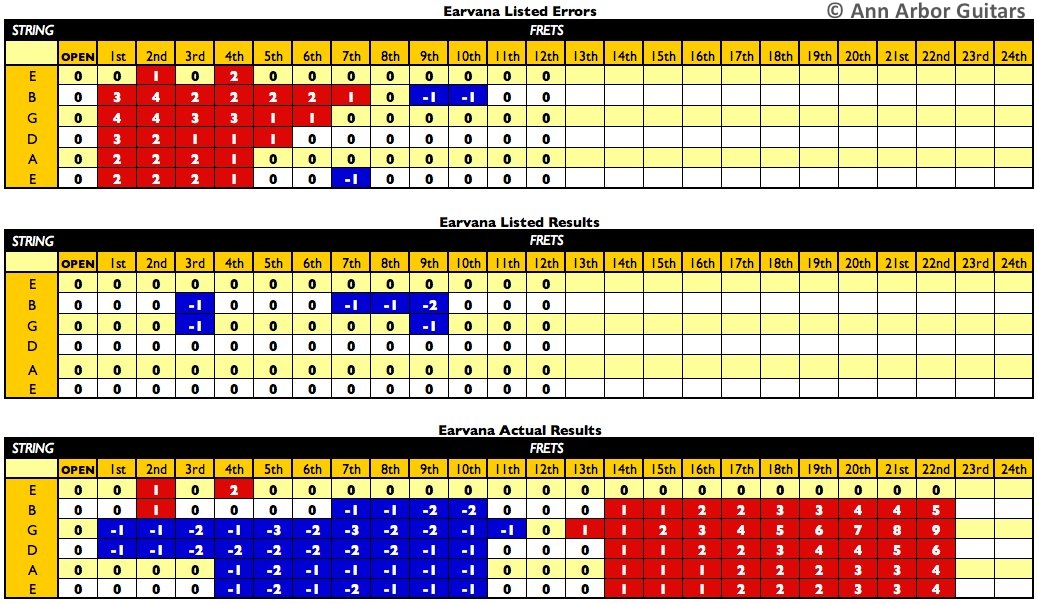
Some of the most blatant errors in their marketing claims can be demonstrated by this chart.
The top two charts are taken directly from Earvana's claims. The first being an example of intonation errors in a guitar before their system was installed. Note that the amount of sharpening at the first fret, as much as 3 and 4¢ is indicative of a nut slot cut grossly too high, or a player with a left hand iron death grip. No
properly cut nut should see this amount of sharpening in the first position with the average player's style.
Rather than address this issue, they push the nut forward to compensate. The second chart shows their reading of how intonation was improved after their system was installed. How exactly they managed to fix the errors on the 2nd and 4th frets on the high E without changing any of the frets around is truly astounding. This would have to indicate that they are somehow bending the laws of physics and mathematics, or perhaps more likely that the reliability of testing procedures through which they arrived at these results should be flagged as questionable.
I'm not saying they intentionally manipulated the results, but whether intentional or not, manipulated them just the same. If you are looking at a tuner when testing something, if something deep inside wants to find results as positive, you are going to bring the note further in tune, whether consciously aware of it or not. If you may have some underlying goal in proving a system to be poor, then you will influence in the opposite direction. Human nature. Intonation is a flexible system, subjective both in playing and reading the results, and it takes an awful lot of planning and care to rule out these variables and be sure you are gauging changes due directly and only to the variable you modified and are testing for. They clearly did not come close to doing this.
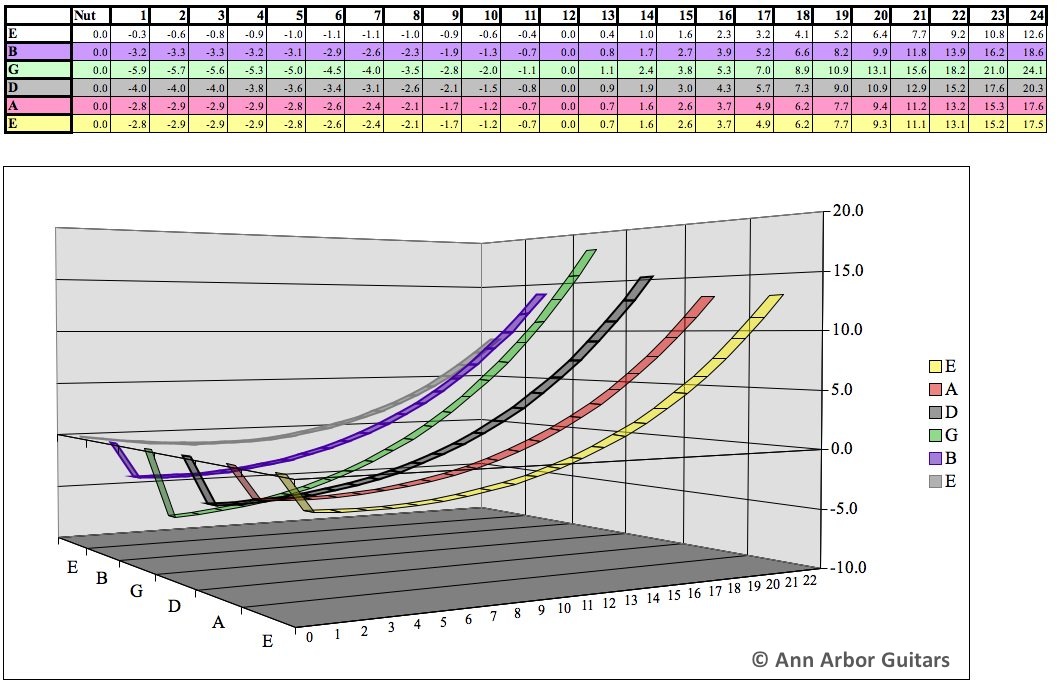
The third chart shows exactly, undeniably, irrefutably, how the results would end up if the guitar from chart 1 were modified with the Earvana nut, and all other variables from setup to playing style were kept exactly the same. Of course they did not include any data above the 12th fret in their original example, so the results shown in chart 3 are displayed if we were to assume that intonation read at 0 on all of these notes. If they read other than 0, then these numbers above the 12th would simply indicate how much and in which direction those results would change.
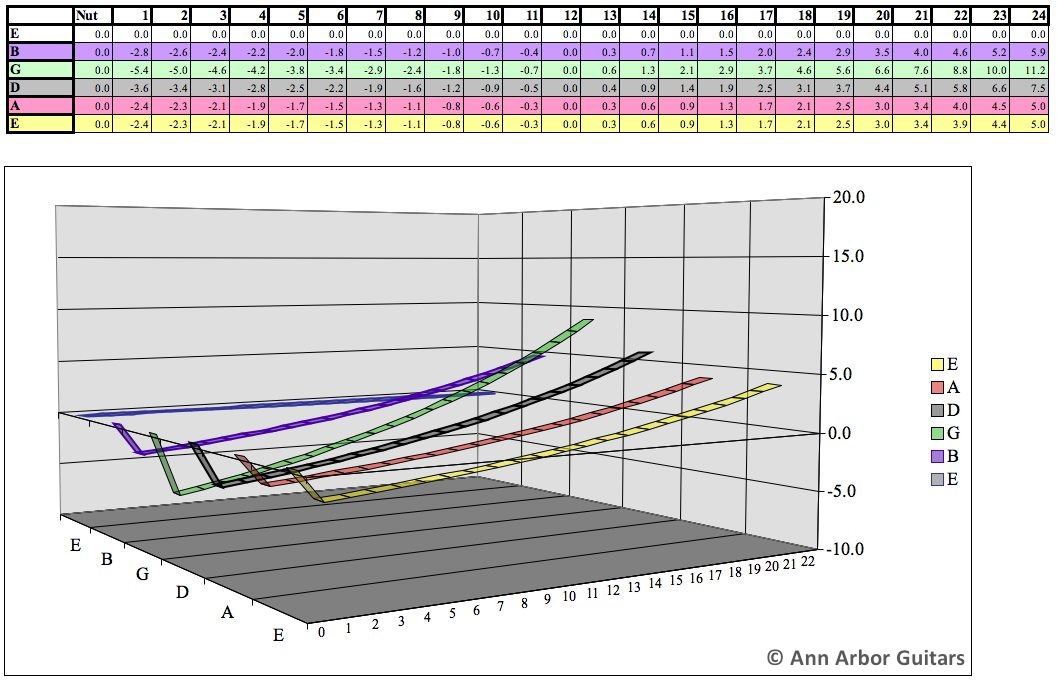
That marketing chart is just one example of issues I have though. Another would be the fact that they seem to say that their system will work just fine, the same way on a Fender or a Gibson. In fact, if you were to install an Earvana nut on a Fender guitar, this is how your intonation would end up different relative to a standard 12TET fretboard (calculated through 24 frets, though the upper few can be ignored on most instruments).
On a Gibson Les Paul however, this is how the intonation would end up sounding relative to a standard 12TET board.
So how do they manage to not notice these differences, and say that the results will be equally effective on either? I'd say this serves to demonstrate what many players have known for centuries, that the human hand can have a great deal of influence on how a guitar intonates. If they are testing one system and they
want to believe it is good, then conscious of it or not, they will make it sound good. It's actually quite hard for a human player not to do. At the very least however, it should bring in to question the reliability of their methods of testing and development of this system, if not the honesty or selective choosing of data for their marketing purposes.
So to recap -
A) Source of the problem is usually nut height, not nut position.
B) Proper solution is typically to address the source rather than the symptom.
C) Though most players and instruments will intonate fine after nut height is cut proper, there will still be some instruments and styles which will benefit from some amount of nut compensation.
D) Any compensation to help first position intonation does not come entirely without side effects in other areas.
E) These side effects should be considered and minimized where they may cross a threshold of creating noticeably negative results, often meaning compromise must be split throughout different areas.
F) There is no one-size-fits-all setup of nut height and compensation. Systems like the Earvana nut attempt to deliver exactly this, though they push toward the most extreme levels of compensation which very, very few players should ever need in my opinion. Best results for any player or instrument should be tailored fit to their particular circumstances.