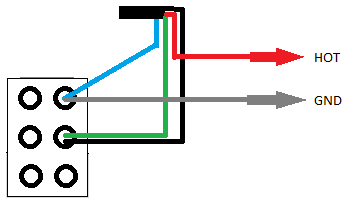
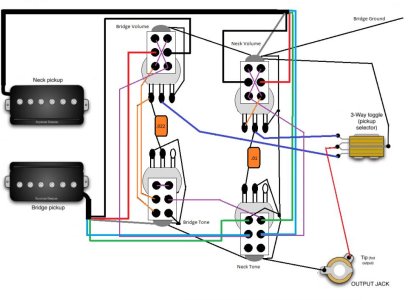
Is there a difference between these screw coil split diagrams?

SunIsLoco

New member
So here are 3 different diagrams, each one splits a humucker to the screw coil:
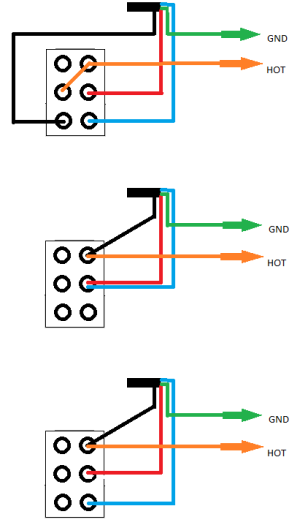
screw coil splits.png

Diagram 1:
red to hot
white and black are isolated
green to ground

Diagram 2:
red, white and black to hot
green to ground

Diagram 3:
red and black to hot
white is isolated
green to ground

The first one I know is best, but I see the second one used often in Jimmy Page wiring diagrams, and the third one in triple shot diagrams. I've heard the second one has a risk of bleeding from the slug coil. Does the third one have that same risk? Better or worse? And is it really that bad as to cause a noticeable difference in sound?
 
Re: Is there a difference between these screw coil split diagrams?

I advise getting some alligator clip wires and trying each with your pickups in your guitar with your rig to determine which is best to you.
 
Re: Is there a difference between these screw coil split diagrams?

Yeah that's probably what I'll end up doing, but I'd still like to understand it from an electrical perspective so I can learn.

I currently have triple shots installed, and I'm pretty sure they use diagram 3.
 
Re: Is there a difference between these screw coil split diagrams?

Flying leads and alligator clips are likely going to buzz.

Here:
screw coil split.png

1) If you short a coil you're golden. Either shorted to ground or hot, it makes absolutely no difference.

2) If you leave a coil open and it's dangling from ground then you're also golden.

3) If it's left open but dangling from the hot wire then it can act like an antenna. Change the wiring so it comports with either 1 or 2.
 
Re: Is there a difference between these screw coil split diagrams?

So in the third one, the fact that black is connected to hot and white is not connected means that the slug coil wires could pick up interference? And diagram 2 wouldn't have that issue, with both black and white on hot?
 
Re: Is there a difference between these screw coil split diagrams?

Hey Gregory, just to clarify: in diagram 2, when red, white and black all go to hot, it works because white and black are shorted? So if I used diagram 2 it would work no problem, even if it wad in series with the other pickup?
 
Re: Is there a difference between these screw coil split diagrams?

I'd be extremely dubious of claims that it sounded any different from the diagram I provided. The same for your first diagram.

If there were any problems with your third I'd be curious to hear them.
 
Last edited:
Re: Is there a difference between these screw coil split diagrams?

Right now I have Triple Shot pickup rings, which are wired effectively the same as the third way from what I can tell. I don't get any weird sounds or interference, but I also cannot tell the difference between parallel mode and the screw coil alone, so I imagine I might be getting some slug coil in the mix.

I'm designing my own push pull wiring that gives me splits to either coil as well as series mode between the pickups, and I want to make sure that each single coil option will play nicely, especially when in series. It's basically JP wiring but replacing the OOP option with the option to change which coil is split, so you can get more virtual humbuckers in series mode. here's the diagram, based on your suggestions on always making sure one coil is shorted (and/or grounded) when the other is active:

wiring diagram V3.jpg

Bridge Volume:
pulled: Splits bridge to Screw Coil
pushed: When neck tone is pulled too, splits bridge to Slug Coil. Otherwise, series HB

Neck Volume:
pulled: Splits neck to Screw Coil
pushed: When neck tone is pulled too, splits neck to Slug Coil. Otherwise, series HB

Neck Tone:
pulled:
If a volume switch is pushed, splits that pickup to slug coil
If a volume switch is pulled, it doesn't do anything
This applies to both pickups at once, so you can get screw/screw, slug/slug, screw/slug or slug/screw

Bridge tone:
pulled: Wires the pickups in series, so depending on the configuration of each pickup, you can get 4 different virtual HBs as well as broadbucker, and screw coils + HBs in series.

This is the main reason I'm paying so much attention to the splits, I want to make sure they all sound good and clean in series with no side effects. As near as I can tell, the non-active coil is always shorted in any configuration, so this should be good. On the bridge they are also always grounded, but on the neck they attach to bridge output, which is why it was important (I think)

Neck is wired 50s style since I mainly play that with the tone dimed. Bridge is modern wiring because I fiddle with both controls on that one and I like the consistency.
 
Back
Top