Is this guy right about finding start/finish wire?

rmackowsky

New member
Is the last part of this correct regarding the start/finish wire? I thought the volt testing gave you the positive and negative wires. Does that also correspond to start/finish?

https://youtu.be/zZzBPxKpvq0

“Okay, firstly set your voltmeter to read in 20kOhms. Now pick any two pickup wires and touch your two voltmeter wires to them. If you get a resistance reading, then both wires are connected to the same coil. If you don't get a reading, then grab another wire and try again until you do get a reading. Once you have two wires that give you a reading, you will also get a reading if you connect the other two wires. To determine which wires belong to which coil, first change your voltmeter to the 20V setting. with one wire pair connected, tap on one of the coils pickup poles with your screw driver. If it changes the reading, then those wires belong to that coil. You'll also notice that the reading will either went positive first, then negative, or vice versa. If you get a positive reading first, then whichever wire is connected to the positive (red) lead of the voltmeter is the start of that coil. If it went negative first, then the wire connected to the negative lead (black) of your voltmeter is the start of that coil. Do this test again for with the other wire pair and you'll know which wires are the start and finish wire for each coil.”
 
Last edited:
No. It isn't quite correct. It could be correct if he was talking about one specific pickup maker, but not all. Consider this simple test. Lets say you have your meter connected as he says. You do the test and get a certain polarity. If I flip the magnet, I'll get the opposite polarity. It has no bearing on start/finish. And that doesn't even take into account that that particular pup winder might have wound the pup in the opposite direction. That too will change voltage polarity.

The only way to determine start/finish, is to unwrap the tape and look. The good news is, start/finish isn't particularly relevant to any wiring scheme or tone. You just need the two coils to be the same polarity.
 
This only shows polarity, as far as if it makes the meter swing positive or negative. Not all pickups are wired the same way.

I just find the two coils and arbitrarily wire them in series. You have a 50% chance they are in phase with each other.

Then you have a 50% change they are in phase with another pickup.


Sent from my iPhone using Tapatalk
 
But don't you need to know the start finish of each coil to wire a coil split?

If you're winding your own pickup, yes. But then you'd know anyway. If it's a commercial pickup, there should be online wiring diagrams.

But lets say you have an unknown in a box. Use the screwdriver test to verify polarity, then just hook up plus to minus on the two coils. For example, on a Duncan pup, I can short red/white together, black to hot, and green to ground. Then use red/white for split. But I can also short black/green together and use red for hot, and white for ground. Same polarity, same tonal characteristic.

Think of the two coils as two batteries in a flashlight. It doesn't matter which comes first as long as you insert them properly. (Plus to minus.)
 
Last edited:
If you're winding your own pickup, yes. But then you'd know anyway. If it's a commercial pickup, there should be online wiring diagrams.

That's the problem, the wiring diagram is wrong (as noted in the other thread on Wilkinson Hot Rails). so yes I basically have an unknown entity. I am able to determine the respective the coil wires as well as polarity, but if I understand correctly, that doesn't tell me start/finish.

From what I've read, to create the series humbucker, you connect the finish wire from each coil. But does that assume that the coils are wired differently (one CW one CCW)? If they are wound the same (both CW for example), would you still connect finish to finish to create a series humbucker, or would it be start to finish?
 
They are almost certainly wound the same direction. So either, finish-to-finish or start-to-start will accomplish the same thing. You don't actually have to worry about start or finish per se. You only need worry about polarity as it pertains to each coil, and then as it pertains to any other pickup you're going to use it with.

For example, to pair an unknown pup with a Duncan, you want a positive voltage as you bring a screwdriver against the coil, and a negative spike as you yank the screwdriver away.
 
Last edited:
One more question about this: if I want to wire an HB in parallel, do I need to know start/finish, or is polarity enough? So for the Wilkinson HB I have referenced in this post, do I have enough info to wire in parallel?
 
Again, no. I'm going to assume that you know its proper series connections. There will be a hot and ground wire. The wire on the coil opposite of the hot wire will become the other ground. The wire on the opposite end of the ground wire, becomes the other hot wire. So, in the case of a Duncan, black and red are wired together and are hot, while green and white get connected together and grounded.

I may not have made that clear. I'll look up a Wilkinson HB'er and get the proper color code.

Edit: So, it looks like you'd use black and white for "hot", and red and yellow for ground, for a Wilkinson in parallel.
 
Last edited:
Again, no. I'm going to assume that you know its proper series connections. There will be a hot and ground wire. The wire on the coil opposite of the hot wire will become the other ground. The wire on the opposite end of the ground wire, becomes the other hot wire. So, in the case of a Duncan, black and red are wired together and are hot, while green and white get connected together and grounded.

I may not have made that clear. I'll look up a Wilkinson HB'er and get the proper color code.

The wire diagram that can with the Wilkinson’s is wrong. I checked with MM. the link in my last post shows this. So basically I know everything except start/finish for each coil. Can I still wire in parallel without knowing that?

I’m sorry if I am repeating myself. I can’t wrap my head around it.

Edit: So, it looks like you'd use black and white for "hot", and red and yellow for ground, for a Wilkinson in parallel.

Which wire color diagram are you basing this on? Appreciate your help.
 
The wire diagram that can with the Wilkinson’s is wrong. I checked with MM. the link in my last post shows this. So basically I know everything except start/finish for each coil. Can I still wire in parallel without knowing that?

I’m sorry if I am repeating myself. I can’t wrap my head around it.


Which wire color diagram are you basing this on? Appreciate your help.

Let me cover this in better detail tomorrow. Just getting ready to hit the rack for tonight. The diagram is just one that I googled for Wilkinson HB'ers.
 
No. It isn't quite correct. It could be correct if he was talking about one specific pickup maker, but not all. Consider this simple test. Lets say you have your meter connected as he says. You do the test and get a certain polarity. If I flip the magnet, I'll get the opposite polarity. It has no bearing on start/finish. And that doesn't even take into account that that particular pup winder might have wound the pup in the opposite direction. That too will change voltage polarity.

The only way to determine start/finish, is to unwrap the tape and look. The good news is, start/finish isn't particularly relevant to any wiring scheme or tone. You just need the two coils to be the same polarity.

Artie,

I've been using the following tutorial video for the last couple years and it has been very reliable in helping me and other folks I've advised here on the forum with figuring out the specs for their pickups. Similar to the video that the OP posted, the person in this video determines start and finish wires per coil by observing the voltage swing on the meter when tapping the coil with a metal object and noting the direction of that swing. Later in the video, he uses a compass to determine the magnetic polarity of each coil. The way each technique is presented separately with no commentary indicating the two are related, has led me to interpret this as meaning that start/finish wire determination is not related to magnetic polarity. I've been thinking that the start and finish wire information was clueing me into *electrical* polarity per coil (wind direction/signal flow direction) and magnetic polarity per coil is its own parameter per coil. I have understood that a coil has both an electrical polarity propety and a magnetic polarity property, distinct from each other, and that any two coils need those two properties to be opposite from each other in order to achieve hum canceling.

https://youtu.be/7UfxQBhqen8

It seems you are saying that magnetic polarity per coil has implications for start and finish wire determination? Or I am misunderstanding what you were saying above? Or maybe I've got a long-held misunderstanding of what this tutorial video is saying that is about to get cleared up? Haha. Thanks Artie.
 
Last edited:
Let me cover this in better detail tomorrow. Just getting ready to hit the rack for tonight. The diagram is just one that I googled for Wilkinson HB'ers.

Great thank you. I’ve been unable to find any info online regarding wire colors for Wilkinson, so please share what you found.
 
https://youtu.be/7UfxQBhqen8

It seems you are saying that magnetic polarity per coil has implications for start and finish wire determination? Or I am misunderstanding what you were saying above? Or maybe I've got a long-held misunderstanding of what this tutorial video is saying that is about to get cleared up? Haha. Thanks Artie.

Let me watch that video with my morning coffee, and I'll see what he's referring to. In the mean time, note that the magnet has nothing to do with hum cancelling. That's purely a function of wind direction, combined with how they're connected.

I'll be right back. ;)
 
Artie,

I've been using the following tutorial video for the last couple years and it has been very reliable in helping me and other folks I've advised here on the forum with figuring out the specs for their pickups. Similar to the video that the OP posted, the person in this video determines start and finish wires per coil by observing the voltage swing on the meter when tapping the coil with a metal object and noting the direction of that swing. Later in the video, he uses a compass to determine the magnetic polarity of each coil. The way each technique is presented separately with no commentary indicating the two are related, has led me to interpret this as meaning that start/finish wire determination is not related to magnetic polarity. I've been thinking that the start and finish wire information was clueing me into *electrical* polarity per coil (wind direction/signal flow direction) and magnetic polarity per coil is its own parameter per coil. I have understood that a coil has both an electrical polarity propety and a magnetic polarity property, distinct from each other, and that any two coils need those two properties to be opposite from each other in order to achieve hum canceling.

https://youtu.be/7UfxQBhqen8

It seems you are saying that magnetic polarity per coil has implications for start and finish wire determination? Or I am misunderstanding what you were saying above? Or maybe I've got a long-held misunderstanding of what this tutorial video is saying that is about to get cleared up? Haha. Thanks Artie.

I have watched that video several times, I used it to determine the wiring for my pickups, which proved the wiring diagram is wrong (othes have done the same). However, I don't believe there is anything in the video that shows how to determine start/finish wire for each coil, or winding direction for that matter. Again, if start/finish isn't required for parallel wiring, then I'm good to go, but my understanding is that it is necessary. I am tempted to buy one pickup just to take it completely apart to look at the wiring. Easier than soldering it all together and having to take it apart again to reverse the wires if it's wrong.I did remove the coil tape to take a look, but the whole thing is wrapped in copper tape, and I'm not taking that off.
 
I have watched that video several times, I used it to determine the wiring for my pickups, which proved the wiring diagram is wrong (othes have done the same). However, I don't believe there is anything in the video that shows how to determine start/finish wire for each coil, or winding direction for that matter. Again, if start/finish isn't required for parallel wiring, then I'm good to go, but my understanding is that it is necessary. I am tempted to buy one pickup just to take it completely apart to look at the wiring. Easier than soldering it all together and having to take it apart again to reverse the wires if it's wrong.I did remove the coil tape to take a look, but the whole thing is wrapped in copper tape, and I'm not taking that off.

The 2nd video doesn't identify start & finish. That's a good thing, because it isn't necessary for guitar wiring. It's only necessary if you're going to rewind a broken coil on a bad humbucker. But if you're a winder, you'll know what to do anyway. ;)

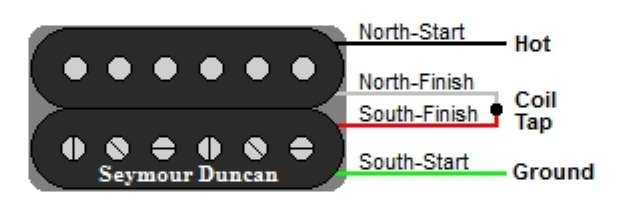
The 1st video posted, (Guns and Guitars), is just wrong. He isn't identifying start and finish. There is NO test, (volts, ohms, magnetic polarity, etc.), that can determine that. And there's no need to determine that, as I just said. Consider this Duncan wiring diagram:

Duncan_colors-01.png
If I did his "screwdriver" test, I'd get a positive for the black wire and a positive for the red wire. One is a start, and one is a finish. If I flip the magnet, I'll get a positive for the white wire and a positive for the green wire. Again, a start and a finish. You only need to know positive vs negative to wire a pickup properly. Start and finish are irrelevant.

I suppose I should make my own video. :)
 
The 2nd video doesn't identify start & finish. That's a good thing, because it isn't necessary for guitar wiring. It's only necessary if you're going to rewind a broken coil on a bad humbucker. But if you're a winder, you'll know what to do anyway. ;)

The 1st video posted, (Guns and Guitars), is just wrong. He isn't identifying start and finish. There is NO test, (volts, ohms, magnetic polarity, etc.), that can determine that. And there's no need to determine that, as I just said. Consider this Duncan wiring diagram:


If I did his "screwdriver" test, I'd get a positive for the black wire and a positive for the red wire. One is a start, and one is a finish. If I flip the magnet, I'll get a positive for the white wire and a positive for the green wire. Again, a start and a finish. You only need to know positive vs negative to wire a pickup properly. Start and finish are irrelevant.

I suppose I should make my own video. :)

Awesome - thank you. So, if I know + and - for each coil, as well as magnetic polarity (north/south), but don't know the start/finish, can I wire in parallel?

This is what I know about the Wilkinson M series hotrails using the MM:

North Pole: Black +
White -
South Pole: Red +
Yellow -

They come wired in series with red and white joined. How would I wire this in parallel? I want to use a DPDT pot to switch between parallel and series.
 
Black and red will be your "hot" output, and white and yellow will be your ground. ;)

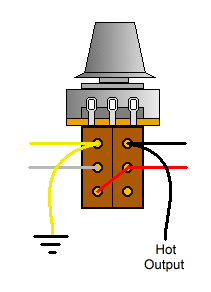
Fixed . . . for Wilkinson. The bottom of the push-pull is the same as a DPDT.

Wilkinson_series_parallel.png
 
Last edited:
I probably uploaded that pic just as you were reading. Just ignore the "pot" part of that pic. The switch part is identical to a DPDT switch.
 
Back
Top