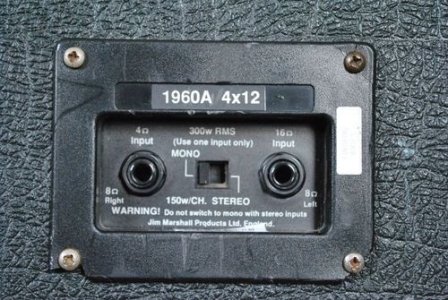
Re: Marshall 1960a Cab and running 8 Ohm head
Is it a solid-state head or a tube head with an output transformer?
Solid-state amps generally act as voltage sources in their linear range, and they like to see a certain minimum load. You can usually run a solid-state amp into a higher-impedance load (more ohms) without hurting anything, though it will probably impact the maximum volume the thing will put out and the overall efficiency of the power transfer. (You usually get the maximum power output when the load impedance matches the output impedance of the amp.) If you go too low on the impedance with a solid-state amp, at higher volumes it can't maintain the output currents being demanded of it, and it may clip and/or go into thermal protection. You might also notice sonic issues -- unwanted distortion, bass gets thin -- as you push the envelope more and more relative to what the amp is comfortable with. If you play at a level where the amp sounds right and doesn't seem to get hot or shut down, you're probably safe.
Tube amps are a little different. They often have specific taps on the output transformer for specific speaker loads, and it's a good idea to keep the two matched. A tube amp, with its impedance-matching output transformer, acts more like a current source than a voltage source. It tries to maintain a certain output current with a given input signal into it, which is why it's a bad idea to run a tube amp without a speaker load or with too high a load impedance. Some of the guys with more tube amp experience can probably expand on how and when you can play around with these rules. Personally, I have enough trouble with tube amps as it is, so I like to play it safe.