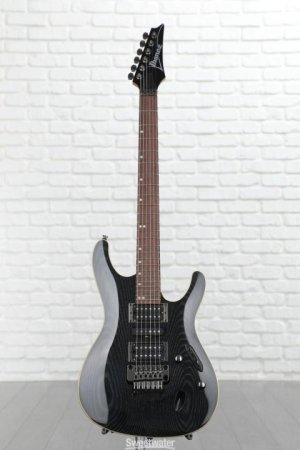
NGD: Ibanez S570AH

Nice wood grain on that one. What are the body and neck made of?

Neck is Wizard III, maple topped by what they claim is rosewood. To my eye, it does look like "real" rosewood and not one of the popular modern substitutes--a nice even reddish-brown. This makes me happy.

Body is "ash" of some sort. Never had an ash guitar before. It's kind of hard to see the pattern in the pic because of shiny, but its got concentric circles in it, which is unusual for these guitars. Usually they're parallel wavy lines that run front to back. It's an eye-catcher.
 
Yep, S-series. I think I like the thin body; it's taking a little getting used to, but it's very comfy.

I remember playing one of those when they first came out at the guitar shop across the street from Berklee. I loved that guitar but as a college kid, I could barely afford lunch let alone a new guitar. That is a really sweet score.
 
The Quantum pickups are very good, I would try to make them work unless you need something fundamentally different. I don't have any experience with that bridge. I have had a handful of Fujigen Ibanez Sabres and they are good guitars. Mine all had mahogony bodies, and the ones I owned exhibited a wide range of tonalities. One of the ones I kept has a quilted Sapele top and honestly the guitar sounds like Basswood. They dont have great sustain which is probably a combination of the abbreviated body, bolt on, and floyd.

The defining characteristics of the Sabre, IMO is that its a decent sounding guitar that is also lightweight. I think mine with lo pros are around 6#, while typical super strat is around 8#. That can make a real difference if you are not a brawny manly man. But the sabres look kinda like a toy when I play them.

I didn't know they were making Sabres with ash now. I know that there are many varieties of ash, so I can't predict how the guitar will sound or how heavy it will be.
 
What's the difference between Japanese ash and North American ash, other than the location?

Very little. They are both classified as the genus fraxinus, and over 50 varieties of ash grow throughout the Americas, Europe, and Asia. There is some difference in leaves, but the lumber is basically the same - with a few exceptions. Mostly straight grained, it can exhibit some flamed grain, and in the case of tamo ash - a very dramatic blistered grain sometimes referred to as peanut. Veneer can vary in appearance between rotary cut, sliced, and sawn. Weight varies even within trees felled in the same location. It works and finishes well as a general rule. Reasonably strong wood, useful in a variety of applications from furniture to sporting goods, and also as musical tonewood. Known in some areas as "poor man's oak". Susceptible to disease via boring insects.
 
Last edited:
Cool. That's some nice grain.

Traditionally, the S has been a mahogany guitar; the original idea was to make something with the mahogany sound but lightweight. There have been some variants using other woods over the years, like ash or maple (alone or in combination with something). E.g. there was an SV5470 some years ago with an ash or maple top option and mahogany back.

Sen was, of course, used for the fabled lawsuit Destroyers and Rocker Rolls, and a whole host of Strat style guitars.
 
Back
Top