Please help me understand Chorus,Flange, Delay and phase

MetalManiac

Li'l Junior Member
Please help me understand Chorus,Flange,Phase and Delay.
Am I right to assume that an 'analog delay' pedal is a tape echo based effect simulation?Am I right to assume 'Flange' and 'Phase' is a Leslie simulation?
What about Chorus?
 
Re: Please help me understand Chorus,Flange, Delay and phase

Analog delay can be a few things. It can be an old tape system, or it can be an analog chip that is basically a recorder that has no analog to digital back to analog converter. Flanger is a filter effect, so is a phaser, and chorus is like a slightly pitchy delay of sorts.
 
Re: Please help me understand Chorus,Flange, Delay and phase

analog delays were not originally designed to mimic or simulate tape delays. They were designed to make a delayed sound without all the wow and flutter and in a smaller, more reliable package.
Univibes were an attempe to simulate leslies, as were phasers, but by that time they were really an effect in their own right. Flangers take that sound one step further and simulate the sound of two tracks of tap running slightly out of sync.
CHoruses were an attemps to simulate two instruments playing in unison by using phase and delay technology.
 
Last edited:
Re: Please help me understand Chorus,Flange, Delay and phase

^ Thanks so much guys. Just what the Doctor ordered! :bowdown:
 
Re: Please help me understand Chorus,Flange, Delay and phase

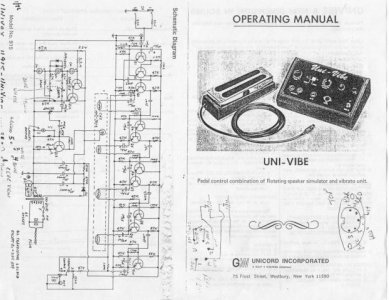
Here is a cool piece...

Notice on the front page of the manual of the Uni Vibe it says "Rotating speaker simulator"...

univibe1.jpg

It really missed the mark if you listen to as Leslie and a Uni Vibe but it made a cool sound on it's own!
 
Re: Please help me understand Chorus,Flange, Delay and phase

I think delays would have been more accurately called Echos.
 
Re: Please help me understand Chorus,Flange, Delay and phase

I think the way to properly understand this is to go back to what these effects are based on. Listen to sound bites of an original Leslie, then listen to the flange, phase pedals and I think you will agree the Leslie is really quite different. I also am one who prefers Digital Delay over analog. Analog IMHO gets sloppy sounding and the deterioration of the sound is very distorted in almost every analog effect of this type that I have heard including a real tape echo. I just can't seem to make them work the way I want to. I prefer my trusty old DD3 thank you. I think Chorus is similar to Leslie but not really the same. My board is setup with a CE2, DD3 and a few other basic pedals but I don't really use a lot of effects. Personally I would love to have a real Leslie!!!
 
Re: Please help me understand Chorus,Flange, Delay and phase

The name flange comes from the practice of having two reels of tape with the same tracks sync'd up, then making one reel of tape go at a different speed by laying a finger on the flange of the reel.

/trivia
 
Last edited:
Re: Please help me understand Chorus,Flange, Delay and phase

Alright, let me break it down...

A tape delay uses a loop of tape to delay the signal by some amount. An analog delay uses a Bucket Brigade Device (BBD) that makes a crude recording of a piece of the signal into an array of capacitors, also delaying the signal by some amount. The degradation of the audio signal is a little different between the two, but the signal will degrade (usually rolling off higher frequencies) the more times it is regenerated through the loop. A tape loop set for infinite repeat will halt further degradation, whereas a BBD will not, at least not as much. A true digital delay uses an analog-to-digital converter to sample the input signal, then delays and re-mixes the signal in a DSP chip before using a digital-to-analog converter to produce the output signal. You will tend to hear less degradation in a digital delay because the signal does not need to be resampled with every regeneration - it is only sampled once. Any degradation is caused by mathematical roundoff errors or intentional analog modeling algorithms.

Flanging takes the input signal, delays it by some amount through an echo circuit, then mixes this back with the original signal. This causes certain frequencies (and even harmonics) to be filtered out, while others are enhanced. Phase shifting does a similar thing, but uses a simple resonant circuit that will delay some frequencies more than others. In a phase-shift circuit, the different frequency components of the signal are delayed by different amounts of time; in a flanger all frequency components are delayed by the same amount of time.

To get the "swooshing" sound of a flanger or phase shifter, the delay time is modulated up and down slightly. This causes the affected frequency notches and resonant peaks to shift as well, introducing the swirling effect.

A chorus usually uses a tremolo/detuning circuit and a time delay to take one signal and make it sound like two. The main difference between chorus and flanging (as I understand it) is in how much detuning is involved.

A Leslie relies on the different dispersion of different frequencies out of a speaker. As the speakers in a Leslie cabinet rotate, higher frequencies roll off faster when the speaker is not pointed toward the listener, while low frequencies have less directionality. This is a different kind of swirling effect that is not easily modeled in the digital domain.

This is a simplified explanation, but the take-away is that these are all similar effects that result in subtly different frequency content of the output audio. You can often get away with using one in place of the other, but it will not sound exactly the same if you do.
 
Re: Please help me understand Chorus,Flange, Delay and phase

Alright, let me break it down...

A Leslie relies on the different dispersion of different frequencies out of a speaker. As the speakers in a Leslie cabinet rotate, higher frequencies roll off faster when the speaker is not pointed toward the listener, while low frequencies have less directionality. This is a different kind of swirling effect that is not easily modeled in the digital domain.

Actually, the Leslie uses the Doppler effect...there is a pitch shift up as a sound is coming toward you, and a shift down as it is moving away from you. It has to do with increasing the frequency of the waves as the source moves closer to your ear, and the frequency decreasing as the source moves away from you. Picture something moving through water...the waves in front of the object are close together and the waves behind it are far apart. (Or think of a car with its horn blasting coming toward you and then passing you and going away from you). As the speaker (or horn) in a Leslie rotates, that source of sound gets closer and further away from you with each rotation thus raising and lowering the pitch as it does. It has its greatest noticeable affect on higher frequencies
 
Re: Please help me understand Chorus,Flange, Delay and phase

Actually, the Leslie uses the Doppler effect...there is a pitch shift up as a sound is coming toward you, and a shift down as it is moving away from you. It has to do with increasing the frequency of the waves as the source moves closer to your ear, and the frequency decreasing as the source moves away from you. Picture something moving through water...the waves in front of the object are close together and the waves behind it are far apart. (Or think of a car with its horn blasting coming toward you and then passing you and going away from you). As the speaker (or horn) in a Leslie rotates, that source of sound gets closer and further away from you with each rotation thus raising and lowering the pitch as it does. It has its greatest noticeable affect on higher frequencies

Yes, doppler is also a component of the Leslie effect, but not the whole story either. The horn rotates, but the bass speaker doesn't. Instead it has an angled rotating plate above it that reflects the sound outward. The speaker remains at a fixed point, so angular dispersion is a better model for understanding what's going on in the bottom half. There are also baffles in the housing that cause other resonant effects.

Sorry to oversimplify. A Leslie is a very complicated system - one reason why there are still today very few pedals or effect processors that even come close to emulating one.
 
Re: Please help me understand Chorus,Flange, Delay and phase

Yes, doppler is also a component of the Leslie effect, but not the whole story either. The horn rotates, but the bass speaker doesn't. Instead it has an angled rotating plate above it that reflects the sound outward. The speaker remains at a fixed point, so angular dispersion is a better model for understanding what's going on in the bottom half. There are also baffles in the housing that cause other resonant effects.

Sorry to oversimplify. A Leslie is a very complicated system - one reason why there are still today very few pedals or effect processors that even come close to emulating one.

Not to get into a flame war over Leslie speakers (ha ha ha)...but neither driver actually rotates. The horn on top of the tweeter rotates, and the sleeve covering the woofer rotates...although it is not the whole story, as you note, it is mainly the doppler effect that gives the sound. The low and high frequencies do behave differently in this system (their elements are spinning at different rates and brake/accelerate at different rates), but it is mainly the doppler effect that gives the characteristic sound.

More trivia: although the horn on top of the Leslie appears to have two sides, sound only comes out of one of them...the other is for balance.
 
Back
Top