Point to Point soldering

  • Thread starter Thread starter DLT
  • Start date Start date
D

DLT

Guest
I understood that point to point soldering was like in the pictures below. Note the tube soldering. I was told that my 1970 Super Reverb was a point to point soldered amp. In comparison, I see the same type of soldered wiring in my Music Man HD-150. I know the preamp in the MM is a solid state type.
Any comments and pictues would be appreciated. Thanks.
 
Last edited:
Re: Point to Point soldering

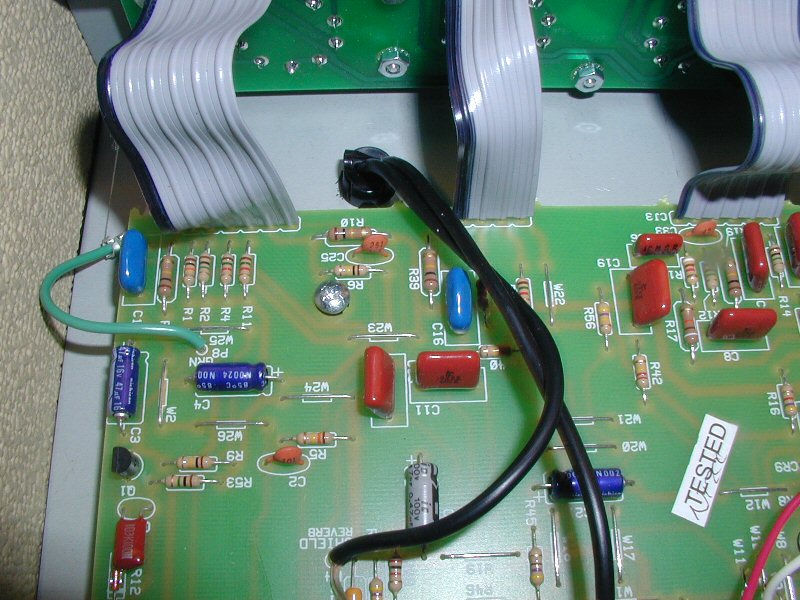
The one on the image is PCB. Notice the faint lines on the back of the board? These are the printed connections. Handwired means that every connection made has to be done bysoldering either a component or a wire wheareas pcb you have the "wires" printed on the board... actually they are not printed but it looks like it.
 
Re: Point to Point soldering

The tube sockets in that MM amp are handwired but the amp as a whole is a PCB amp...your 1970 Super Reverb has a black "tag" board with all the parts on it and the entire amp, board and all was handwired...big difference.
 
Re: Point to Point soldering

This is a PC board. the components are soldered to it and interconnected by copper traces under the board (you can see them through the board here)
FenderPCB.jpg


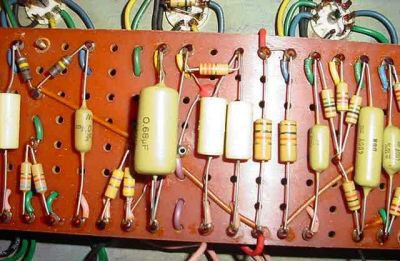
This is an old school point to point board. each component is soldered to a "point" and they are interconnected by other components or actual wires that you can see here...
MarshallTag.jpg
The biggest difference is repairs, it's much easier to fix a piece of wire than a copper trace embedded in the board. and wires dont generally break anyway but epoxy poards can crack, breaking multiple embedded "wires".

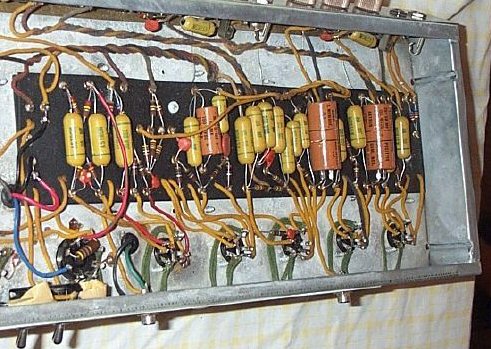
And here's your super for comparison. It's a different kind of board than the brown one (early marshall) but otherwise the same idea.
FenderTag.jpg
Hope this helps. BB
 
Last edited:
Re: Point to Point soldering

This is a PC board. the components are soldered to it and interconnected by copper traces under the board (you can see them through the board here)
FenderPCB.jpg


This is an old school point to point board. each component is soldered to a "point" and they are interconnected by other components or actual wires that you can see here...
MarshallTag.jpg
The biggest difference is repairs, it's much easier to fix a piece of wire than a copper trace embedded in the board. and wires dont generally break anyway but epoxy poards can crack, breaking multiple embedded "wires".

And here's your super for comparison. It's a different kind of board than the brown one (early marshall) but otherwise the same idea.
FenderTag.jpg
Hope this helps. BB

Thank you Big Bob. In your opinion, are the old Music Man amplifiers troublesome with the way they are built?
My opinion is I myself, have only seen minor things like tubes going bad and pots that need cleaning on the MM's, but that is about it. I really love mine, even though it is not point to point soldered. Not one thing has failed in mine for 28 years!
 
Re: Point to Point soldering

You're welcome DLT, I don't have too much experience with MM's but a friend of mine has about 5 of them and that's all he uses for gigs. He picks the appropriate sized one for the venue and a couple pedals . I suspect that they were probably made with pretty heavy PC boards back in the day so they're most likely very durable. You've got two great amps IMO.
 
Re: Point to Point soldering

You're welcome DLT, I don't have too much experience with MM's but a friend of mine has about 5 of them and that's all he uses for gigs. He picks the appropriate sized one for the venue and a couple pedals . I suspect that they were probably made with pretty heavy PC boards back in the day so they're most likely very durable. You've got two great amps IMO.

Much appreciated BigBob! Yes, the PC board is heavy duty from what I see. I have kept this amp in such pristine condition that it looks like brand new. The metal just shines on it, inside and out. Everything is spotless!

Not to boast, but I also have a 68 Vibro-Champ, Fender M-80, A new Custom Fender Vibrolux Reverb and a Rogue 30R tweed practice amp. I am selling off all my amps, except for the Vibrolux and 68 vibro-champ.
I just do not need all this gear anymore, as I will be moving to a condo in the near future. I know the new vibrolux does not come close in quality as my MM amp, but it takes up less space and is easier to transport, incase I want to jam with someone.

$999.00 for a custom vibrolux reverb, a 40W no frills amp, no cover and jensen speakers.
My MM amp, two solid clear oak cabs, with four 12S EVM's and a great 150 watt amp with solid oak shell. All perfect for only $2,000.00. And it comes with heavy duty custom made naugahyde covers. A walk away steal. If I cannot get 2 G's...I will keep it. This amp is louder than a Marshall 100W tube amp!
 
Re: Point to Point soldering

This isn't really point to point. It uses a "tag" board. This is a convenient way to layout a circuit and keep components from having cross-talk noise with neighboring components. Most everyone calls it point to point and I do as well. Point to point these days refers to a general style of handwiring an amp.

In true definition, there'd be very few leads, no tag board, just basically caps and resistors hanging off of pots, jacks and tube sockets. When you see one you'll know as it looks like a freaking rats nest inside.

:smack:
 
Re: Point to Point soldering

^^^^^^^^^^^^^^^^^^^^^^^^^
Scott F.

To my eyes, this is a work of art. WOW

Dave
 
Re: Point to Point soldering

A lot of TLC went into that one as EF86 amps can be really noisy if you're not careful.
 
Re: Point to Point soldering

No doubt there is a lot of nostalgia in point to point wired amps. In a vintage kind of way, they're beautiful.

I believe a well designed, solid state (or even tube) amp, with PCBs (printed circuit boards) can be done - just not sure if it exists yet! You can do a lot of tricks with the traces on a PCB to control the signal, the copper is very pure, and it is sealed with a "resist" coating for longevity.

Why are there so many bad sounding solid state guitar amps out there anyway? There's really no excuse for it today.

Noth
 
Re: Point to Point soldering

That reminds me. Does anyone actually know what percentage of guitar players use tube amps vs. solid state?

Noth
 
Re: Point to Point soldering

No doubt there is a lot of nostalgia in point to point wired amps. In a vintage kind of way, they're beautiful.

I believe a well designed, solid state (or even tube) amp, with PCBs (printed circuit boards) can be done - just not sure if it exists yet! You can do a lot of tricks with the traces on a PCB to control the signal, the copper is very pure, and it is sealed with a "resist" coating for longevity.

Why are there so many bad sounding solid state guitar amps out there anyway? There's really no excuse for it today.

Noth

There are different levels of quality when it comes to circuit boards. Open up a Rivera or a Fuchs and you'll see thick, well-designed boards that should last for a long long time. Open up a <insert mass produced amp name> and you'll find flimsy boards put together as inexpensively as possible. Some do it right, others don't.
 
Re: Point to Point soldering

That reminds me. Does anyone actually know what percentage of guitar players use tube amps vs. solid state?

Noth

100% of the guitarists in my home play on tube amps. :laugh2:


In the rest of the free world, these days, I'm betting 70% are using SS these days.
 
Re: Point to Point soldering

100% of the guitarists in my home play on tube amps. :laugh2:


In the rest of the free world, these days, I'm betting 70% are using SS these days.

Wow! That many? Does that imply that there are decent SS amps available? Or does the whole tube thing scare people off (If I gigged, I couldn't blame them)?

Noth
 
Re: Point to Point soldering

I think some people like the price, light weight and fast turning on of SS amps.
The only real difference I can hear between todays solid state amps vs. tube amps is projection. Step away from a SS amp and the volume drops off. Do it with a Tube amp and it is not so evident.

Any one agree with DLT?
 
Back
Top