Polarity and phase issues when reversing the magnet of a humbucker

Flameycake

New member
Hey guys!

I'm having some trouble understanding the exact effects that reversing the magnet on a humbucker does, its applications and all.
From what I understand, PRS guitars have one of the humbuckers' magnet reversed, and this is done, from what I've read to "make the inner split coils work together". The template I'm sorta exploring is this one:
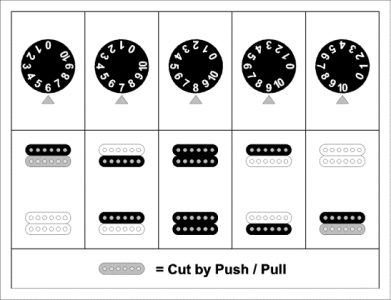
dgt3.gif

So from the things I've learned so far, reversing the magnet will reverse the signal from the string on a coil, but not the hum (since it has no orientational source). And generally we link two coils in a humbucker by reversing both the polarity and the wiring of one so that the string signals stay in phase but the hum cancels itself out.
Here however, if say the bridge humbucker has had its magnet flipped (polarity reversed) relative to the neck pickup, according to what I said initially (supposing that's even remotely correct ...) then all this should do is reverse the string signal phase, without changing the phase of hum.
This means that putting the inner coils in parallel will still have hum, AND will be out of phase ... WHAT THE ...

Assuming PRS is not being run by mental cases, this leaves the question of: Where the bloody hell did I go wrong? XD

Thank you so much for any help that can be offered. If something is unclear in what I explained I can also clarify my understanding.
 
Re: Polarity and phase issues when reversing the magnet of a humbucker

I don't know about many PRS wiring schemes, but the one I have explored is operated by a 5 way superswitch.

What is the diagram above supposed to relate to in the switching dept?

Anyhow, in normal operation the inner slug coils will be in phase with each other, as will the screw coils. They are wound the same way, so I don't think they cancel hum. The phase reversal will mean that the coils are reverse polarity, but now you have to reverse wind them (swap the positions of the leads for each coil) to complete the process. This gives RW/RP which is now in phase but hum cancelling.
 
Re: Polarity and phase issues when reversing the magnet of a humbucker

Flameycake said:
Here however, if say the bridge humbucker has had its magnet flipped (polarity reversed) relative to the neck pickup, according to what I said initially (supposing that's even remotely correct ...) then all this should do is reverse the string signal phase, without changing the phase of hum.
This means that putting the inner coils in parallel will still have hum, AND will be out of phase ... WHAT THE ...

Up to this point you are correct in describing half of the process. The next step, as Alex says is to reverse the polarity of both coils on the humbucker with the flipped magnet. This is accomplished by changing the wiring/connections to the coils.

Since the pickup with a flipped magnet now has a South Slug coil and North Screw coil, you'll have to flip the connections for each coil. Effectively the Black/White swap and the Red/Green swap, compared to the schematic you are looking at. White becomes hot output, Black/Green are tied together and Red becomes ground. Now you've got a pickup that, in full HB mode is in phase with a standard HB, but the individual coils are RW/RP with respect to the equivalent coil on the standard HB. (Inner coils will be in phase and cancel hum, outer coils will be in phase and cancel hum)


My understanding is that PRS handles this internally, so with their pickups you simply wire for outside coils and its hum cancelling.

**** Before you wire like I mention, Artie, GuitarDoc or Funkfingers should confirm, they do this stuff all the time, I'm just doing a theoretical thought exercise... ;)****
 
Last edited:
Re: Polarity and phase issues when reversing the magnet of a humbucker

**** Before you wire like I mention, Artie,****

Yup. I've got a diagram around here somewhere that illustrates this pretty good. Let me see if I can round 'er up.
 
Re: Polarity and phase issues when reversing the magnet of a humbucker

They do this so the pickups can remain in phase and humbucking, with the proper coils selected (inner coils in one position, and outer on another). Schaller makes a MegaSwitch which does this, but you still have to flip a magnet.
 
Re: Polarity and phase issues when reversing the magnet of a humbucker

First, let's review a couple things. There are three ways to control the polarity, (not phase), of a single coil:
Wind direction, (CW or CCW), magnet polarity, or reversing the output wires. Do any two, and you're back where you started. A Duncan humbucker winds both coils the same direction, so the noise they pick up will be the same polarity. Then they wire them together with one coil's wires reversed, so the noise cancels. This would also cancel the signal that we want. So they lay the magnet underneath such that each coil gets a different polarity. That restores the polarity of our signal.

A Stratocaster single takes the opposite approach. The middle pup will be reverse wound, (RW), from normal, but wired with the same polarity. This causes it to cancel noise with the neck or bridge pup. Then, they reverse the polarity, (RP), of the magnet to restore the signal polarity.

Having said all that, look at the following diagram:

!main-02.png

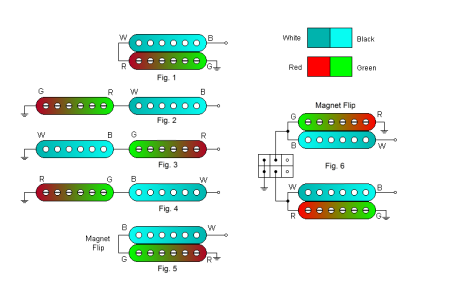
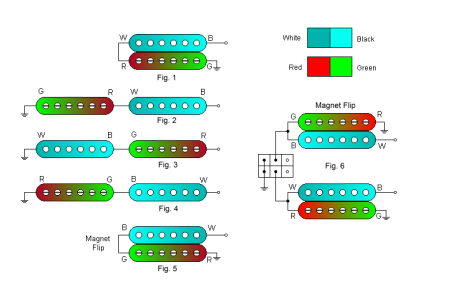
Fig 1 shows a normal Duncan humbucker. Note that if you shorted the red/white wire to ground, you'd short out the screw coil, leaving the stud coil active. This is the "normal" way of splitting a humbucker. Now, imagine the red/white connection is a "hinge", and you rotate the screw coil around so that the coils are in a straight line. Nothing else changes. Now switch the position of the two coils so that the screw coil comes first (Fig 3). You still haven't changed anything electrically, and this is a perfectly good way to wire up a HB'er. Then, rotate the two coils on the center like a propeller. (Fig 4) Now you've reversed the polarity of the pup and it will cancel out the sound if connected the normal humbucker of fig 1. So, last step, flip the magnet so that the signal polarity is restored. (Fig 5)

If you take this rewired, flipped mag pup and hook it up to a normal humbucker, as in fig 6, and you can use the normal method of shorting the coil-connect wires to ground, and end up with both stud coils, with hum cancelling, and the proper polarity of signal.

Make sense? :)

Artie
 
Last edited:
Re: Polarity and phase issues when reversing the magnet of a humbucker

Great simplified explanation Artie.

The final question is:
Does Inner coils and Outer coils provide more of a tonal difference than (N)Stud & (B)Screw and (N)Screw & (B)Stud?

In other words, is the effort to swap the mag worth it for the difference in tones available?
 
Re: Polarity and phase issues when reversing the magnet of a humbucker

I'm not sure. I believe the stud coil to a bit more robust than the screw. I really need to try this myself.
 
Re: Polarity and phase issues when reversing the magnet of a humbucker

The sound is different, as my guitars are wired with stud/stud and screw/screw splits. I had to flip a magnet to keep it hum cancelling, in phase with those coils selected. It is slightly more quacky, I guess, but that really isn't a very technical term.
 
Re: Polarity and phase issues when reversing the magnet of a humbucker

What about this? i have an older squier i love the sound of the single coils but i want a humbucker sound in the bridge. I want to try and use the middle and bridge pickups and wire them into a humbucker.

Here is the issue, the magnets are pole magnets each pole is a magnet there is no magnet to flip around on the bottom of each single coil. ALSO the pickups have a trioval plate so how would i wire these and how would i stack em?

Right now i have them side by side with the 2 tri-oval plates on the outsides and wired in series but im not sure if this is the optimal way to have them wired. They seem to cling together like they have a north and a south to the poles.

I want the fatest highest output humbucking sound i can get out of the 2 coils if its possible.
 
Re: Polarity and phase issues when reversing the magnet of a humbucker

Nice catch. Drink more wine. :D

Fixed:

!main-02.png

Unfortunately, I can't fix the original. It's from a website that I no longer host. (At least, for the moment.)

Artie
 
Re: Polarity and phase issues when reversing the magnet of a humbucker

Why does the signal leave the pickup and decide to go out whichever lead that is being used for positive instead of getting grounded by the lead that is used for negative?
 
Re: Polarity and phase issues when reversing the magnet of a humbucker

A guitar pickup is an AC voltage generator. Exact same thing at Niagara Falls, but on a microscopic scale. "Ground" is simply the term we use to designate the "reference" point. That is, the point by which we make our measurements. Put the black lead of your meter on the negative terminal of a car battery, then place the red terminal on the positive terminal, and you'll measure +12 volts. Reverse the leads, and you get -12 volts. You get to pick the "reference".

Same with a guitar pickup. Pick one wire to "ground", ie., make as your reference, and the other lead becomes the "hot" wire". AC doesn't care. Actually, DC doesn't care either. It's your choice. That's why we have all the wiring options, and confusion, about guitar wiring. ;)
 
Re: Polarity and phase issues when reversing the magnet of a humbucker

A guitar pickup is an AC voltage generator. Exact same thing at Niagara Falls, but on a microscopic scale. "Ground" is simply the term we use to designate the "reference" point. That is, the point by which we make our measurements. Put the black lead of your meter on the negative terminal of a car battery, then place the red terminal on the positive terminal, and you'll measure +12 volts. Reverse the leads, and you get -12 volts. You get to pick the "reference".

Same with a guitar pickup. Pick one wire to "ground", ie., make as your reference, and the other lead becomes the "hot" wire". AC doesn't care. Actually, DC doesn't care either. It's your choice. That's why we have all the wiring options, and confusion, about guitar wiring. ;)

Thanks for replying. I still don't understand because I thought electricity can be directed by incentivizing it to get to ground. Why doesn't it just run out the ground lead in the first place?
 
Back
Top