crusty philtrum
Vintageologist
Re: rosie is born!
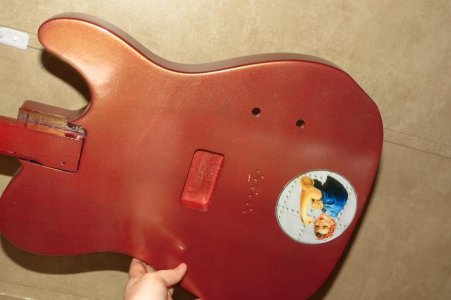
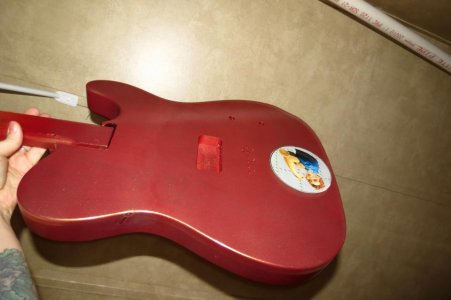
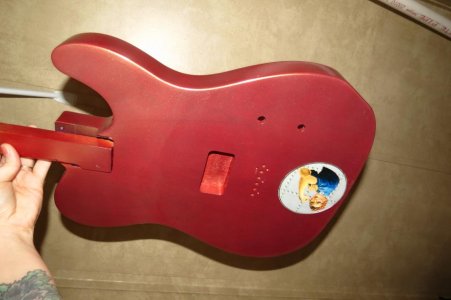
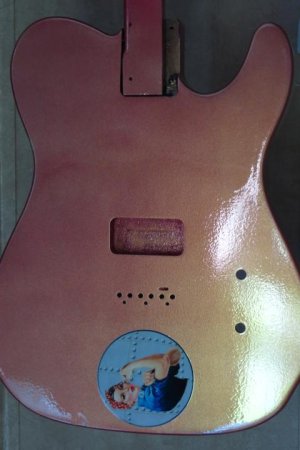
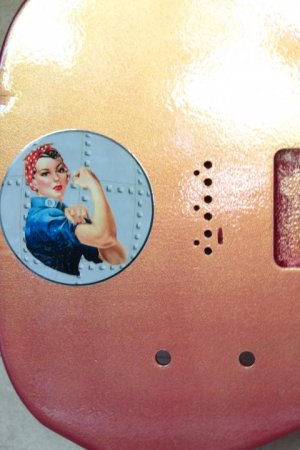
I'd put four or five coats of lacquer ONLY on the decal first if your next step is wet sanding. Even if you aren't wet sanding but going straight to clear coats, I'd still give the decal a bunch of coats first (do the first couple of coats as 'mist coats' to avoid damaging the decal in any way, unless it came with instructions telling you differently ... then a few regular coats to build up thickness).
After that, you can spray the entire body normally, without having to pay special attention to the decal area, and you don't need to spray ten coats if you want ten coats on the decal ... i.e. the decal will have about twice the number of coats as the rest of the body .... more protection for the decal, less uneccesary thickness on the body.
There would be two ways of spraying the decal ... either cut a hole in a big piece of paper or cardboard and mask the front of the body, or spray the decal with no masking and try to stop the overspray spreading out too far. In the first method, you will end up with a slight finish ridge at the edge of the masking that will need to be feathered into the surrounding area without damaging or breaking through the surrounding area. With the second method, there won't be any ridges, and critical sanding techniques won't be required. However, it relies more on how well you shoot the protective coats in the first place ... with a rattle can, one quick shot would constitute a coat. For that method, draw some similarly-sized circles on big sheets of paper and use them as 'targets' to practise the micro-technique.
I'd use the second method. You might prefer to do it in some altogether different way.
Just remembered you can use a method that's a bit of both ... cut a round hole in the middle of a piece of cardboard but don't tape it to the body, hold it in one hand and spray through it ... obviously you'd hold the cardboard somewhere near the body, lined up over the decal .... by being a few inches above the body, it will keep the paint in a circular pattern but allow it to create a 'fuzzy edge' to the circle of lacquer rather than the sharp edge that forms when the masking is taped down. Again, some rough tests will let you find what works best for the situation.
I'd put four or five coats of lacquer ONLY on the decal first if your next step is wet sanding. Even if you aren't wet sanding but going straight to clear coats, I'd still give the decal a bunch of coats first (do the first couple of coats as 'mist coats' to avoid damaging the decal in any way, unless it came with instructions telling you differently ... then a few regular coats to build up thickness).
After that, you can spray the entire body normally, without having to pay special attention to the decal area, and you don't need to spray ten coats if you want ten coats on the decal ... i.e. the decal will have about twice the number of coats as the rest of the body .... more protection for the decal, less uneccesary thickness on the body.
There would be two ways of spraying the decal ... either cut a hole in a big piece of paper or cardboard and mask the front of the body, or spray the decal with no masking and try to stop the overspray spreading out too far. In the first method, you will end up with a slight finish ridge at the edge of the masking that will need to be feathered into the surrounding area without damaging or breaking through the surrounding area. With the second method, there won't be any ridges, and critical sanding techniques won't be required. However, it relies more on how well you shoot the protective coats in the first place ... with a rattle can, one quick shot would constitute a coat. For that method, draw some similarly-sized circles on big sheets of paper and use them as 'targets' to practise the micro-technique.
I'd use the second method. You might prefer to do it in some altogether different way.
Just remembered you can use a method that's a bit of both ... cut a round hole in the middle of a piece of cardboard but don't tape it to the body, hold it in one hand and spray through it ... obviously you'd hold the cardboard somewhere near the body, lined up over the decal .... by being a few inches above the body, it will keep the paint in a circular pattern but allow it to create a 'fuzzy edge' to the circle of lacquer rather than the sharp edge that forms when the masking is taped down. Again, some rough tests will let you find what works best for the situation.
Last edited: