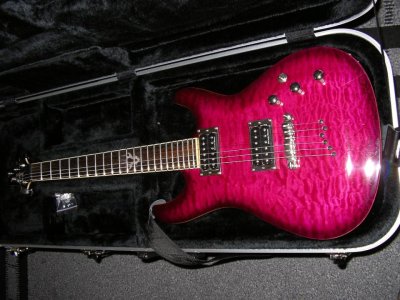
Same guitar, all mahogany

Re: Same guitar, all mahogany

Thanks, really interesting!

How many pieces is the mahogany back of the body?

Afraid I no longer have it, and no pix I can find of the back. The whole guitar was essentially a butcher block as I recall, but sounded and played very well. "Tone glue!" :)


Larry
 
Re: Same guitar, all mahogany

IMO everything makes a difference - but how much difference each part makes in any given guitar can vary wildly. And IME neck wood often makes quite a bit more difference than body wood in terms of tone. But not always.

There are generalizations but no hard rules, and the specific outcome is down to each individual guitar.

Everything I've learned and experienced in playing hundreds of guitars over more than fifty years has led me to believe that not only is every piece of wood different, but that the way the different pieces interact also varies from one instrument to another.

Two guitars of the exact same base wood (or combination) can sound very different indeed.
Yet sometimes guitars made of different woods wind up sounding virtually the same.

In this case I'd say you might expect a warmer top end and a rounder, more voicelike midrange. That's typical of mahogany.
Whether or not you'll actually get that, you won't know until you play the guitar through your own familiar rig.
 
Re: Same guitar, all mahogany

Afraid I no longer have it, and no pix I can find of the back. The whole guitar was essentially a butcher block as I recall, but sounded and played very well. "Tone glue!" :)


Larry

I have two SZ's and they both sound amazing. Very resonant!

Mayeb it's the age, they are the oldest guitars I have. I guess by now the wood is fully dry and the wood resins hardened into colophony, making things more resonant. I read somewhere that when a woodworker knows what he's doing when glueing blocks together, it doesn't matter much, but can ruin the sound when it's thrown together haphazardly? Who knows?

Maybe all older wood sounds better?
 
Re: Same guitar, all mahogany

^ There is not a single test anywhere that will tell you the sum of a group of wood blanks glued together.....NOT 1!!!

Especially given they then get cut into shapes and part of them routed away for various hardware items.

The only 'tap test' with any validity is where you have an acoustic top cut to shape and you are affixing bracing. The tap will tell you at that precise location whether you have given enough support to the span - or too little or much.
It still doesn't tell you however whether the top will play well with the sides, back and neck though.
 
Re: Same guitar, all mahogany

That's an unusual technique you've got. I usually pluck the strings, with either a pick or my fingers.

Well,

I once had the opportunity (I think they came from a failing store) to buy two Michael Harding Patriots, new and identical, at half the price.

Same wood, same pickups, and they sounded very differently. You can hear it when you tap them with your knuckle, the knock (natural resonance frequency) is at least two whole tones apart, they couldn't be more apart. One was very midrange heavy, the other has a really deep, dark sound. The big difference really baffled me. But then again, no two pieces of wood are the same.
 
Re: Same guitar, all mahogany

I tap test when I'm trying out a guitar. Not for tone, though - never been able to get a good read on that by tapping.
That's not to say an experienced luthier couldn't have a better take on it when matching pieces for a build - I'm just a player.

And in WDeeGee's case of two identical guitars I can accept it as a legitimate indicator that there's a difference. Just not sure how I'd use that knowledge when sampling instruments out in the wild. I should test my own herd (which I already know well) and see if I find a definitive correlation. Good rainy day project.

Anyway, my traditional tap test is for liveness. If I tap the back of a headstock and feel the whole guitar shiver with a vibration that lingers for a moment, then usually it's a live neck and a good solid connection to the body.

IME guitars that felt lively when tapped behind the headstock have been the ones that came alive at reasonable volume.
And given today's lower stage levels, that's even more important than it used to be.
 
Re: Same guitar, all mahogany

I tap test when I'm trying out a guitar. Not for tone, though - never been able to get a good read on that by tapping.
That's not to say an experienced luthier couldn't have a better take on it when matching pieces for a build - I'm just a player.

And in WDeeGee's case of two identical guitars I can accept it as a legitimate indicator that there's a difference. Just not sure how I'd use that knowledge when sampling instruments out in the wild. I should test my own herd (which I already know well) and see if I find a definitive correlation. Good rainy day project.

Anyway, my traditional tap test is for liveness. If I tap the back of a headstock and feel the whole guitar shiver with a vibration that lingers for a moment, then usually it's a live neck and a good solid connection to the body.

IME guitars that felt lively when tapped behind the headstock have been the ones that came alive at reasonable volume.
And given today's lower stage levels, that's even more important than it used to be.

I like guitars like that too . . . they make me feel happy when they're thrumming along next to my body. They also sound/feel better when playing unplugged (which I often do while practicing). In a blind test listening to sound samples though, I can't tell the difference between a guitar that does this with the same pickups/setup/amp as a decently made guitar doesn't. Maybe it makes a difference at extremely high volumes?
 
Re: Same guitar, all mahogany

That's an unusual technique you've got. I usually pluck the strings, with either a pick or my fingers.

Haha lol yeah, so do I. You hold them by the neck at the headstock, let'm hang and tap the back like you would knock on the door. A loud, clear knock means good resonance. A dull knocking sound is no good, you can hear the same thing by playing some chords acoustically. But, the knocking will tell you the guitar's resonant frequency. Between guitars this can vary a lot. I was just suprised that two "identical" guitars would have such a different resonant frequency. And this translated when playing electrically too.
 
Re: Same guitar, all mahogany

I like guitars like that too . . . they make me feel happy when they're thrumming along next to my body. They also sound/feel better when playing unplugged (which I often do while practicing). In a blind test listening to sound samples though, I can't tell the difference between a guitar that does this with the same pickups/setup/amp as a decently made guitar doesn't. Maybe it makes a difference at extremely high volumes?

Not a tone thing for me - it's all feel.
However in terms of effects that could be measurable, IME a lively guitar usually gives better sustain at medium volumes than a stiff one.
You can feel when they're trying to take off; it happens sooner with a lively axe.

At extremely high volumes the most rigid guitar will come alive, even guitars with a metal neck for instance.
The rare exception is really dead wood. Such guitars do exist.
 
Re: Same guitar, all mahogany

I lauphed when I read this post. its an age old question. Theres a guy on YouTube swearing up and down that wood and construction makes no difference. He claims that only pickups will change tone. When I asked him.......what amp are you playing through? he comes back with..... A Johnson with built in processor. So he processes the hell out of his tone and only the strongest pickup variations are gunna be noticable at that point.
Wood makes a noiticable difference as well as neck wood and thickness of neck wood. Yup, its true. we did two identicale strats one alder one ash. the alder had a more pronounced midrange, the ash had a more pronounced top and bottom but softer midrange. how big was the difference? only about 10%. on a clean fender amp you could hear it. if it was heavily processed probably not. with heavy distortion not too much except we found the ash had a more pronounced gain on the high end notes like a little extra precense on every note so as to sound a little sharper. again with heavy chorus and reverb too? maybe or probably not that noticable. many performers eq their signal to sound basically the same no matter what guitar they pick up so it all stays consistant.
the answer to this question is simple.....the more simple the tone, the more a simple differance like wood will matter. a mahagany les paul with a maple cap will definently sound different through a el 34 Marshall full stack then a alder strat with a bolt on neck and floyd rose no matter if both guitars have a JB in the bridge. if you over process and sterilize the tone to death (80s new wave....flock of seaguls or New Order) then no, you could almost sound identical on a Dan Electro.
 
Last edited:
Re: Same guitar, all mahogany

one more thing, if the wood on the neck of a strat is quartersawn it makes it sustain longer about 25 to 30 percent and it has a more snappy midrange with harmonics being more pronounced. That doesnt mean it sounds better. it only means thats what the wood differance will do to the tone. If you like a soft, round, clean tone on a strat you may hate the snappy, punchy, articulate quartersawn neck tone. Theres no right or wrong here. Its simply what you prefer.
I will say this......If you had a quartersawn neck on a strat your gunna notice about a 20 percent differance in tone (max and only if your good enough to exploit it). But if you add real steel saddles about 10% diffence, and a large brass block 15% differance, and a more efficent capacitor 10 to 15% difference, and a titanium claw and heavier springs 10% difference, all without even starting on the pickups, you will suddenly have a significant differance as long as you dont overprocess the tone.
I have not experimented with baked necks yet as I have only played about 5 guitars with baked necks. I have done no side by sides with the same model. Those that like baked necks really swear by them and claim the sustain is better and the tone clearer. I found the guitars I played had definently good sustain and a clear, articulate tone. I think a polyester finish would nulify much of that so your back to exploiting the baked neck by trying to use a Nitrous finish so it would really resonate more and the diffence would become more noticable.
Its expensive to naturally enhance your guitar tone for different tone and more sustain. Pickups are often the easiest and most affordable way to quickly change your tone. I will say the best players are gear heads and tweakers for a reason. Natural good tone always sounds great unless over processed.
good luck gentleman. Im a hopeless tweaker and gear head. Its just something I love to do. Theres no right or wrong and your experiance and tastes will vary.
 
Last edited:
Re: Same guitar, all mahogany

The more you distort your guitar signal, the more it compresses.

And the more it compresses, the more frequencies (you know, the building blocks of tone) get "squashed".

Eventually resulting in a flat, lifeless tone... at that point, you've squashed the signal.

And, at that point (like others have said) it doesn't matter much what guitar you plug in, it's all gonna sound the same.

Wood matters... and so does the amount of gain/distortion you use... when it comes to your guitar's inherent tone.
 
Last edited:
Re: Same guitar, all mahogany

The more you distort your guitar signal, the more it compresses.

And the more it compresses, the more frequencies (you know, the building blocks of tone) get "squashed".

Eventually resulting in a flat, lifeless tone... at that point, you've squashed the signal.

And, at that point (like others have said) it doesn't matter much what guitar you plug in, it's all gonna sound the same.

Wood matters... and so does the amount of gain/distortion you use... when it comes to your guitar's inherent tone.


So, in your view all metal and hard rock is **** guitar tone where the guitar doesn't matter?
 
Re: Same guitar, all mahogany

So, in your view all metal and hard rock is **** guitar tone where the guitar doesn't matter?

Where in my explanation did I indicate that "metal and hard rock" levels of distortion was the point where guitar tone starts turning into over-compressed ****?

Besides, you've heard my clips - you know what I play. (metal and hard rock is a forte' of mine) :lol:

Like AlexR says, "Some people's pickups/rig/processing just kills any of the more subtle aspects of the tone. They're the ones you typically hear saying there is no difference at all."

When I was kid and didn't know jack about tone, I would layer gobs and gobs of distortion on my tone for the aggression, but mostly to hide my crummy playing.

That's more the point where tone starts turning into over-compressed ****. It wouldn't have mattered the guitar I used; would've sounded the same.
 
Last edited:
Re: Same guitar, all mahogany

I have 3 of the SZs. They all sound the same. 2 320s. One Black and one Gold Top. And 1 520 with quilted maple top. The Black is the lightest most resonant, but still sounds just like the other two.
 

Attachments

  • Guardian case 001.jpg
    Guardian case 001.jpg
    113.1 KB · Views: 0
Last edited:
Re: Same guitar, all mahogany

I have 3 of the SZs. They all sound the same. 2 320s. One Black and one Gold Top. And 1 520 with quilted maple top. The Black is the lightest most resonant, but still sounds just like the other two.
Is that thing actually hot pink or is that just the camera being quirky? I love it!
 
Back
Top