Same pickup type - different DCR readings within spec - difference?

Rex_Rocker

Well-known member
Not sure how to word this question correctly, so please bear with me.

So I suppose pickups made by Duncan have a 10% tolerance, right? And I know they're wound to number of turns rather than DCR measurements for costitency. But let's say I bought two JB's, and both happen to be at the outer edges of the tolerance range. Let's say one measures mid 15K's, and the other mid 17K's. Let's also assume that's the only difference between both, and both have magnets charged equally. What would be the tonal difference between both? Also, what would be the physical and electrical difference between both? I would assume it's not much, but I also have a hard time believing it's completely negligible, subtle as it may be. I mean, after all, there's close to a 1.6K difference there.

Is my assumption correct that the one reading higher might actually have slightly thinner wire on average and the one reading lower might have thicker wire? So the one reading low might actually have a bit more copper in it? Or is my assumption wrong?

Just thought I'd discuss.
 
Last edited:
Is my assumption correct that the one reading higher might actually have slightly thinner wire on average and the one reading lower might have thicker wire? So the one reading low might actually have a bit more copper in it?
Yes, it's correct.

All other factors being equal, the difference between a 15k and a 17k pickups would be a slightly louder signal from... the lower DCR (!), whose Q factor would also be a wee bit higher.

Now, two pickups of the same model can exhibit exactly the same DCR and different inductances making them sound differently.

FWIW.
 
Yes, it's correct.

All other factors being equal, the difference between a 15k and a 17k pickups would be a slightly louder signal from... the lower DCR (!), whose Q factor would also be a wee bit higher.

Now, two pickups of the same model can exhibit exactly the same DCR and different inductances making them sound differently.

FWIW.
That's interesting. Thank you.

I'd love to try to source a JB that reads really low vs. one that reads really high to make this experiment.
 
I have some neck pickups

With a range of 7.2k to 9.1k
There's four of them

When installed they all sound almost identical

My old ears cant hear any difference

Now it is not a straight A-B test
I do have to swap them out and set them up , and tune back up ... so its about 20 to 30 minutes between samples

I did have them in separate identical guitars

And again they sounded in-perceptable
 
Honestly, after you took one pickup out, put the other one in and re-strung, it might be harder to hear small differences.
But I could record clips with both. I do that all the time to compare my guitars for fun. I sometimes do it during pickup swaps to really compare.

That's if I ever got one that's super low or super high within spec, but hunting out one that reads that low or that high seems like a difficult endeavour. Not really planning on swapping out my JB's anytime soon, though.
 
Last edited:
Certainly worth doing for fun, and for science, but practically I don't know how much difference it would make...especially whan you could make up gain or EQ differences with other gear.
 
Practical differences between guitar pickups and especially between passive ones are largely due to external parameters anyway. I'm often surprised to read about pickups as having a defined and fixed tone when in fact, the simple use of 100' of cable VS a wireless emitter without cable emulation gives two different sonic profiles.

Now and about the difference of DCR: it's a part of the "Dual-Resonance" recipe, for the record. Some DiMarzio models have two coils wound from different wire gauges with exactly the same number of turns, giving exactly the same inductance but with a slightly different output level and Q factor for each coil (and a different stray capacitance setting the resonances at different frequencies, hence the "Dual-Resonance" concept). In this case, the "small" difference noticed has a bigger effect on tone than expected.

Off topic footnote: if my ears were never noticing any difference between pickups with different specs, I'd check my audiogram, I think. But being old myself, I understand that being a little deaf because of age can make life way simpler. ;-)
 
Last edited:
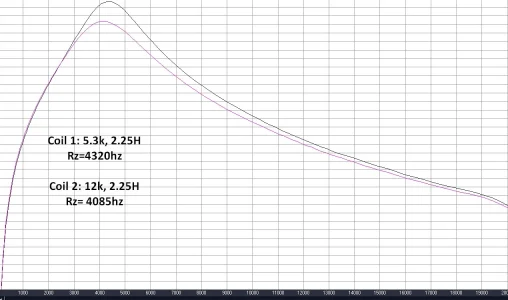
Example below of raw (not "integrated") electrically induced response on a Dual-Resonance model whose specs make the situation rather clear: the 5.3k coil is almost 3dB louder @ resonance than the 12k coil with same number of turns / same inductance. Vertical steps of 1dB. The pickup was "loaded" (associated to pot resistance and wiring capacitance). The pic is about coils excited separately in split mode. It doesn't show what happens when coils are in series (where different stray capacitances give a comb filtering effect).

And to be clear myself: all other factors being equal, such differences in resonant peaks DO give different tones. So much that decades ago, DiMarzio was already describing resonant frequencies as THE parameter defining the sound of guitar transducers. He was obviously oversimplifying the question but it doesn't make wrong his statement (and all the lab tests done here are about things shaping the tone anyway: it wouldn't have any interest to measure a spec on a guitar pickup if it had no tonal effect). I know the Duncan team knows the importance of this spec as well, since the old Duncan Pickups chart was precising the resonant frequencies of all models (unloaded)...

Two JB's of 15k and 17k wouldn't / shouldn't have a difference of 3dB and 235hz between resonances: it would probably fall under the perception threshold.
Now, a SH2 that I've measured at 7.28k / 4.2H and another one measuring 7.24k / 3.75H did NOT sound the same (but not because of DCR: the perceived tonal variation was due to the 0.45H gap in measured inductance, which is quite high).

DualRzExample.webp
 
Last edited:
Now, a SH2 that I've measured at 7.28k / 4.2H and another one measuring 7.24k / 3.75H did NOT sound the same (but not because of DCR: the perceived tonal variation was due to the 0.45H gap in measured inductance, which is quite high).
Wonder what would cause the inductance to measure differently if the DCR is the same. Is it how tightly the wire is wound around the pickups? Or something else?
 
Wonder what would cause the inductance to measure differently if the DCR is the same. Is it how tightly the wire is wound around the pickups? Or something else?
I don't know how to word my answer since we're touching here to the art of making pickups, where factors affect each others...

Let's say that a more tightly wound coil should have a higher Q factor, more resistance and stray capacitance but less inductance...

...while more inductance can be obtained from a more "generous" physical size and shape of the winding around the bobbin (+ a different TPL formula... but there, I don't feel authorized to be more precise in a public context, thx for your understanding).

Although other factors affect the inductance, of course: the iron content of the whole magnetic circuit is crucial here.

All that being said: one can wind three coils from a same spool of wire with a same machine set in the same way and still measure different LRC specs finally.
 
I think in real time. It would amount to something barely noticable by the time youve completly adjusted the screws with the OCD precision most of us do.
And if back to back swaps were done. Youd forget the subtltys by the tine youve removed replaced resoldered and readjusted the next one in. IMHO
 
To be fair, I do absolutely detect differences in pickups that are close in measured values, but I am suspect of how obsessive I need to be about small measurable differences.
I'd rather just play than take stuff apart (again).
 
Back
Top