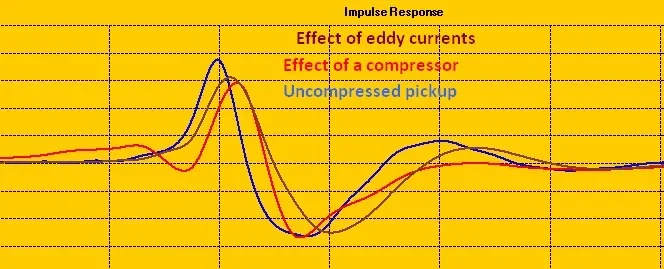
But my point was more along the lines of a '59 with a ceramic vs. a '59 with A2. If I had to take a guess, I'd probably say the higher output ceramic '59 would have more dynamic range.
My LP number one hosts P.A.F. clones including NOS short A2 magnets. Nothing special when it comes to LRC specs, resonant peaks + Q factors or measured flux strenght.
But when I play these puppies, it's as if a compressor was always on. I can dig the strings and obtain more or less grit by doing this but the output level somehow limits itself. No spiky transients. Just an even response (without the usual perceived flaws of LP's: no muddy or boomy neck position, no ice pick from the bridge PU. It's always as if the tone was premastered).
It amazes and delights me for 20 years now. To illustrate what I mean, I could play here "I Thank You", first tune of the
Deguëllo album from ZZtop since it's exactly the tone that I get,
whatever are the pedals, amp and cab used.
I've not tried ceramic/ferrite bars in this set. I certainly don't want to ruin it since it's my favourite pair of passive PU's, beside a handful of real vintage ones (including my early 59's as Duncan reissued 'em in limited edition recently).
But I wouldn't be surprised to notice a wider dynamic range (spikier transients) with ceramic, due to higher Gauss levels and less Foucault currents. It wouldn't cancel the possibility to obtain a compressed tone, but this compression would come from some gain stage defeated by the transients and no more from the pickups themselves... A (ceramic loaded) Jackson BC50 in my old Charvel does exactly that. Also delightfully compressed to me for more than 40 years but for way different reasons. ;-)