
You are using an out of date browser. It may not display this or other websites correctly.
You should upgrade or use an alternative browser.
You should upgrade or use an alternative browser.
So you think you can solder....
- Thread starter Lewguitar
- Start date


I do think a lot of people struggle because they just don't have great tools. A weak iron (or a way over-powered one) and a less-than-ideal workspace (& bad lighting) can really impact the quality of the work. Also, if you only do this a few times a year, you simply don't get good at it, and it feels like starting over every time you sit down to work on this sort of thing.

Lewguitar
New member
I do think a lot of people struggle because they just don't have great tools. A weak iron (or a way over-powered one) and a less-than-ideal workspace (& bad lighting) can really impact the quality of the work. Also, if you only do this a few times a year, you simply don't get good at it, and it feels like starting over every time you sit down to work on this sort of thing.
When I was kid, I had no one to show me how to do it right.
So I tried to solder by heating up a screwdriver on our old gas stove until it was red hot.
Didn't work out too well.
When I learned, I went to the local Radio Shack, since I was always going there for stuff. The person who worked there played guitar, and told me what to get. I think the fact that we don't have a local electronics store, and a lack of mentors makes learning this skill a little harder.

Mr. 80's
Well-known member
No crime. I was just saying that I bet most of the people here could make it that clean if they really needed/wanted to. Give me a nice tip and an hour, I bet I could come close (after a handful of screwups).
I can easily do it that good but I'm also aerospace certified and use to build electronics for a living for the military/Boeing and Lockheed. So great skills was a must.
Last edited:

ErikH
Well-known member
I wasn't all that great at it until I was working with electronics in CA in PCB boards and learned some skills from an older lady who worked for the military doing electronics work. She was a definite pro and showed all sorts of stuff, right down to avoiding cold solder joints, keeping tips clean, basic care for the tools. Invaluable information.
Speaking of ground rails, I once used a paper clip in a Strat when I wired it up. Ran it from the back of the volume, through the ground lug and across the top of the two tone pots. Worked like a charm.
Speaking of ground rails, I once used a paper clip in a Strat when I wired it up. Ran it from the back of the volume, through the ground lug and across the top of the two tone pots. Worked like a charm.

Artie
Peaveyologist
Here's how I do a pot. Bend back the terminal, while gently pushing down so that you don't break the rivet point, then just the minimum amount of solder so that you don't fill the lug hole. Now you have a convenient place to make your ground connections without "toasting" the back of the pot. This is also where I bridge the volume pot to the tone pot with 18 AWG solid wire to make a nice "ground" bridge. All grounds go there. No more connections to the cover of a pot.
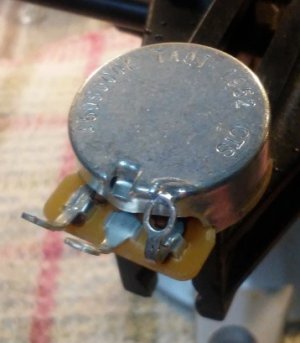
Here's how I do a pot. Bend back the terminal, while gently pushing down so that you don't break the rivet point, then just the minimum amount of solder so that you don't fill the lug hole. Now you have a convenient place to make your ground connections without "toasting" the back of the pot. This is also where I bridge the volume pot to the tone pot with 18 AWG solid wire to make a nice "ground" bridge. All grounds go there. No more connections to the cover of a pot.
I'm guessing you need to use bare wire, ime heating larger wire can melt the insulation.
Soldering well, takes good tools and patience.
So many of my early jobs, I didn't want to remove the pot or switch from the guitar, so I'm reaching down into the control cavity, pushing wires out of the way, so I can heat up the pot enough to attach a wire. Like a reverse game of Operation.
Then if you have a cheap, low wattage iron it can be difficult to transfer enough heat, so you are feeding solder into the joint from the spool... of course this is bad technique... but when you are 18 and have a new Super Distortion and want to put it in your guitar and play it, thats what you do.
So many of my early jobs, I didn't want to remove the pot or switch from the guitar, so I'm reaching down into the control cavity, pushing wires out of the way, so I can heat up the pot enough to attach a wire. Like a reverse game of Operation.
Then if you have a cheap, low wattage iron it can be difficult to transfer enough heat, so you are feeding solder into the joint from the spool... of course this is bad technique... but when you are 18 and have a new Super Distortion and want to put it in your guitar and play it, thats what you do.


Dave Locher
New member
The detail I like and would never have thought of is the ground passing through the terminal. Neat. (Literally!)
Does anyone know why the tone caps are so big?
Does anyone know why the tone caps are so big?

Ascension
Well-known member
That is what my soldering looked like while I was in the military and doing component repair work, however, that was many aeons ago.
Regardless of who, what, when, where, nicely done.
Where I learned also what branch? AF here.
Agreed on the second point that is some NICE WORK!
Ascension
Well-known member
I didn't read a single post in this thread... BUT Why doesn't everyone do work like this?
This level work takes good tools a steady hand and patience. I can do it but don't take the time to because I'm the only one who will ever see it on my own stuff. My stuff not sloppy by any standard but just not that pretty. Many however just don't have the right tools and the skill to pull that off. Takes some of both to do that level work.
Ascension
Well-known member
When I learned, I went to the local Radio Shack, since I was always going there for stuff. The person who worked there played guitar, and told me what to get. I think the fact that we don't have a local electronics store, and a lack of mentors makes learning this skill a little harder.
Spot on not only with this but a WHOLE lot of learned skills. Working on a project here with some guys to set up a facility and teach these kinds of skills again it's NEEDED!
Similar threads

- Replies
- 8
- Views
- 148


- Replies
- 13
- Views
- 210

